
Grow Your Firm Without Limiting Your Future Exit Options
Watch the Replay Are Your Growth Decisions Expanding or Limiting Your Future Exit Options? Many advisors focus on growth without realizing the structural decisions they make today can shape their future exit options. In this on-demand webinar, Succession Resource Group explores how growth-stage RIAs and independent advisory firms can increase enterprise value while preserving strategic flexibility. Learn how firms position themselves to remain scalable, transferable, and attractive in today’s M&A market, while keeping the door open for internal succession, a future sale or merger, capital investment, or long-term independence by choice rather than default. Download the Presentation Deck Here Download Speakers Host David Grau Jr. MBA CEO/President Paper-plane Linkedin-in Host Kristen Grau, CPA, CVA, CEPA Executive Vice President Paper-plane Linkedin-in Host Parker Finot Director of Transaction Advisory Services Paper-plane Linkedin-in
The SEC’s Marketing Rule Sweep: Endorsements in Advisor M&A (Ep. 30)
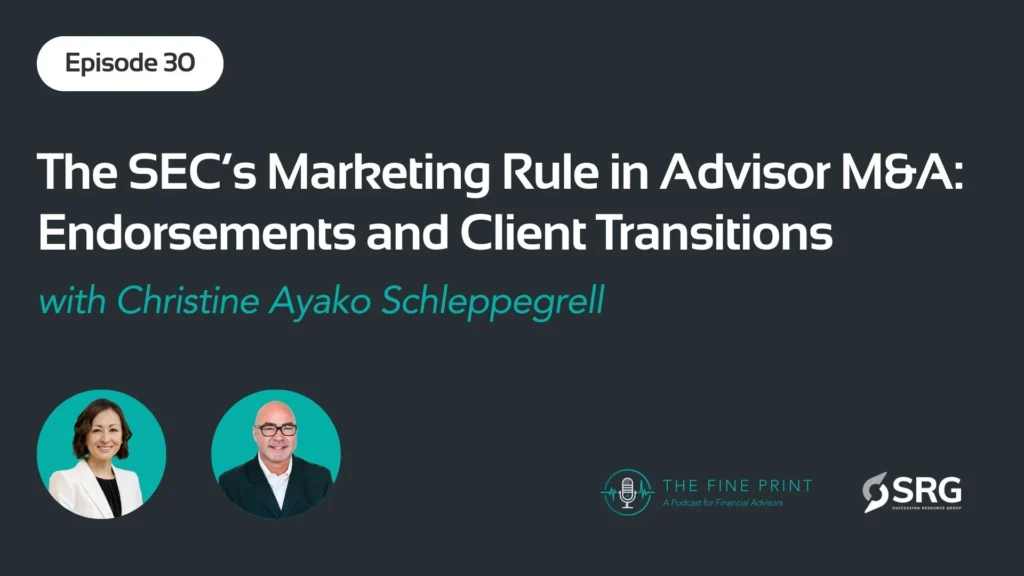
Endorsements and the SEC Marketing Rule in Advisor M&A Regulatory scrutiny is evolving, and RIAs involved in acquisitions or succession transitions are starting to see a new area of exam focus: how the SEC’s Marketing Rule endorsement provision may apply to certain client transition communications. In this episode of The Fine Print, SRG General Counsel Todd Fulks is joined by Christine Ayako Schleppegrell, Partner at Morgan Lewis and former SEC attorney, for a timely discussion on what firms are seeing in exams and deficiency letters, and why this issue is emerging now. You will hear how a rule many advisors associate with testimonials and advertising is beginning to surface in the M&A transition context, and what firms can do to stay prepared. Featured in This Episode Todd Fulks, JD, BFA (SRG General Counsel) Christine Ayako Schleppegrell (Partner, Morgan Lewis; Former SEC Attorney) Guest
Why Relying on Your Broker-Dealer to Sell Your Practice Is a Costly Mistake

Why your broker-dealer is not a neutral partner in your exit, and why home office referrals often fail. Many advisors believe that when it’s time to transition their practice, their broker-dealer’s home office team will actively help them sell their business. After years of interacting with relationship managers, home office consultants, practice management specialists, and OSJ leadership, it’s natural to assume that: They know your business. They know your goals. They care about your success. They’ll help you find the right buyer when you’re ready. Seller Advocacy. Your Sell-Side Partner. Sell Your Book of Business or Financial Advisory Practice with SRG See Service Home office representatives often feel like an extension of your practice. They attend your conferences. They support your growth initiatives. They review your business metrics. Some even position themselves as strategic consultants or sounding boards. When they offer to “connect you with a few people,” it can feel like genuine advocacy. This leads advisors to believe: “My home office wants to help me transition successfully, and they will connect me with the right successor when the time comes.” But this belief is built on a misunderstanding of what the home office is designed to do. Their job is not to manage your exit. Their job is not to evaluate buyer fit. Their job is not to find you the best deal. And most importantly: Their job is not to represent your interests. Their job is to retain assets, not to help you leave. This creates a dangerous misconception for sellers, because trusting your home office to guide your exit often leads to the exact opposite outcome you want: poor successor fit mismatched introductions delays and false starts underinformed buyers reduced valuation wasted time stalled transitions and structural misalignment In other words: good intentions, bad incentives. The Reality: Home Office Teams are Not Your M&A Parter While home office professionals may genuinely like you and want to be helpful, their fiduciary duty is to their employer. Not to your sale, not to your clients, not to your employees, and not to your retirement plan. Below are the key reasons why relying on your broker-dealer to help with your exit strategy is almost always the wrong move. 1. Home Office Professionals Are Incentivized to Retain Assets This is the most important point. Broker-dealers make money from assets, production, product placement, and technology usage. When you exit your business, the firm risks losing those assets, that revenue, and all associated advisor economics. So while the home office may want to “support” you, their version of support is very specific: Keep the assets where they are. This is not the same as: finding you the best buyer maximizing your valuation protecting your timeline aligning culture and client philosophy ensuring your staff is supported giving you a clean or flexible exit Their job is to protect the firm, not enhance your exit strategy. 2. Home Office Referrals Are Strategically Motivated, Not Seller-Centric When a home office representative says: “I know some advisors I can introduce you to,” What they usually mean is: “I know some advisors we want to keep or recruit.” Home office referrals are based on: which advisors they want to retain which advisors are loyal to the BD which practices are growing which advisors they want to “strengthen” which advisors they’re recruiting which offices they want to protect from leaving who they believe will keep the most AUM on-platform These referrals are not based on cultural alignment, client compatibility, operational fit, deal structure preferences, buyer financial readiness, successor experience, or long-term service philosophy. The home office’s job is to recommend buyers who will stay— not buyers who are the right match. This is a conflict of interest hidden behind friendly support. 3. Home Office Introductions Lack Process, Screening, or Qualification The typical home office introduction is typically blind. No valuation review. No practice analysis. No buyer readiness assessment. No disclosure of buyer’s capabilities. No examination of client demographics. No buyer/seller compatibility analysis. No assessment of culture or service model. No review of deal structure preferences. No financial vetting. This creates serious problems from awkward mismatches to wasted time to repeated dead ends. Succession Resource Group has supported sellers who received zero meaningful referrals from the home office for months. Others received only one referral, and it was not even close to a fit. Some received referrals that were actually recruiting targets, not actual buyers. This is not a process, it’s a hope. Are You Ready to Exit? Download SRG’s Seller Readiness eBook 4. Home Office Support Delays Your Timeline Because home office referrals are sporadic, informal, and unstructured, sellers experience: long gaps between introductions buyers who show up unprepared deals that start but never progress repeated back-channel conversations long delays with no traction stalled negotiations transitions that fall apart after months of waiting What feels like “support” often becomes paralysis, not progress. Most advisors lose months, sometimes years, waiting for the home office introduction that will “change everything.” It rarely does. 5. Home Office is a Solid Resource. Just Not One for Finding Your Buyer Home office employees can be extremely useful for: Data gathering Pulling client segment reports Practice diagnostics Compliance guidance Technology updates Preparing transition paperwork Historical production review Team structure analysis But they shouldn’t (and often cannot) conduct a successor search, evaluate buyer financial readiness, maximize your asking price, provide neutral guidance, prepare your business for sale, protect your confidentiality, manage buyer negotiations, structure a deal, or manage your legal risk. They are support partners—not M&A specialists. And they represent the broker dealer— not the seller. 6. Advisor Loyalty to Home Office Creates Delays, Lost Value, and Damages One of the most harmful, yet least discussed, drivers of this myth is advisor loyalty. After years or even decades with a broker-dealer, many advisors feel a moral responsibility to “give the home office the first shot” before involving a professional succession partner like SRG. It sounds reasonable. “They’ve always supported me. I’ll let them try first, and if that doesn’t work, I’ll bring in a consultant later.” But this instinct, while emotionally understandable, is structurally dangerous. Here’s why: 1. By the time you realize it’s a bad plan, you’re already in too deep. Home office introductions feel promising at first. A warm conversation here. A possible peer match there. Maybe a potential buyer raises their hand. But because there is no process, no structure, and no vetting, the advisor has already invested months, sometimes a year, has shared superficial practice information, has engaged in
2026 State of Compensation: Pay, Equity & Incentives for RIAs and Advisory Teams
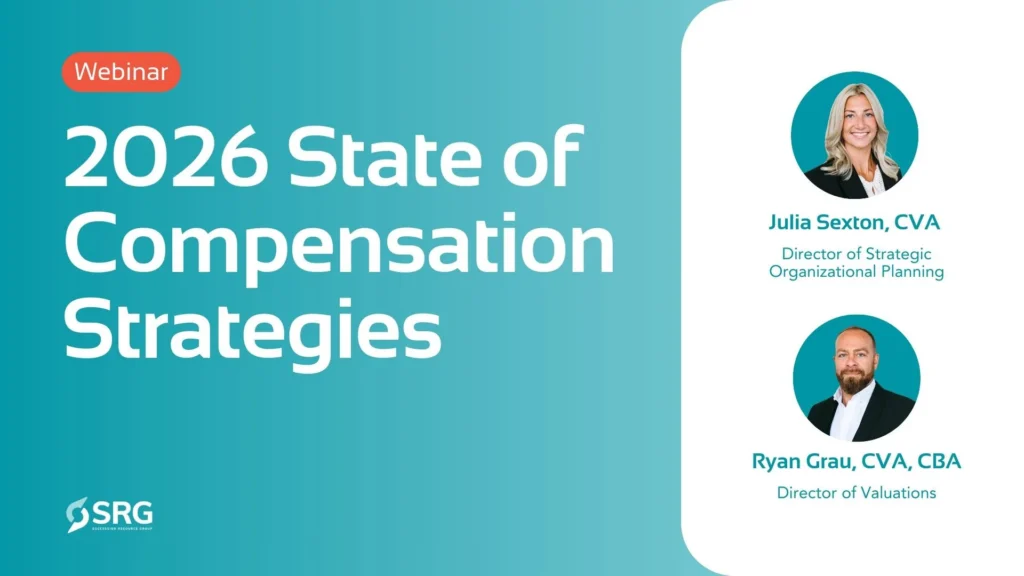
Watch the Replay Is Your Compensation Plan Helping You Grow or Holding You Back? Not sure what to pay your advisors and team in 2026, or whether your current compensation plan is actually competitive? In this on-demand webinar, SRG breaks down real-world compensation benchmarks for RIAs and advisory firms, including salary ranges, bonus structures, phantom equity, and staffing trends across advisor, operations, and executive roles. Using data pulled from valuation and compensation analyses, you’ll see what firms are actually paying and how to align incentives with the behaviors you want, so you can attract and retain talent without letting compensation outgrow the role. Download the Presentation Deck Here Download Speakers Host Julia Sexton, CVA Director of Strategic Organizational Planning Paper-plane Linkedin-in Host Ryan Grau, CVA, CBA Director of Valuations Paper-plane Linkedin-in
Phantom Equity Plan Options: Liquidation Rights (LR) vs. Appreciation Rights (AR)

Introduction Phantom equity plans allow firms to reward and retain key team members by providing an economic interest in the business without transferring actual ownership. Two of the most common phantom equity structures are Liquidation Rights and Appreciation Rights. While both align incentives with firm value, they differ meaningfully in how value is measured, communicated, and paid. Liquidation Rights (LR) A Liquidation Right provides the participant with a contractual right to receive the full fair market value of a defined number of company shares upon a qualifying event (e.g., sale, retirement, termination without cause), subject to plan terms. In effect, it mirrors ownership economics tied to the company’s overall value at the time of the triggering event, rather than only rewarding value created after the award is granted. Because it is typically event-driven, it is commonly used to support long-term retention and alignment by linking meaningful upside to major transition or liquidity milestones. How Value is Determined Each LR is denominated in shares or units Upon vesting, payout equals: Key features Tracks total enterprise value, not just growth Uses a fixed share/unit count to determine per-share value Includes built-in anti-dilution and adjustment mechanics Paid in cash and treated as compensation (or equity shares, if permitted) Best suited for Long-term reward and retention of senior leaders Succession and retirement-oriented incentives Firms seeking simplicity and alignment with entity-level valuation Appreciation Rights (AR) An Appreciation Right provides the participant with the increase in value of a defined number of units or shares between the grant date and the exercise date. It is designed to reward future growth above a baseline value established at grant, meaning the participant benefits only if the company’s value increases over time. This structure is often used to align incentives with performance and expansion, since payouts are directly tied to appreciation rather than total enterprise value. How Value is Determined Grant date value is established upfront Upon vesting, payout equals: Key features Rewards growth above a baseline value No payout if the company value does not increase Uses a fixed share/unit count to determine per-share value Can be more complex to track over time Paid in cash and treated as compensation (or equity shares, if permitted) Best suited for Performance-driven incentives Growth-stage firms Shorter- to mid-term incentive horizons Side-by-Side Comparison Key Takeaway Both Liquidation Rights and Appreciation Rights are powerful phantom equity tools—but they serve different strategic purposes. Liquidation Rights emphasize stability, clarity, and long-term alignment with enterprise value, while Appreciation Rights emphasize performance and upside growth. The right choice depends on your goals, timeline, and the role you want equity to play in motivating your team.
Succession Planning 101: Steps and Processes for Advisory Companies

Introduction All businesses, regardless of type and size, have an organizational structure that determines how the company is managed on a daily basis. While they may have all the right advisors in place for the current state of the business, it is important for organizations to make sure they have a plan in place to keep the business thriving long-term, regardless of who is at the helm. Succession planning, as both a concept and a strategy, establishes a framework for identifying and developing next-gen talent to replace the founder when she/he exits the business. What Are the Seven Steps for Company Succession Planning? While it may be difficult to predict when a succession event will (or should) take place, it is best to begin the succession planning process early enough to construct a thorough and seamless plan that facilitates both the qualitative and quantitative parts of the process. While seven to ten years before the founder’s retirement are ideal for internal succession, or two to four years for a merger/sale, timelines are often much shorter. Unforeseen events within a company, health issues, and changes-of-heart can occur, even for the steadiest of businesses and owners. This underscores the importance of defining a strategy and committing that plan to writing as soon as possible. Even if there is no inkling that changes are imminent, it is critical to begin with the end in mind since no one lives forever. Here are seven key steps to succession planning to keep in mind: 1. Determine Objectives and Clarify the Owner’s Vision: The preferred outcome for succession planning may be different for each individual business, however, the goal for most will be for the business to continue to thrive with the next generation of advisors at the helm. It is crucial to have clarity on the primary objectives within a succession plan. This could include objectives such as improved retention, sustaining long-term growth, identifying successors for key positions, defining how the plan will be funded and taxed,, and creating business continuity. 2. Identify Key Positions and Leadership Requirements: A succession plan should clearly account for the integral roles that are critical for organizational success. An assessment of the career trajectory for the employees may inform the priority each role has within a succession plan and who will assume the duties of the founder upon his/her exit. If planned retirements are in place, a succession plan can be executed with even more focus and precision. For all key positions, it should be determined what the primary skills, knowledge, and qualifications are required to do the job effectively and ensure that a business continues to run smoothly with the next generation of leadership. 3. Evaluate Organization for Potential Candidates: The organization may already have several key employees with high potential that should be considered as part of the succession plan. By identifying and developing employees to meet the requirements of leadership positions in the company, a business can proactively plan for a succession event and give employees more incentives in the process. If the firm lacks such candidates, developing an alternative strategy as a back-up is critical. 4. Create a Development Process: Organizations should always be investing in the career development of internal talent within the company. However, in the midst of succession planning, this becomes even more important. Succession choices should have a plan in place for training and development to help them grow into viable candidates for leadership roles in the organization. A company may consider having these employees take part in mentorship programs, rotating jobs within the organization, or even furthering their education with courses that will help develop a relevant skillset for the long-term goals of the succession-planning process. 5. Look Externally: While there is significant value in working to develop employees for key roles in the future, an organization should have an open mind and be willing to look elsewhere for a successor/buyer. In some cases, the best candidates for stepping into an ownership role may be found externally. External candidates may already have the necessary experience, knowledge, and qualifications to help fulfill a successful transition. This may be especially valuable in instances where the succession planning period begins on short notice with an urgency to fill a key management role. In most situations, however, a thorough assessment of both internal and external talent is part of an effective succession planning process. 6. Communicate and Implement the Transition Plan: Once the succession plans have been established, it is important to begin communicating the plan to all key stakeholders involved since this takes time. If internal employees will be the successors, they should be aware of the plan and career development path ahead of them. This open communication will also give the employees an opportunity to verify that they are interested in working towards the ownership role within the company and understanding what that means. Once the key employees are on board, the development process should begin with long-term succession in mind. Trial runs can also be beneficial for helping employees test the waters of their future role. This could include shadowing, gradually taking on relevant responsibilities, or even filling in when the owner(s) are out of the office. As the date for the founder’s eventual retirement gets closer, it is a good idea to have some extended and planned absences so the next generation has an opportunity to fill the leadership role before the founder(s) are gone for good. 7. Formalize Plan Documentation: Since succession planning requires various forms of transition and financial implications, it is important to make sure to formalize the process through supporting documentation, including a formal valuation beforehand. The succession planning will likely include the detailed written plan as well as the agreements with key employees and shareholders. In addition to these agreements, company records and documentation should be well organized to help facilitate a seamless transition within the company. As the succession planning documents are formalized and the career development of the key employees or candidates
How to Maintain Client Experience and Retain Staff When Selling to an Outside Buyer

A practical roadmap for readiness, people, and a smooth client transition Selling a financial planning practice is not just a transaction. It is a change event that touches clients, staff, regulators, technology, and your own identity as the founder. The advisors who feel best about their outcome tend to do two things well: Prepare the business like an acquirer will run it tomorrow. Communicate the transition in a way that protects trust and continuity. Why “seller readiness” is the real deal leverage Many owners think “getting ready to sell” starts when a buyer is identified. In practice, it starts much earlier, because early preparation gives you options: tax planning, negotiation leverage, cleaner due diligence, and a calmer client transition. SRG’s dissolution guidance recommends beginning 12 to 24 months before close to allow time for tax optimization, buyer negotiation, and client transition planning without rushing. A simple readiness checklist that buyers actually care about Before you name a price or talk terms, start by getting your house in order. SRG’s Seller Readiness eBook highlights several practical pre-sale actions: Verify and document internal processes. Shift as much revenue as possible toward recurring sources. Reduce overhead and eliminate long-term obligations where possible. Create documentation and manuals for core workflows. Assemble your M&A team early. One more important point: avoid casually floating the idea of selling around your network. When you are ready, leverage a structured process and an advocate who can screen candidates thoroughly. That matters because you only sell this business once. Your timeline and process should be built to protect clients and reduce the risk of a rushed decision. The transition plan is not optional Even in a strong market, sellers can underestimate the work required after the deal terms are signed. A transition plan is how you protect enterprise value after closing, because retention is where the economics are either earned or given back. A typical relationship transition often spans 6 to 18 months and can require hundreds of hours of transition-related support time. That benchmark is a useful anchor because it signals realism. Selling is not an event. It is a structured handoff. Your staff can make the deal easier or harder If clients are the revenue engine, staff are the continuity engine. They hold systems, workflows, relationships, and culture. That is why employee communication is one of the most sensitive parts of the process, with real implications for morale, reputation, and legal risk. When to tell the team In many deals, you need staff involved before a transaction is complete because due diligence requires data gathering, reporting, and operational support. At the same time, timing matters. Tell staff too early and you can create uncertainty. Tell them too late and you can fuel rumors. Clear, definitive messaging reassures employees and helps retain top talent. How to tell the team A strong best practice is to communicate face-to-face first. Avoid using email, phone calls, instant messaging, or text for the first conversation. A helpful structure is: Individual conversations first, so people can react privately Then a group discussion to reinforce consistent messaging and create a forum for questions What to say so you keep people You do not need a perfect script, but you do need clarity. Cover: why you are selling what the sale means for them what is likely to stay the same (location, roles, compensation and benefits, service model, workflows) the expected timeline (due diligence, close, what happens after) Also consider retention bonuses for key employees and incentives for the added workload your team takes on during due diligence. Lack of buy-in can create friction for buyers and the deal. Client communication: protect trust with sequencing and clarity Clients do not need every detail. They need confidence, continuity, and a clear plan. Effective communication maintains trust and continuity, reinforces what will remain the same (services, relationships, points of contact), and outlines next steps and timeline. Plan first, then execute Communication planning is a phase, not an afterthought. Key pre-work often includes: identifying stakeholders developing a notification timeline drafting the client letter with buyer collaboration preparing transition paperwork building call scripts and meeting plans Be mindful when sharing client-specific information. Only disclose what is necessary for service delivery or compliance purposes, and protect sensitive data throughout the process. Sequence communication to reduce confusion A practical sequence is: regulators custodians clients This sequencing helps ensure you are prepared to support the transition when clients hear the news. Timing expectations that reduce surprises Written notice typically goes out immediately after close, and should not be delayed. For key relationships, plan to call priority clients, schedule introductory meetings with the seller and buyer, and then provide transition paperwork. Operational continuity: the unglamorous details that keep clients calm A transition can fail because of small operational mistakes that create friction for clients. Office and system updates matter, such as: redirecting phones and emails forwarding websites and ensuring portals work updating access controls and permissions keeping workflows stable during the handoff One important caution: implementing changes too early can create privacy issues, confuse clients, and create costly reversals if the sale does not close. Compliance and wind-down: avoid avoidable risk after a sale A sale does not eliminate your obligations overnight. Recordkeeping, data security, and regulatory procedures still matter after close. Maintain records for the required statutory period and secure client data appropriately. Also remember that regulatory filings do not automatically dissolve the underlying business entity, and filing too early can create problems during the account transition. Your stakeholders matter, but they need to be used at the right time Sellers should not do this alone. The right stakeholders improve outcomes and reduce risk, including: staff legal counsel tax and accounting professionals trusted partners who can provide perspective an experienced advocate to manage the process and screen buyers When used correctly, the people around you do not create noise. They create clarity. Conclusion: sell with clarity, not urgency
Larger firms, rising multiples: Is this the new standard for advisor M&A?
By: Steve RandallPublishing Date: February 9, 2026 The M&A landscape for financial advisory practices is heating up, with 2025 emerging as a year of larger deals, richer valuation multiples and more complex terms. According to the latest industry benchmarking report from Succession Resource Group, drawn from 171 completed transactions totaling more than $14 billion in assets under management, there’s a clear shift away from small, relatively simple handoffs to deals marked by deeper capital structures, advanced financing and a heavier presence of institutional buyers. Among the most notable trends in 2025 was a meaningful uptick in multiples paid for recurring revenue and profitability. Transactions valued on an EBITDA basis averaged 9.98x business earnings, while recurring revenue books commanded an average of 3.27x. This increase continued a pattern of expanding valuations seen the prior year, reflecting strong buyer confidence despite broader macroeconomic uncertainty. One quarter of deals paid above 3.5x recurring revenue, with more than one in five surpassing 4.0x, a sign that strategic acquirers are willing to pay premiums for quality revenue streams. Third-party financing also played a larger role in closing deals, rising to 56 % of transactions as interest rates steadied and lenders grew comfortable extending leverage. In many cases, bank and broker-dealer financing now supports up to 70-80% of purchase prices, with sellers taking back notes on the balance. SRG’s data shows a pronounced decline in deals involving buyers from outside the seller’s home state, dropping to 24.8 % from a prior peak. At the same time, the buyer base has become more concentrated around experienced acquirers, reducing the ratio of buyers to sellers and suggesting more competitive processes. SRG’s President David Grau Jr. attributed rising valuations to the caliber of practices on offer and the financial discipline of buyers. “The valuations paid today are higher than they’ve ever been before, but the same core fundamentals still apply – the deals have to cash flow.,” he said. “Sellers can get a higher value than we’ve ever seen, but it is paid for large (multi-billion-dollar RIAs), well-run firms, and the value is paid ‘on terms’ meaning most of that value is contingent.” Who’s buying? Internal equity transactions, where succession occurs via sales to existing partners, expanded to 32% of all deals, reflecting a maturing succession planning ecosystem within advisory businesses. At the same time, nearly half of firms making internal transitions brought in outside capital to support equity buys by next-generation leadership teams. SRG also observed that earn-outs are increasingly used to bridge valuation expectations and share risk between buyers and sellers. Large private equity groups and aggregator platforms continued to invest aggressively, often structuring deals with smaller initial cash downs and significant future equity or earn-outs. These flexible structures are enabling sellers to access above-market valuations while remaining tied to growth outcomes. The SRG team forecasts continued expansion of M&A activity in 2026, albeit with a focus on larger, well-capitalized buyers and fewer but higher-value deals. Creative deal terms, innovative financing and a continued premium on firms with robust financial performance are expected to shape the market. “Founders who focus on building a sustainable firm, optimizing their business, and remaining focused on the best fit for their clients at their exit will always get the best value. Period,” concluded Grau Jr. To read the full article, please visit: https://www.investmentnews.com/ria-news/larger-firms-rising-multiples-is-this-the-new-standard-for-advisor-ma/265188 Disclaimer This article was first published by Steve Randall. The original article can be found here. All rights to the original content are held by InvestmentNews.
Your Employment Agreement Won’t Protect You Like You Think (Ep. 29)

Employment Agreements and Restrictive Covenants Employment agreements are often treated as a formality, until a key employee leaves, client relationships walk out the door, or a succession plan starts to unravel. In this episode of The SRG Exchange, SRG’s consulting team and General Counsel unpack why restrictive covenants matter, what they are actually designed to do, and why the biggest risk for many firms is having no clear agreement in place at all. You will hear how employment agreements influence everything from client retention and team stability to firm value, M&A outcomes, and internal succession planning. Why employment agreements are more than legal paperwork The team explains that strong agreements are not just about restriction. They create clarity around expectations, roles, and what happens if someone leaves unexpectedly. Non-compete, non-solicit, and no-serve: what is the difference? The episode breaks down the most common restrictive covenant provisions and why advisors often misunderstand how each one works in practice. Why enforceability depends on reasonableness and state law The group discusses how restrictive covenants are treated differently across jurisdictions, and why overly aggressive language often fails when challenged. The real risk is client portability A major theme of the conversation is that clients are not “owned,” and firms must think carefully about how to protect relationships, goodwill, and continuity without relying on unrealistic assumptions. Buyout language matters as much as restriction language The team highlights that many firms focus too heavily on “you can’t do this” clauses, while overlooking buyout provisions and practical exit pathways that reduce conflict. Common mistakes advisors make with templates and outdated agreements The episode warns against generic, one-size-fits-all employment documents that do not reflect the realities of the advisory business, especially during growth, mergers, or succession planning. How these agreements affect firm value and transaction readiness Restrictive covenants and employment terms play a direct role in due diligence, buyer confidence, and long-term enterprise value. Weak documentation can become deal friction at the worst possible time. Setting expectations early prevents disputes later The conversation closes with a reminder that agreements work best when they are implemented proactively, aligned with culture, and revisited as the firm evolves. Who is Featured in This Episode David Grau Jr., MBA Julia Sexton (Sullivan), CVA Ryan Grau, CVA, CBA Kristen Grau, CPA, CVA, CEPA Parker Finot Todd Fulks, JD, BFA Key Takeaway Entity design and maintenance are foundational. When done strategically, they make it easier to share equity, retain talent, execute transactions, and protect long-term value. When ignored, they create friction at the exact moments when a firm needs clarity the most.
How Firms Use Equity Stakes to Retain Top Advisor Talent, Drive M&A
By: Tobias SalingerPublishing Date: January 27, 2026 Internal transactions in which financial advisors buy equity in their firms represent a growing share of wealth management M&A deals, a new study found. Those deals boost advisors’ compensation via stakes in expanding firms, making them more likely to stay long-term. And they’re becoming more popular, according to a webinar last week held by consulting firm Succession Resource Group on its annual M&A study and hosted by founder and CEO David Grau and Parker Finot, its director of transaction advisory services. The study analyzed data from 171 transactions in 2025, including firms with about $14 billion in total client assets that Succession Resource advised, as well as other deals that used financing from Oak Street Funding and PPC Loan, which both collaborated in the study. Across M&A deals, a small group of highly competitive buyers continues to drive record valuations, leading to new highs in transaction volume. The number of potential acquirers per seller plummeted last year to 61 from 85 in 2023 and from 66 in 2024. Grau noted four main M&A trends from 2025: private equity investors’ impact on deal sizes, overall higher valuations, a smaller pool of possible buyers and a rising number of internal deals. “That’s not noteworthy in the sense that there’s more succession planning taking place,” he said. “But it’s noteworthy because most of these that we’re seeing are not supporting a partner retiring, and younger gen-two, gen-three folks buying them out. That happens too, but that’s separate. These are just straight-up purchases, buying into a firm that these advisors are working at and it’s happening a material amount of the time where we want to take note of it and share that with you today.” To read the full article, please visit: https://www.financial-planning.com/news/how-m-a-is-rewarding-top-financial-advisor-talent Disclaimer This article was first published by Tobias Salinger The original article can be found here. All rights to the original content are held by FinancialPlanning.com.