
Dealing with Acquisition Risk: How Buyers and Sellers Balance Price, Terms, and Uncertainty (Ep. 36)

Host How Do Buyers and Sellers Account for Risk in an Advisory Deal? Every advisory firm acquisition carries risk, and the higher the purchase price, the more of that risk lands on the buyer. The tools for managing it are clawback clauses, variable payments, and specialized financing structures. Understanding which tool fits your situation is what separates a deal that works from one that unravels post-close. In this episode, David Grau Jr., drawing on more than two decades of closing advisory firm transactions, breaks down the main risk mitigation methods available to buyers and sellers today. He explains why PE-backed aggregators have become so disciplined at structuring high-multiple offers while still protecting their downside, and why any buyer can apply the same thinking. The episode closes with a simple benchmark: in a well-structured deal, both parties should walk away feeling they gave a little too much. If the seller thinks they left some value on the table and the buyer thinks they paid slightly more than they should have, the deal is probably balanced. SRG’s Transaction Advisory Services team helps buyers and sellers reach exactly that point. Key Takeaways Risk scales with price. A clawback clause is a contractual adjustment to the purchase price post-sale, triggered when retention falls below an agreed target. The higher the premium a buyer pays, the more aggressive that target typically needs to be, sometimes requiring 100% retention to justify the price. External deals carry client attrition risk. When a seller moves clients to a new firm, clients must be notified and sometimes repapered. Historically, retention rates in advisory acquisitions run at 90% or above, but on paper the risk is real and needs to be priced into the deal structure. Internal deals carry a different risk: profit erosion. Clients rarely leave in internal successions. The risk is market-driven revenue compression squeezing the margin an internal buyer needs to service their debt. Same dollar of risk, different source. PE firms use a repeatable structure that any buyer can learn from. Roughly 40 to 60% cash at closing, with the balance split between rolled equity in the acquirer and an earn-out tied to 10 to 20% growth targets over four to five years. This is how they justify premium prices while managing their downside, it is not magic, it is structure. Retention clauses have three variables. What you measure (revenue, AUM, or client headcount), when you measure it (typically 12 months post-close), and what the target is (90% for a fair-market deal, up to 100% for a premium). Every other negotiation point flows from these three. Client-based retention clauses are gaining popularity because they factor out market risk. A revenue-based clause can penalize a seller even when every client stayed, if markets dropped 15% during the measurement period. A client headcount clause separates delivery from market performance. A stretch note is an internal financing tool where buyer payments are tied to profit distributions rather than a fixed amortization schedule. If distributions are low, payments are low. The deal cannot structurally fail, making it a strong option for first-time internal buyers. The right outcome is both parties feeling slightly uncomfortable. If the seller thinks they left a little on the table and the buyer thinks they paid a little too much, the deal is probably calibrated correctly. True win-wins in M&A usually mean someone was misinformed. Frequently Asked Questions What is a clawback clause in an advisory firm acquisition? A clawback clause is a contractual provision that adjusts the purchase price after closing if client retention falls below an agreed target. It protects the buyer if clients leave following the sale. The three key variables are what you measure (revenue, AUM, or client headcount), when you measure it (typically 12 months post-close), and what retention target triggers an adjustment. What is the difference between revenue and client-based retention clauses? A revenue-based clause compares revenue one year after closing to revenue the year before. A client-based clause compares the number of households retained. The key difference: revenue is affected by market performance, so a seller can deliver all clients and still trigger an adjustment if markets decline. A client-based clause isolates the seller’s actual performance from market movement. What is a stretch note in an internal advisory firm succession? A stretch note is a seller-financing structure where the internal buyer’s payments are tied to their after-tax profit distributions rather than a fixed amortization schedule. If distributions are lower in a given period, payments are lower. This eliminates the structural risk of a buyer being unable to service debt during a down market, making it especially useful for first-time internal buyers. How do PE-backed aggregators structure their acquisitions? PE-backed aggregators typically put 40 to 60% cash down at closing. The remaining balance is split between rolled equity in the acquiring firm and an earn-out tied to hitting 10 to 20% growth targets over four to five years. This structure lets them offer headline multiples of 10x to 12x earnings while still protecting their downside if growth targets are not met. How long is a typical retention period in an advisory acquisition? The most common measurement window is 12 months following the close of the transaction. Eighteen months is occasionally used. Retention periods longer than 18 months are rare, because client attrition beyond that point is generally not attributable to the transition itself. Hosted By David Grau Jr., MBA (Founder / CEO)
Advisor Compensation Plans: The B.B.P. Model for RIAs

Authors “Firms rely on an outdated playbook.” Most advisory firms still pay advisors on decades-old revenue-based models designed for solo producers, not the integrated teams they are building today. That mismatch is compressing margins, stalling succession plans, and destroying enterprise value. A modern framework built around base salary, targeted bonuses, and profit participation aligns incentives with the business you are trying to build. Why Is Advisor Compensation Broken at So Many Firms? Growing teams, rising M&A activity, and continued industry consolidation are reshaping independent wealth management. Scale, next-generation advisors, growth, and enterprise value are now the industry’s central conversation. As professional service businesses, client-facing advisors are central to delivering on those objectives, making advisor compensation more important than ever. Firms are trying to balance profitable growth and increasing enterprise value with the need to retain and attract talent through competitive compensation. Over- or under-compensating advisors, or misaligning incentives, can have long-term consequences that quietly undermine margins, culture, and value. The core problem is straightforward: teams, roles, and growth strategies have evolved faster than the compensation models behind them. Drawing on more than 2,000 firm valuations, with compensation data covering tens of thousands of professionals, SRG compensation specialists are seeing more advisors form and grow true teams. Not just loose groups sharing back-office costs, but integrated firms with unified service models, investment strategies, and operations. At the same time, this research shows that most firms are still compensating advisors using models that have remained largely unchanged for decades. In roughly 95% of the teams that SRG works with, the stated goal is to create collaboration and work as a team within an ensemble structure. Yet the compensation model still rewards individual production. That gap between what firms say they want (efficiency, growth, and continuity) and how they pay advisors continues to widen. The result is margin compression, confused career paths, frustrated owners, and suppressed enterprise value. How Does the Traditional Revenue-Based Model Work? The most common approach, across independent RIAs and dually registered teams alike, is to pay advisors a “salary” that is calculated as a direct percentage of the revenue or AUM they service. Advisors are typically paid anywhere from 30% to 90% of revenue, depending on the support received, and are responsible for sourcing and servicing their own clients. This model works well for its original purpose: rewarding advisors focused on building and servicing their own books of business. These are the “hunters.” If they grow, they earn more. If they don’t, compensation adjusts accordingly. It is a clean model: recruit producers, provide infrastructure, and share in the upside. Advisors who thrive here value autonomy and unlimited upside in exchange for risk. The revenue-based model originated decades ago in wirehouses and banks, where advisors received a 30% to 40% payout and the house provided the office, desk, and clients. When advisors went independent, the structure came with them, only the payout jumped to 80% or 90%. The mechanics stayed the same: pay for production. That structure still has a place. But it was designed for a world of solo practitioners building individual books, not for the ensemble firms dominating the industry today. What Happens When You Pay Farmers Like Hunters? Where the traditional model breaks down is in growing firms that are no longer hiring hunters but instead are recruiting and training younger professionals to service assigned client households. These are the “farmers.” They are hired to create capacity, deliver a standardized service model, and support firm-level growth, not to source business independently. Paying farmers the same way hunters are paid creates increasing tension for firm owners, as compensation grows rapidly over time without a corresponding increase in workload or responsibility. Consider a simple example. An advisor is hired at $250,000 plus modest bonuses to service 100 households representing $100 million in AUM. Seven years later, that advisor is still servicing those same 100 households. Market appreciation has doubled the assets and fees, but not the scope of work. The advisor’s compensation is now $500,000 for effectively the same role.The math gets worse at scale. If an advisor is assigned 100 households, each with $1 million in investable assets at a fee of 100 basis points, they are managing $100 million in AUM, or $1 million in annual fees, with a salary of 50%, or $500,000 annually. Ten years later, the markets have done reasonably well, and the advisor has not lost any clients. The firm is now paying that advisor $1 million annually to do effectively the same job and take care of the same 100 households. For most RIAs, this is simply unsustainable. Margin Compression and Owner Pay Inversion You cannot build a scalable ensemble using a compensation system designed to reward individual autonomy and production. Revenue-based payouts become the equivalent of a cost of goods sold on the P&L, taking dollars right off the top before the firm even starts the day. What makes this especially painful is that in many cases, the top advisors end up making more than the business owner. The owner may earn the highest total, but they always get paid last, after all operating expenses. Convincing an advisor who takes a percentage off the top line to buy in and trade that for a percentage of the bottom line is one of the hardest conversations in succession planning. Good luck convincing your highest-paid team member to reduce their guaranteed percentage so they can become an owner and take on more risk. That is the trap revenue-based compensation creates for internal succession plans. What Is the Base, Bonus, Profit (B.B.P.) Compensation Model? B.B.P. stands for Base, Bonus, and Profit. It is SRG’s proprietary compensation framework, derived from the largest and most successful advisory firms in the industry and tested and proven to help attract and retain talent more successfully and efficiently than the traditional production-based model. The model incentivizes the right behaviors while maintaining a team focus. The framework has three components, each calibrated differently depending on whether the advisor’s primary
Merger or Sale? Finding the Right Path for Your Exit

Authors “It depends on your objectives.” The right exit path for your advisory firm depends on your objectives, not your firm’s size. A merger and a sale serve fundamentally different goals, and choosing the wrong one can cost you years, money, and the legacy you spent decades building. This article walks through both paths and provides a framework to help you decide which one fits your situation. “Should I merge or sell my firm?” Key Differences Between a Merger and a Sale (Source: SRG Webinar, August 2026) These terms are often used loosely throughout the financial services industry, creating confusion that can complicate exit planning. Understanding the distinction between a merger and a sale is an important first step in determining which path best aligns with your objectives. A merger is a combination of two or more businesses into a single entity with shared ownership and shared control, if intended by the parties. Two firms become one new operating unit. Revenue, expenses, and profits are pooled. Both parties typically stay involved in the business going forward, often for years. Mergers tend to combine operations, reduce duplicative costs, and create growth opportunities that neither firm could achieve alone. A sale is a transfer of ownership from one party to another. The buyer acquires the business, and the seller exits daily operations. A sale prioritizes immediate liquidity and a clean reduction in risk. Once the deal closes, the seller’s ongoing involvement is typically limited to a defined transition period. “A merger isn’t just a smaller sale, and a sale isn’t automatically the better move. The right path depends on what you want your role, your clients, your team, and your legacy to look like once the transaction is done.” Kristen Grau, CPA, CVA, CEPA Why Your Exit Path Shapes Everything That Follows Why This Decision Matters: Seven Areas Your Exit Path Shapes (Source: SRG Webinar, August 2026) The decision between a merger and a sale affects nearly every aspect of your transition, including value, control, timing, client experience, staff retention, tax planning, and post-close obligations. Each of these considerations plays out differently depending on the path you choose. Value. A merger and a sale get valued differently and, more importantly, get paid out differently. In a sale, the purchase price is typically a defined sum paid through some combination of cash at close, a promissory note, and earn-out payments. In a merger, the “price” is usually expressed as an equity stake in the combined entity, which appreciates over time rather than arriving as a lump sum. Control. In a sale, control generally transfers to the buyer. In a merger, control depends on the ownership percentages, voting rights, management roles, and approval requirements negotiated by the parties. Depending on the structure, you may retain significant influence, share control equally, or hold a minority voice in the combined business. Timeline. Some exits wrap up in months with a defined end date. Others keep you involved for 5 to 15 years. The path you choose determines which end of that spectrum you land on. Client transition. How your clients experience the change depends heavily on the structure. A merger can position the transition as a growth story. A sale requires a more deliberate communication strategy to ensure clients feel secure with a new owner. Staff retention. Your team watches closely during a transition. In a sale, staff may face uncertainty about their roles under new ownership. In a merger, the combined entity may create new opportunities, but it can also create redundancies that need to be resolved. Tax planning. The two paths create different tax outcomes. In a sale, the deal structure determines how proceeds are taxed. In a merger, equity contributions can often be structured as tax-deferred events, though the specifics require careful planning. Post-close obligations. A sale typically involves a defined transition period with clear boundaries. A merger means ongoing obligations as a co-owner, including governance, decision-making, and shared accountability for results. “Your exit path isn’t a decision you make once and forget. It shapes years of your life afterwards.” Kristen Grau, CPA, CVA, CEPA The Sale Path: What to Expect The Sale Roadmap: Five Steps from Preparation to Close (Source: SRG Webinar, August 2026) Most advisors think they understand what selling looks like. But the firms that get the best outcomes follow a structured process that starts well before any buyer enters the picture. Step 1: Get the Firm Ready This is the step most advisors underinvest in because it does not feel like progress. There is no buyer yet, no offer, nothing exciting happening. But this is where deals are won or lost. Start by clarifying your objectives. What do you want your life to look like in three years? What does a successful outcome look like for your clients and your team? Without clear answers to these questions, you cannot evaluate any offer against your actual goals. Then get your financials in order. Organize historical and current financial data from sources a buyer can verify. “Sloppy books don’t just slow due diligence, they cost you money. Uncertainty and a lack of organization gets priced as risk.” Kristen Grau, CPA, CVA, CEPA Third, get a formal valuation. A certified valuation report helps you understand your value, what is driving it, and what is putting it at risk. Do this well before sitting across from a buyer who already knows your numbers. Finally, streamline your processes. Reduce how much of the business runs through you personally. Document your workflows. “Every process that is tied directly to you, or goes undocumented, is a discount that the buyer will find.” Kristen Grau, CPA, CVA, CEPA Step 2: Find and Screen the Right Buyer Finding a buyer is not a sourcing problem. It is a screening problem. Advisors receive unsolicited acquisition letters regularly. The work is figuring out which buyers are actually right for you. Screen every buyer against consistent criteria: financial strength, how they are funding the transaction, their plan for your clients
Sloppy books, dirty data can undermine RIA sales or mergers
By: Tobias SalingerPublishing Date: August 20, 2026 Before embarking on a succession plan through a merger or sale, registered investment advisory firm owners need to take a careful look at their company’s data. Leaner, comparable figures will aid owners who choose either type of deal, according to a webinar held earlier this month by consulting firm Succession Resource Group. Kristen Grau, the head of the firm’s seller advocacy listing program, and Nicole Frey, its director of team solutions, explained how the quality of a firm’s data affects its formal valuation. And getting a professional valuation represents an essential step prior to pursuing any sales, Grau said, and one that Frey said she highly recommends for owners ahead of a merger, as well. Unfortunately, data preparation “is the step that most advisors underinvest in, because it doesn’t feel like progress,” Grau said. Reliable data, she said, can help prospective sellers by accomplishing four important goals: Ensuring that due diligence and valuations come from standard metrics Rooting out personal expenses and other costs that don’t relate to operations Placing owner compensation at market levels Verifying that assets and liabilities stem from the actual business To read the full article, please visit: https://www.financial-planning.com/news/sloppy-books-dirty-data-can-undermine-ria-sales-or-mergers Disclaimer This article was first published by Tobias Salinger.The original article can be found here. All rights to the original content are held by FinancialPlanning.com.
How to Use Equity Compensation to Boost RIA Valuation and More

By: Tobias SalingerPublishing Date: June 1, 2026 Deciding to pay a current or future partner in equity is only the first step in a complex process for registered investment advisory firm owners. But stock compensation can help firms attract and retain financial advisor talent, create a succession plan and boost their valuation, according to a webinar held last month by consulting firm Succession Resource Group and led by Julia Sexton, the firm’s director of strategic organizational planning, and Nicole Frey, its director of team solutions. A successful equity pay plan requires choosing the right structure for the firm’s goals and the correct corporate entity for tax and compliance. Advisors should start by figuring out the end goal with the compensation, Sexton said. This helps clarify complex decisions, such as whether to pay with phantom equity (which provides appreciation or liquidation rights without technical ownership) and how possible voting rights may affect the firm’s governance, taxes or possible future M&A deals. Disclaimer This article was first published by Tobias Salinger.The original article can be found here. All rights to the original content are held by FinancialPlanning.com.
Merger or Sale: The Right Path for Your Exit
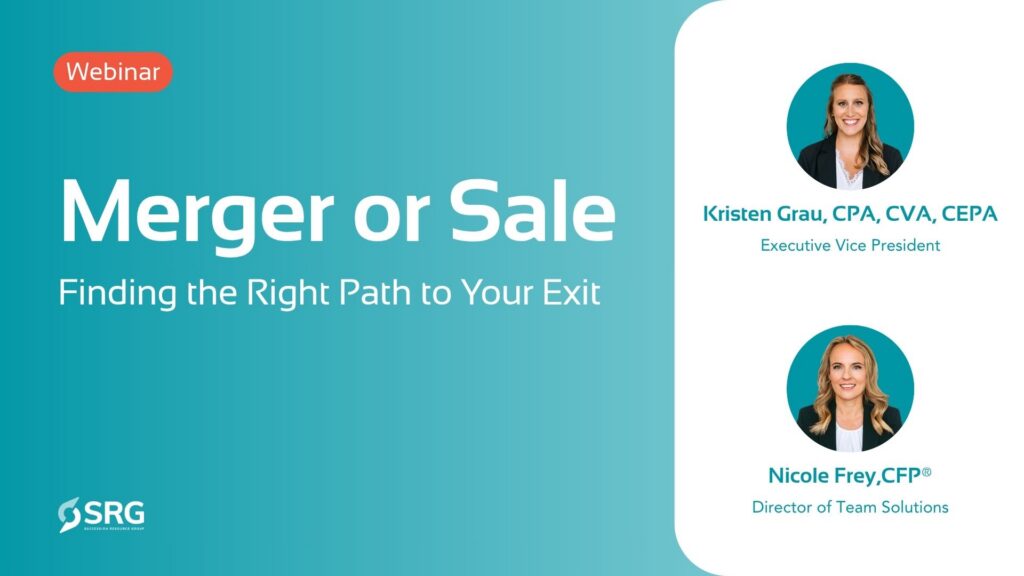
Watch the Replay Please enable JavaScript in your browser to complete this form.Please enable JavaScript in your browser to complete this form.First Name *Last Name *Phone * Work Email * Would you like to join SRG’s newsletter to receive industry updates and other webinar opportunities? Yes No Access Recording Should You Merge or Sell? The Right Exit Depends on Your Goals, Not Your Size. In this session, Succession Resource Group’s Kristen Grau, CPA, CVA, CEPA, and Nicole Frey, CFP®, walk advisory firm owners through one of the biggest decisions of their career: whether to sell the firm or merge it. Their throughline is that the right path depends on your objectives, not your firm size. Kristen lays out the five-step sale roadmap, from getting data ready and valuing the firm before you ever meet a buyer, to why finding a buyer is really a screening problem, to the asset-versus-equity-sale choice that drives your taxes, leverage, and optionality. She also explains why a headline multiple hides what matters: how the price is actually paid in cash, note, and earnout, and how each is taxed.Nicole then covers the merger path, where two firms become one shared entity: matching partners on growth goals, dividing ownership from a valuation, structuring cash and equity to avoid a disguised sale, and protecting yourself with clear roles, voting classes, and exit terms. Owners weighing a clean exit against staying on to grow, sole proprietors who want a built-in successor, and anyone trying to keep both paths open will find this a practical guide to choosing deliberately. Host Kristen Grau, CPA, CVA, CEPA Executive Vice President Paper-plane Linkedin-in Host Nicole Frey, CFP® Director of Team Solutions Paper-plane Linkedin-in
Merger or Sale: The Right Path for Your Exit
Watch the Replay Should You Merge or Sell? The Right Exit Depends on Your Goals, Not Your Size. In this session, Succession Resource Group’s Kristen Grau, CPA, CVA, CEPA, and Nicole Frey, CFP®, walk advisory firm owners through one of the biggest decisions of their career: whether to sell the firm or merge it. Their throughline is that the right path depends on your objectives, not your firm size. Kristen lays out the five-step sale roadmap, from getting data ready and valuing the firm before you ever meet a buyer, to why finding a buyer is really a screening problem, to the asset-versus-equity-sale choice that drives your taxes, leverage, and optionality. She also explains why a headline multiple hides what matters: how the price is actually paid in cash, note, and earnout, and how each is taxed. Nicole then covers the merger path, where two firms become one shared entity: matching partners on growth goals, dividing ownership from a valuation, structuring cash and equity to avoid a disguised sale, and protecting yourself with clear roles, voting classes, and exit terms. Owners weighing a clean exit against staying on to grow, sole proprietors who want a built-in successor, and anyone trying to keep both paths open will find this a practical guide to choosing deliberately. Host Kristen Grau, CPA, CVA, CEPA Executive Vice President Paper-plane Linkedin-in Host Nicole Frey, CFP® Director of Team Solutions Paper-plane Linkedin-in Transcript Kristen Grau: Hello. We’re going to wait a few moments to let everyone jump on, and then we’ll get started. Looks like we have most of you today, so welcome to today’s session, “Merger or Sale: Finding the Right Path to Your Exit.” Over the next hour, Nicole and I will walk you through how to think clearly about one of the biggest decisions you’ll make as a firm owner: whether a merger or a sale is the right path to exit your business. Before we get into the framework, quick context on Succession Resource Group. SRG officially began in 2012, but some of us have been doing this for much longer. We’re a team of 23 full-time specialists with multiple credentials and an average project-lead tenure of over 12 years. This matters because you want confidence that the team you hire has been through this before. And because mergers and sales touch valuation, tax, legal structure, and people all at once, you don’t want four different consultants who don’t talk to each other. You want one team that already speaks all four languages. That’s Succession Resource Group. Just as important, what we actually do spans the full life cycle. We complete valuation work, including expert witness and divorce valuations, equity design and compensation planning, entity support, buy-side and sell-side deal structuring, succession planning, mergers, and deal support. If it touches ownership transitions, we’ve built a service line for it. We’ve also picked up outside recognition for our expertise from ThinkAdvisor, Wealth Management, and Inc. Best Places to Work. The people in this room don’t just talk about these things, we live them. A couple of quick introductions before we dive in. I’m Kristen Grau. I’m a certified public accountant, a certified valuation analyst, and a Certified Exit Planning Advisor. I serve as Executive Vice President here at Succession Resource Group, leading the sell-side transactions and making sure the advisors and firm owners we represent actually get heard and protected through a process that can otherwise move fast around them. Joining me today is my colleague, Nicole Frey. Nicole is a Certified Financial Planner and our Director of Team Solutions. She leads mergers and entity consulting work, and her background in law and financial services brings a depth of contracts, entity structure, and legal process that matters enormously when two firms actually decide to combine. Nicole will take you through the merger path later in this session, so you’ll hear directly from her shortly. For now, let’s clear the housekeeping. There is a Q&A box to ask any questions as we go. Nicole and I will be watching it, and we’ll get to as many as we can live. Anything we don’t cover, we’ll follow up with you directly after the session. You’ll also get today’s recording by email within 24 hours, so you can relax and actually listen. The deck will be available if you’d like a copy. Our team will contact you after the webinar to address any questions and help you determine your exit path. Lastly, don’t forget to register for our upcoming webinars, which we’ll share in the chat. To help us understand who’s in the room today, we’d love it if you could answer a few short polling questions that will show up on your screen in a moment. We’ll wait a couple of seconds for you to answer before I dive in. It helps us develop the content for you and better tailor today’s presentation. While you’re completing that poll, here’s how we’ll spend our time together. First, we want to help you understand what choosing the right exit path looks like, and the actual decision-making framework between a sale and a merger, not just a pros-and-cons list. Then we’ll walk you through what a sale path looks like in real depth, and help you tell whether a sale goes well or turns into a headache. After that, Nicole will take you through the merger path at the same level of depth. Then we’ll bring it all together and compare the two directly, including benefits and trade-offs, side by side, so you’re not just choosing which exit path is right, but seeing how to take it from an abstract concept into actual application. So let’s dive in. Before defaulting to a particular exit path without full information, we want you to actually understand the difference between the two. And before we do that, we need to be on the same page, because “merger” and “sale” get used loosely in our industry, and that causes real confusion. A
How RIA Valuations Work: What Drives Your Number

Author “Is my practice worth 15x?” If you have spent any time around other advisors lately, you have probably heard some version of this. Someone sold for 15 times EBITDA. Maybe it came up at a conference, maybe a peer mentioned it over dinner, maybe it showed up in a headline about a big platform acquisition. Here is the part worth sitting with: that number is probably real. Somebody likely did sell for that. What tends to get lost is what the number was actually describing. Try asking it a different way. Is your practice worth 15x to your partner in a buy-in, or to the next advisor who might take it over one day? Almost certainly not, and that has nothing to do with how good the practice is. The cash flow simply will not support a price like that. No lender is going to underwrite it at that level, and no successor could service that kind of debt without the deal collapsing under its own weight. Now, ask it again about a well-capitalized acquirer who can fold your firm into a much larger platform, layer in synergies you could never generate alone, and pay a meaningful part of the price in equity rather than cash. Suddenly 15x is not just possible. It might be exactly right. Same practice, two very different buyers, two very different numbers, and neither one of them is wrong. That is really the question underneath the question. Before anyone can tell you what your practice is worth, you both need to agree on who is asking and why. A number built for an internal succession plan and a number built for a strategic sale were never meant to be the same number, and holding one up next to the other is a bit like comparing what a house would rent for against what it would sell for. Both are real. They are just not the same measurement. This is where a closer look at the data helps, not because it hands you a single magic multiple, but because it shows you the range and what actually lives inside it. SRG’s 2026 Advisor M&A Review looked at 171 peer-to-peer transactions completed in 2025, representing roughly $14 billion in transferred AUM. Here is how EBITDA multiples broke down across that data: Statistic EBITDA Multiple Maximum 13.75x Third quartile 12.71x Median 11.65x Average 9.98x First quartile 6.41x Minimum 5.90x Standard deviation 3.03x The high end of that range topped out at 13.75x, with an average of 9.98x, up from 9.2x the year before. Recurring revenue multiples averaged 3.27x, up from 3.08x. Worth flagging: this data set is built entirely from peer-to-peer transactions, and we intentionally leave private equity and aggregator deals out of it. Those transactions are measuring something different, what a specific, well-capitalized buyer is willing to pay given its own synergies and growth plans, rather than what a typical buyer would pay in the open market. If you have heard about a deal north of 13x or 14x, there is a good chance that is exactly where it came from. None of that means the number you heard was wrong. It probably was not. It just was not answering the question you are actually asking, which is usually some version of, what is my practice worth to me, right now, for the purpose I have in mind. That is the question this article is built to help you answer, drawing on what SRG’s valuation team sees across thousands of engagements, working almost exclusively with financial advisory practices. The multiple is an output, not an input So, to get to your number, and to understand why it might not resemble your neighbor’s at all, it helps to clear up something almost nobody explains plainly: the multiple everyone talks about is not where a valuation begins. It is where one ends. A gross revenue multiple, an EBITDA multiple, and an EBOC multiple are not, on their own, a finished valuation. The market approach genuinely does start with a multiple, that is the whole premise behind it, but a raw multiple pulled from someone else’s transaction reflects that transaction’s risk profile, not yours. Before it means anything for your practice, it has to be risk-adjusted to reflect the specific characteristics of the practice being valued. The income approach works differently. Rather than starting from a multiple, it discounts a practice’s projected cash flow directly, using a discount rate built around that practice’s own risk, to arrive at value. Either way, the number you hear at a conference is rarely the number that would actually apply to your practice, because it has not been adjusted for the risk that is unique to it. There are three generally accepted valuation approaches, asset, income, and market, and pricing multiples live only inside the market approach, derived from private transaction data on comparable practices. Taking a hearsay multiple and applying it to your own revenue is not the market approach. It is arithmetic built on someone else’s assumptions, for someone else’s transaction. Here is a real example of how far that gap can stretch. In a recent engagement, a single market-based value indication implied an EBITDA multiple of 22.56x against the firm’s own reported earnings. That figure looked alarming until we adjusted the earnings side. A buyer acquiring full control would not carry several of the seller’s current costs: one of the older owner’s compensation would not be replaced along with several other roles that would simply be absorbed into the buyer’s existing infrastructure. Adding those costs back roughly tripled the earnings figure, and the very same value, measured against that buyer-adjusted number, implied 8.38x instead. Same practice, same dollar value, same date. Only the earnings side of the ratio changed. Observation: A multiple only means something once it has been risk-adjusted to your practice. SRG Pro Tip: When you hear a multiple, ask three questions before you react. Multiple of what? Under whose expense structure? How much was cash at close? The question behind the question: who is the buyer? We touched on this earlier with the partner buy-in example, but it deserves a closer look, because almost every disagreement about value traces back to this exact point. It is rarely a disagreement about methodology or market conditions. It is a disagreement about who the assumed buyer is. Different buyers bring different cash flow, different levels of control, and a different ability to make a price actually work, so naturally, they do not land on the
To PE or Not to PE: What Every Advisor Should Know About Private Equity Offers (Ep. 35)

When Private Equity Calls: A Guide for Advisors Private equity has officially moved downstream. PE-backed aggregators that once targeted billion-dollar firms are now writing offers for practices with $150 million to $500 million in AUM, and many advisors are receiving these offers without having gone looking for them. In this episode, David Grau Jr, MBA. and Kristen Grau, CPA, CVA, CEPA cut through the headlines to explain what a PE-backed deal actually looks like from the inside. The conversation covers who these buyers are, how they structure offers, and why the classic idea of “selling and retiring” often does not fit the PE model. David and Kristen walk through financial normalization, recurring revenue debates, P&L preparation, and the often-overlooked reality that time kills deals. If you have ever been approached by a PE-backed firm, or think you might be, this episode gives you the framework to evaluate the offer clearly. SRG works exclusively alongside sellers in the M&A process, helping advisors get the right offers in front of the right buyers. Whether you received an unsolicited offer last week or you are thinking three to five years ahead, now is the time to understand the landscape. Show Notes PE-backed aggregators vs. direct PE: Direct PE investment goes to large enterprises (typically multiple billions in AUM). PE-backed aggregators have already taken that investment and are deploying it through acquisitions of firms as small as $150M to $250M in AUM. The seller profile is shifting: PE buyers want firms they can grow. The new seller profile is 50 to 70 years old — someone still willing to work and grow, not ready to retire in 12 months. Big multiples come with conditions: PE buyers may quote 10x to 12x earnings, but achieving that figure typically requires staying on for three to five years and hitting specific growth targets above current trajectory. Normalization can shrink your effective multiple: If you plan to leave post-sale, PE buyers add replacement comp back into expenses — often 25% to 35% of revenue — reducing normalized earnings and the effective payout. Know your numbers: Experienced buyers will cross-reference reports and look at client-level data. Sellers who do not know their numbers give buyers leverage to negotiate down. Clean your P&L before going to market: Remove owner-discretionary expenses, get onto a consistent tech stack, and track your financials quarterly for three to five years before selling. Best price or best terms — rarely both: A high purchase price often means more back-end risk and longer commitments. A lower cash deal with clean terms and a shorter transition may serve some sellers better. When you get an offer, pause: PE buyers are disciplined and experienced. They will create urgency. Pause, shop the offer, and call SRG before signing anything. Hosted By David Grau Jr., MBA (Founder / CEO) Kristen Grau, CPA, CVA, CEPA
How to Get “PE Value” With or Without PE

Watch the Replay Please enable JavaScript in your browser to complete this form.Please enable JavaScript in your browser to complete this form.First Name *Last Name *Phone * Work Email * Would you like to join SRG's newsletter to receive industry updates and other webinar opportunities? Yes No Access Recording Can You Get Private Equity Value Without Selling to Private Equity? In this session, Succession Resource Group’s David Grau, Jr., MBA, unpacks how advisory firm owners can pursue private equity-level value whether or not they sell to private equity. The webinar breaks down the difference between direct PE investment and PE-backed aggregators, how headline multiples of up to 15x EBITDA translate into the 9x to 11x most sellers actually realize once deal terms are accounted for, and why the definition of a seller has shifted toward owners who sell and continue to run their firm. David also reviews the four variables that shape the right path, including practice size, timeline, buyer universe, and long-term priorities, along with the deal structures that decide what an owner takes home, from the traditional 80/20 down payment to today’s 40/30/30 split of cash, rolled equity, and earnouts. He then shows how internal succession and peer-to-peer sales can close the value gap and approach PE-level outcomes when firms start early, keep growth in focus, and sell in tranches. Advisors weighing an exit in the next three to ten years, evaluating an unsolicited offer, or planning an internal succession will find this a practical, data-backed guide to their options. Host David Grau Jr. MBA CEO/President Paper-plane Linkedin-in