
What to Expect from M&A in 2026 (Ep. 32)
What to Expect from M&A in 2026 Valuations are at record highs, private equity is changing the game, and deal structures look nothing like they did five years ago. In this episode of The Fine Print, David Grau Jr. digs into the real numbers from 2025 and breaks down what they mean for advisors navigating M&A in 2026. Show Notes RIA valuations continue climbing. Revenue multiples averaged 3.27x in 2025, with 38% of deals closing above 3.5x. EBITDA multiples have reached nearly 10x. But higher valuations are coming with different terms than the industry is used to. Higher profits do not always mean higher multiples. Firms with 45-50% margins often get lower multiples (6-7x EBITDA) because those margins signal underinvestment. The firms earning 11-13x are the ones reinvesting in staff, capacity, and growth — even though their margins sit closer to 25-30%. Private equity is moving downstream. PE-backed aggregators are now making offers to firms doing as little as $2 million in revenue. The typical deal structure: 40% cash at close, 30% performance-based payments (tied to 10-20% CAGR targets), and 30% rolled equity in the aggregator. The headline multiple is not the whole story. A 12x or 13x offer from PE sounds compelling, but only about 40% arrives as cash at closing. The rolled equity may be illiquid and aggressively valued. The real question: five years post-closing, did you actually come out ahead? Internal equity sales hit record highs. Nearly a third of all transactions in 2025 were internal fractional sales — up from single digits historically. Financing was split roughly 50/50 between seller-financed and externally financed deals. Phantom equity is surging. Stock appreciation rights (SARs) and liquidation rights are becoming mainstream succession tools, even for firms as small as $2 million in revenue. They help attract and retain talent, seed the next generation with economic value, and make future partners more bankable when it comes time to buy in. Compensation models are shifting. Larger advisory enterprises are moving away from grid-based payouts toward base-salary-plus-bonus structures that better fit service-oriented teams. Deal volume is expected to rise. Elevated multiples and increased PE activity are pulling more advisors off the fence. If you are a buyer, get your house in order. If you are a seller, treat your business like a home going on the market — make sure the curb appeal is there. Hosted By David Grau Jr., MBA (Founder / CEO)
SRG’s Ensemble Process for Northwestern Mutual Teams
A step-by-step guide to forming a structured, scalable ensemble practice within Northwestern Mutual. This resource outlines SRG’s four-phase process, covering independent practice valuations, ownership and compensation strategy, legal documentation, and implementation, designed to help NM advisor teams move from individual practices to a formally structured ensemble with defensible equity, clear roles, and governing agreements in place. Please enable JavaScript in your browser to complete this form.Please enable JavaScript in your browser to complete this form. Name * FirstLast Phone Work Email *How Did You Hear About SRG? *— Select Choice —ConferenceDirect MailExisting/Past ClientGoogle AdWordsOtherReferralSocial MediaSeminar/WorkshopWebinarWebsite Download
How to Make a Merger a Growth Move
Watch the Replay Is a Merger the Right Growth Move for Your Advisory Firm? In this webinar, Succession Resource Group’s Nicole Frey, CFP®, and Ryan Grau, CVA, CBA, walk advisory firm owners through the full merger process, from initial preparation to post-merger integration. The session covers why firms pursue mergers, how to evaluate whether a potential partner is the right fit, and what structural and legal considerations need to be addressed before any deal moves forward. Download the Presentation Deck Here Download Speakers Host Nicole Frey, CFP® Director of Team Solutions Paper-plane Linkedin-in Host Ryan Grau, CVA, CBA Director of Valuations Paper-plane Linkedin-in Transcript 100:00:05.100 –> 00:00:17.260Nicole Frey: Hello, and welcome to Succession Resource Group’s monthly webinar series. Today, we will share with you how you can become stronger together by making a merger a growth move. 200:00:17.360 –> 00:00:29.270Nicole Frey: For those of you who are interested in more content from us, we have a webinar coming up every month. You see the next two up here on the screen, and in the chat, you will find the link to sign up for those webinars. 300:00:29.270 –> 00:00:42.069Nicole Frey: If you forget, or if you want to postpone that to a later time, please feel free to follow us on LinkedIn. You will find the announcements there as well, along with other great content that we publish on a regular basis. 400:00:43.780 –> 00:00:56.829Nicole Frey: For those of you who are not familiar with us, just a quick introduction. Here at SRG, we help advisors turn business goals into reality. Our mission is to help you understand your options. 500:00:56.950 –> 00:01:01.779Nicole Frey: Develop a great strategy, and ultimately put your plan into action. 600:01:02.150 –> 00:01:12.580Nicole Frey: Our team’s experience covers areas such as valuations, M&A, equity planning, HR resources, and organizational strategies. 700:01:13.340 –> 00:01:18.989Nicole Frey: At the end of the day, our goal is simple. We want to help you build a strong and lasting business. 800:01:20.310 –> 00:01:36.499Nicole Frey: Your presenters today include Ryan Grau, our Director of Valuations. Ryan is a Certified Valuation Analyst and Certified Business Appraiser. I would say he’s the industry-leading expert on valuing advisory and wealth management firms. 900:01:36.550 –> 00:01:43.930Nicole Frey: He has been admitted in multiple states, as an expert witness, and testified in FINRA arbitrations. 1000:01:44.010 –> 00:01:50.680Nicole Frey: NT has completed thousands of valuations for M&A, succession, litigation, and tax purposes. 1100:01:51.480 –> 00:02:03.759Nicole Frey: My name is Nicole Frye. I am the Director of Team Solutions here at Succession Resource Group. I help advisors with entity formations, entity restructurings, and mergers. 1200:02:03.760 –> 00:02:16.519Nicole Frey: My background is mainly legal. I study law in Germany, where I’m originally from, and I’ve worked for law firms for quite a few years. And now here at SRG, I help advisors, 1300:02:16.950 –> 00:02:21.209Nicole Frey: Integrate their firm successfully, and also build sustainable partnerships. 1400:02:23.410 –> 00:02:40.000Nicole Frey: Before we start with today’s agenda and content, I just want to get some housekeeping items out of the way to make sure you’re set up well for this presentation. Our team will also pull up a short poll survey here to answer some questions, so please feel free to submit your responses. 1500:02:40.340 –> 00:02:56.450Nicole Frey: For any questions you might have, we encourage you to submit those in the Q&A section of this webinar. We love to hear from you. We also like to know if something is not clear, so we can help clarify that and customize the content to your particular needs. 1600:02:56.770 –> 00:03:05.950Nicole Frey: The webinar recording will also be available in the next 24 hours, so please look out for an email from our team with a link so you can access that. 1700:03:06.130 –> 00:03:23.479Nicole Frey: And if you like today’s presentation deck, you can also request that from us. So please feel free to reach out to our team, or you can just wait until our team reaches out to you. They want to make sure that your questions are answered, and that might be a good time to also request the slide deck. 1800:03:24.530 –> 00:03:34.979Nicole Frey: All right, so your poll questions and responses are in. We appreciate that feedback, so that we can tailor our communication to you based on your particular needs. 1900:03:37.790 –> 00:03:40.500Nicole Frey: For today’s agenda. 2000:03:41.480 –> 00:03:59.129Nicole Frey: I want to start off by talking about why advisory firms seek out mergers, before we dive into the different phases of a merger. And those phases will cover the pre-merger preparation that you can take in order to get ready for that merger. 2100:03:59.130 –> 00:04:08.640Nicole Frey: We will then talk about the actual merger process, and here Ryan will help you understand some of the valuation considerations that are necessary. 2200:04:08.640 –> 00:04:28.990Nicole Frey: And then we’ll talk about the post-merger implementation, which is often forgotten, unfortunately, and then the merger is not going to be as successful as it can be. So definitely something we want to take some time today to help you understand what is needed in order to make that merger as successful as possible. 2300:04:31.790 –> 00:04:55.359Nicole Frey: When it comes to reasons why advisory firms seek out mergers, they can be very different, so it depends on where your business is in its current life cycle. Obviously, for some advisors, they’re seeking faster growth, so rather than just growing their business organically, they’re looking into merging other partners in who also have a book of business. 2400:04:55.450 –> 00:04:59.470Nicole Frey: So the merger is one good strategy to get that accomplished. 2500:04:59.820 –> 00:05:14.580Nicole Frey: Mergers can also result, or should result, in more scale. We see that all the time, that mergers result in more revenue being combined, so you see a lot more growth there on that end. 2600:05:14.580 –> 00:05:25.349Nicole Frey: While the expenses grow at a slower rate. So that’s the
CRM
Please enable JavaScript in your browser to complete this form.Please enable JavaScript in your browser to complete this form.First Name *Last Name *Email *Phone Submit
The Silent Risk Healthy Advisors Never See Coming

Why waiting until you feel ready puts your practice value, clients, family, and successor options at risk—and why the strongest advisory exits happen long before you feel ready. Many advisors believe that as long as they are healthy, active, and fully capable of running their business, there’s no need to think about preparing their practice for sale or building a succession plan. The logic seems straightforward: “I feel great. I’m in control. I have time.” But this belief focuses entirely on the advisor’s current physical state and overlooks a fundamental truth of this industry: practice value, transition readiness, and successor options have nothing to do with how healthy you feel today. The most successful transitions happen years before advisors intend to slow down—not after decline, fatigue, or urgency begin to set in. Feeling healthy may make you feel secure, but it does not eliminate the long-term risks of waiting too long, losing leverage, or being forced into a rushed exit. Seller Advocacy. Your Sell-Side Partner. Sell Your Book of Business or Financial Advisory Practice with SRG See Service Separate from your own well-being, advisors often forget another uncomfortable reality: unexpected health issues frequently arise not for the advisor, but for the people around them—a spouse, aging parents, children, or even a key employee who carries critical operational knowledge. These events can demand time, attention, and emotional energy, forcing advisors to step back abruptly or reprioritize their life without warning. Even if you are perfectly healthy, life can change your timeline overnight. Feeling healthy today isn’t a reason to delay your succession plan—it’s proof that now is the ideal time to create one while you still have full control, full energy, and full optionality. In the advisory industry, where client relationships, revenue continuity, and risk exposure define the value of the business, waiting until you “need to” is rarely strategic. The truth is clear: Healthy advisors with no urgency are the ones who get the best deals and those who wait unit circumstances force their hand almost always get the worst. The Reality: Health Is Not an Exit StrategyBelow are the core reasons why health—your own or your loved ones’—is not a reliable foundation for your succession timing Being Healthy Today Does Not Protect Future Practice ValueMany advisors assume that as long as they feel physically strong and engaged, their business will remain equally strong. But practice value is tied to stability, not personal wellness. Buyers look for consistent revenue, low transition risk, and a clear, well-orchestrated succession path—not the advisor’s current level of energy. In fact, the healthiest advisors often receive the highest valuations precisely because they have the time and capacity to participate in a thoughtful, well-paced transition. Waiting until health changes or energy declines reduces leverage, constrains options, and introduces uncertainty that buyers notice immediately. Buyer Optionality Shrinks When You WaitWhen you plan early, you have the broadest universe of potential successors—individual buyers, teams, consolidators, RIAs, and strategic partners. This allows you to compare philosophies, personalities, cultures, financial profiles, and deal structures. But as time pressure builds, the buyer pool narrows significantly. Urgency forces advisors to choose the buyer who is available—not the one who is truly aligned. This is why advisors who wait often end up settling for deals that don’t reflect the scale, value, or legacy of the practice they built. Health Issues Among Loved Ones Can Disrupt Your Timeline InstantlyEven if you personally remain healthy, your timeline can be upended by the needs of those closest to you. The most common reasons advisors suddenly accelerate their exit have nothing to do with their own health. They include: a spouse’s unexpected medical diagnosis the need to care for aging parents emergencies involving children the loss of a key employee who carries operational knowledge These situations force advisors to shift priorities quickly. When this happens without a succession plan in place, the result is often panic-driven decision-making, lower valuations, and minimal buyer optionality. Emergency Sales Are the Most Expensive SalesAdvisors who delay planning often find themselves in reactive mode: scrambling to gather documents, explain financial trends, prepare staff, and communicate with clients—all under the pressure of a shortened timeline. Buyers recognize this pressure and adjust terms accordingly. Distressed sales typically produce smaller upfront payments, more contingent structures, reduced negotiating power, and fewer protections for client and staff continuity. The unfortunate reality is that urgency signals vulnerability—and the market responds to vulnerability by lowering value. Preparing Early Doesn’t Mean You’re Leaving EarlyThis point is widely misunderstood. Planning is not retiring. When advisors begin planning early, they gain clarity on valuation, understand their deal options, and learn what steps will actually strengthen their business over the next several years. Early planning also puts structure around the advisor’s role after closing—whether that’s two years of client introductions, part-time involvement, consulting, or an eventual clean break. Planning empowers advisors to shape their legacy while continuing to work at full capacity. Delaying, on the other hand, strips away flexibility and forces decisions to be made from a place of constraint. Early Planning Gives You Control. Late Planning Takes It Away.An advisor who plans early controls the narrative, the timing, the successor selection, the client messaging, and the economics of the transaction. They set the pace. They negotiate harder. They attract better-aligned buyers. And they protect the people who depend on the business—including clients, staff, and family. But when planning begins only after health changes or life intervenes, the advisor’s control diminishes quickly. Urgency becomes the driver. Buyers dictate terms. The timeline compresses. And optionality disappears. Early planning isn’t just advantageous—it’s protective. Are You Ready to Exit? Download SRG’s Seller Readiness eBook Conclusion: Health Is Not a Reason to Wait—It’s the Best Reason to Start Now Feeling healthy and capable does not mean you should delay your exit planning—it means you are at the perfect stage to protect your future. Early planning gives you: maximum value maximum leverage maximum buyer fit maximum time to transition clients maximum options for your role maximum
The Exchange: What Advisory Firm Owners Get Wrong About M&A (Ep. 31)
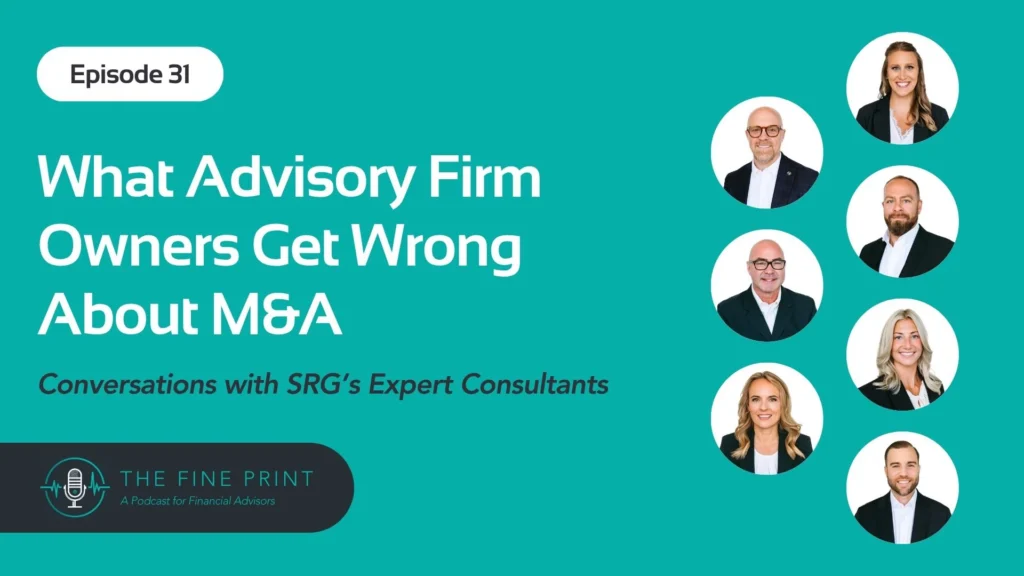
What Advisory Firm Owners Get Wrong About M&A M&A activity in the financial advisory space continues to reach new highs, but many firm owners are entering deals with assumptions that quietly cost them time, money, and negotiating leverage before they have even started. In this episode of The SRG Exchange, David Grau Jr. leads SRG’s consulting team and General Counsel through a candid conversation on what firm owners consistently get wrong about M&A, from when to involve an outside team to how valuation methodology, entity structure, and equity sharing all factor into a successful outcome. You will hear why showing up “80% done” often means you have not really started, how appraised value and sale price are not the same thing, where market multiples landed in 2025, and why entity planning and equity sharing have become essential considerations for advisory firms of nearly every size. Featured in This Episode David Grau Jr., MBA (Founder / CEO) Parker Finot (Director of Transaction Advisory Services) Kristen Grau, CPA, CVA, CEPA (Executive Vice President | Seller Advocacy) Ryan Grau, CVA, CBA (Director of Valuations) Nicole Frey, CFP® (Director of Team Solutions) Julia Sexton, CVA (Director of Strategic Organizational Planning)
Mergers and Acquisitions 101: M&A for Financial Advisors

Originally Published on November 18, 2020 What Exactly Is M&A? The term “mergers and acquisitions” (M&A) broadly refers to the process of one company combining with another; however, the method and legality of how these terms are processed are slightly different. Mergers occur when two organizations join together, and both parties remain active and involved on an ongoing basis. This can be done by subsequently forming a new legal entity under a single corporate name, or more simply by an existing advisor joining forces with a peer and contributing his or her book of business in exchange for a proportional share of value in the receiving party’s business. In many cases, mergers occur between two entities of approximately the same size. This allows the two organizations to combine forces and market share instead of directly competing against each other. For instance, in 2015 H.J. Heinz Company and Kraft Foods merged together to establish themselves as one of the largest food and drink companies in the world. After merging, their new business entity was named The Kraft Heinz Company. While this is obviously a much larger transaction, it is indicative of why many advisors consider merging. Acquisitions, on the other hand, are when one company purchases another entity outright and establishes itself as the new owner. This can come in the form of buying another advisor’s book of business (an asset purchase) or alternatively, buying the exiting advisor’s equity in their business. Legally, the target advisor that was acquired no longer exists, but its brand (name, website, logo, phone number, etc.) may still remain post-sale to ensure the retention of clients. An example of this is when Morgan Stanley MS acquired E*TRADE Financial in 2020 in an all-stock deal worth $13 billion. This effectively solidified Morgan Stanley amongst the leaders in the wealth management industry and gave them more technology assets, customers, and recurring revenue streams. There are a multitude of transaction structures for mergers and acquisitions. A merger may provide each advisor with partial ownership and control of the newly merged organization. Compare that with an acquisition, which results in the selling advisor being retained for a period, but usually as an employee or contractor of the acquiring firm. The lines between merger and acquisition terminology are often blurred in public-facing communications because the goal is to ensure there is a seamless transition from the client’s perspective. Who Deals With Mergers and Acquisitions? The responsibility of who manages the merger and acquisition process may vary depending on the size of the companies involved and their experience with such activities. But, it is a good idea to ensure you have a neutral intermediary, or buy and sell-side representation to usher the deal towards close and ensure all the moving pieces are being managed and discussed. It is also common to have the assistance of external counsel, such as lawyers and accountants, to conduct a final review of the transaction and documents. It is important to ensure that as the owner buying, selling, or merging, that you actively manage your external professional counsel and set clear expectations. This is critical to ensure you don’t spend weeks working with an intermediary and craft a well thought out strategy, only to have your counsel review and begin renegotiating on your behalf, resulting in you losing a deal. Attorneys and CPAs are tremendous resources, but it is most effective to ensure you have a knowledgeable industry expert who works with mergers and acquisitions daily to help the parties make fully informed decisions and avoid reinventing the wheel. Why Do Advisors Merge and Buy/Sell? The reasons for companies pursuing mergers or acquisitions will vary, but most are motivated by improving long-term prospects and potential for their business. Factors to consider when pursuing a merger or acquisition may include the ability to create a competitive advantage, diversify the customer base, expand service offerings, reduce operating costs, expand to new geographies, increase capabilities and assets, and more. In many cases, the reason to move forward with a deal would be a combination of several factors. Here are some of the most common motivations for moving forward with a merger or acquisition: Growth: Mergers and acquisitions can be a shortcut of sorts, allowing a business to expand its operations effectively overnight. Whether looking to merge or acquire strategically (expanding new service offerings for example through a merger or purchase) or economically (merging or acquiring a firm that will add more of the same type of revenue), mergers and acquisitions can quickly increase market share. Eliminate Competition: By merging with or acquiring a target company that is a competitor in an industry, a business can effectively increase their market share and potential customer base. Synergies: Mergers or acquisitions of a complementary business allows companies to combine their strengths, business activities, and differentiators to bolster their offerings and potentially lower costs. How Long Does an Acquisition Take? The acquisition process is detailed and complex; it requires many steps along the way. While each deal is different, acquisitions can often take anywhere from a few weeks (in a best-case scenario) to several months to complete. Much of the timing relies on how well both parties are aligned and how efficiently they are able to work together to move the process along. There are several factors that can impact the timeline of any given acquisition: Decisiveness: The decision-making process can take time. Each owner involved in the transaction wants to have full confidence that this is the best move to make, that the deal is fairly priced, and that there are no better options available. If there is hesitation on either side of the deal, more time and research will likely be needed to help it progress. Complexity: The transaction timeline can be impacted depending on if the target company is generally similar or different to the acquiring company, and also the level of complexity in the business structure of the company being acquired. Management: Willingness for management teams to cooperate can
Sell Smart, Not Late: Maximizing Advisor Valuation and Exit Plans
Unable to join us? Book a time below to discuss your business goals! Schedule a Call Schedule a Call
Financial advisor pay is ‘one of the most powerful strategic levers’ for RIAs
By: Tobias SalingerPublishing Date: March 17, 2026 Registered investment advisory firms or other advisory practices must create career paths and pay plans that evolve quickly enough to keep up with industry competition, advisor career advancement, geographic factors and the company’s long-term goals, according to a webinar last month on compensation trends led by Julia Sexton, the director of strategic organizational planning at consulting firm Succession Resource Group, and Ryan Grau, the company’s director of valuations. They presented the first of what will become an annual compensation study based on data from the RIAs that use the firm’s services. And the central takeaway revolved around the divergent impact among firms that have taken proactive steps, and those that haven’t. “Today isn’t just about benchmarking numbers,” Sexton said. “It’s about aligning compensation with role, clarity, behaviors, growth objectives and long-term enterprise value, because when compensation is designed intentionally, it becomes one of the most powerful strategic levers that you have in your firm and is so critical to so many transaction and business growth initiatives, succession planning, viability and just the overall cultural and financial health of your business.” On the other hand, Grau jumped in to add, failing to build an effective compensation strategy is “one of the quickest ways to derail value.” What do you make? Of course, any pay strategy begins with the basic amount that advisors will collect, and just as with any other profession, they will want to know how their pay compares to peers. Sexton and Grau’s presentation broke down advisor career paths into three general categories: Support advisors (less than five years in the field): Responsibilities include planning and investment tasks and starting to identify possible new clients, and compensation includes base salary, bonus and profit sharing. Service advisors (five to 10 years, CFP mark): Responsibilities include oversight of planning and analysis, delegating tasks to junior members and much more identification of new potential business, and compensation includes a base salary (a fixed amount plus some pay tied to assets under management), a bonus, profit-sharing and so-called phantom equity (deferred compensation carrying some of the same benefits as actual company stock). Lead advisors (10+ years, several certifications): Responsibilities include acting as the primary manager of client accounts, business development and the team’s staffing; compensation includes base salary with AUM-tied pay, a bonus and an equity grant or purchase opportunity. In terms of the dollar value of the compensation for those types of advisors, it varies significantly. Support advisors make total salary and bonus pay of between $50,000 and $85,000 per year with a median of $65,000; service advisors make total salary and bonus pay of between $66,964 and $120,000 per year with a median of $90,000; and lead advisors make total salary and bonus pay of between $108,000 and $235,750 per year with a median of $159,902. Disclaimer This article was first published by Tobias Salinger. The original article can be found here. All rights to the original content are held by financial-planning.com.
Sell Smart, Not Late: Maximizing Advisor Valuation and Exit Plans
Unable to join us? Book a time below to discuss your business goals! Schedule a Call Schedule a Call