
Organic & Inorganic Growth | How to be Successful with Both with Jeff Concepcion (Ep.26)

Organic and Inorganic Strategies for Financial Advisors In the fast-paced world of financial advisory, understanding the avenues toward sustainable business growth is crucial. The Fine Print Podcast recently featured an insightful discussion between David Grau Jr. MBA, President of Succession Resource Group, and Jeff Concepcion, Founder & CEO of Stratos Wealth Holdings. Their conversation explored the dynamic interplay of organic and inorganic growth, offering strategies and perspectives that every advisor striving for long-term success should consider. Introduction to Industry Challenges David Grau Jr. opened the dialogue by underscoring the importance of leveraging both organic and inorganic growth to build durable firms. Drawing from market valuation insights and succession planning, he highlighted how striking the right balance between these two growth engines can transform a practice from a traditional advisory business into a sustainable enterprise. Understanding Organic Growth Organic growth emerges from within a firm and relies on refining internal processes, optimizing referral marketing, and nurturing client relationships. Jeff Concepcion emphasized that organic growth should not be overshadowed by inorganic efforts. Instead, it should be treated as the foundation of a healthy business, with inorganic strategies serving as a complement. He also noted that organic growth can be a relatively low-cost, high-return strategy when firms apply discipline and creativity—whether through referrals, alliances, or using technology such as data analytics to uncover new opportunities. Inorganic Growth: The Acquisition Pathway The conversation then turned to inorganic growth, including mergers, acquisitions, and strategic partnerships. While this path often promises rapid expansion, Jeff Concepcion cautioned that it requires significant resources and should not serve as a substitute for organic growth. Rather, inorganic strategies are most effective when layered onto an already thriving business. Balancing the Two Growth Engines One of the most compelling points raised was the challenge of balancing growth strategies in the context of succession planning. David described how founders frequently worry that successors lack the ability to replicate their growth momentum. The solution, he argued, lies in preparing the next generation of advisors not just to maintain the status quo, but to innovate and lead new growth initiatives. Actionable Insights for Advisors Throughout the conversation, Jeff Concepcion shared practical advice for advisors looking to compete in today’s evolving marketplace. He stressed the importance of reinvesting in the business—whether through upgrading technology, acquiring top talent, or building infrastructure that supports scalable growth. By reinvesting strategically, firms can strengthen their organic growth engines while positioning themselves to take advantage of inorganic opportunities when they arise. This dual approach, he explained, is what ultimately creates enduring enterprise value. Conclusion: The Path Forward Looking to the future, Jeff Concepcion predicted increased concentration in the industry, with a small group of firms becoming notably large and influential. At the same time, he pointed out that new entrants continue to emerge, keeping the market vibrant and competitive. For advisors, this underscores the importance of tailoring growth strategies—both organic and inorganic—to their unique business models and long-term goals. The clear takeaway from this episode of The Fine Print: the path to building a successful advisory business is paved with intentional reinvestment and a balanced approach to growth. Whether through referrals, technology, or acquisitions, advisors who embrace both strategies will be best positioned to thrive in an ever-changing financial services landscape.
The RIA & Advisor Dissolution Playbook

Download Your eBook! Please enable JavaScript in your browser to complete this form.Please enable JavaScript in your browser to complete this form. Name * FirstLast Phone Work Email *How Did You Hear About SRG? *— Select Choice —ConferenceDirect MailExisting/Past ClientGoogle AdWordsOtherReferralSocial MediaSeminar/WorkshopWebinarWebsite Download Dissolve Your RIA the Right Way. Dissolving your RIA is rarely simple. It requires thoughtful coordination across legal, tax, compliance, and client transition steps. Each stage, from initial exit planning and regulatory filings to employee communications, financial wind-down, and document retention, brings unique requirements and potential risks. In this comprehensive playbook, SRG outlines the essential phases of an orderly dissolution, supported by detailed checklists, timelines, and best practices drawn from decades of industry-specific expertise. You’ll learn how to structure the process to minimize regulatory exposure, protect client relationships, and reduce the likelihood of costly missteps. This guide also covers special considerations for RIAs and registered reps, including employee obligations, custodial transitions, tax reporting, and post-dissolution compliance. By following this structured roadmap, advisors can ensure they exit with clarity, safeguard their legacy, and complete the dissolution process efficiently and with confidence. Created by SRG’s team of expert consultants, Kristen Grau, CPA, CVA, CEPA, Nicole Frey, CFP® and Parker Finot, this playbook distills years of hands-on experience guiding advisors through complex transitions—providing the tools, structure, and peace of mind to navigate one of the most significant business decisions with precision and care.
Succession & Next-Gen Leadership: Insights from Industry Veterans
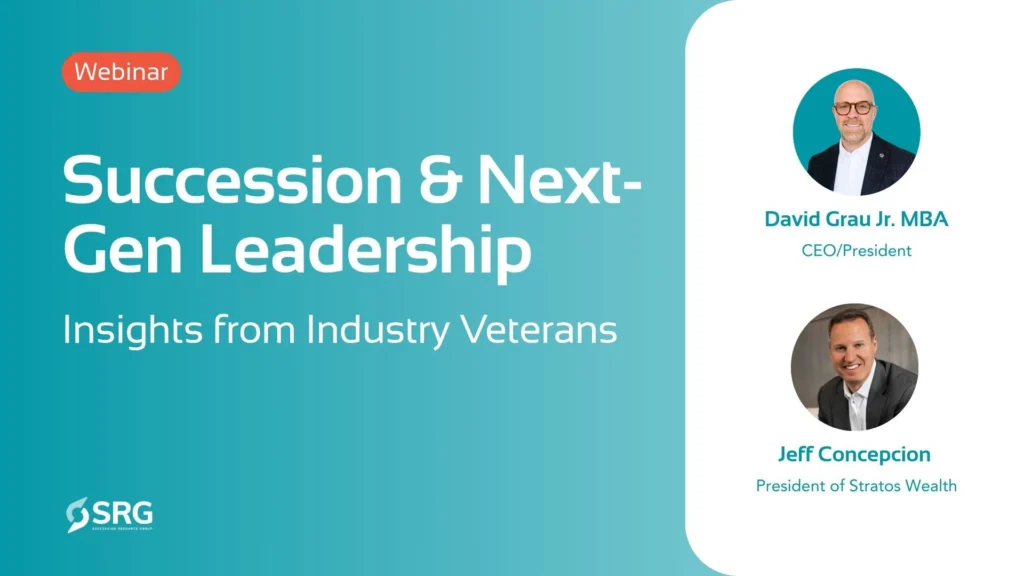
In this session, two founders and CEOs — David Grau Jr. of Succession Resource Group and Jeff Concepcion of Stratos Wealth Partners — shared candid insights on succession planning. They discussed when and how to start the process, stressing that early preparation leads to stronger outcomes and continuity. The conversation covered strategies to protect and maximize enterprise value before transition, giving owners practical ways to future-proof their businesses. A major focus was preparing next-gen advisors for leadership, with actionable steps they can take now to be ready for ownership. For both current owners and emerging leaders, this replay offers experience-driven guidance on navigating succession successfully. Watch the Replay Host David Grau Jr. MBA CEO/President Paper-plane Linkedin-in Host Jeff Concepcion President of Stratos Wealth Partners Linkedin-in
A Legacy Preserved Under Pressure

When Time Is Short, the Right Partner Makes All the Difference Succession planning after advisor death is one of the most urgent and complex challenges a firm can face. When a long-time Hawaii-based financial advisor unexpectedly passed away, their family was left with a major challenge: how to transition a complex, high value practice in under 60 days while mourning the loss of their loved one. Without a succession plan in place, the estate faced potential client attrition, lost value, an employee in limbo, a lease payment, and industry regulated complications. That’s when the family reached out to the deceased advisors’ Practice Management Consultant who referred to them to Succession Resource Group for help. The Challenge Following the sudden death of the advisor, the estate was left without a succession plan or an interim servicing advisor in place. The practice itself had a strong revenue base, generating $684,227 in revenue (79.0% recurring) and serving 248 households. However, it faced several immediate and significant challenges. Among these was an active lease obligation with 33 months remaining, adding financial pressure during a time of uncertainty. Coordination with the broker-dealer and regulatory compliance were urgently needed, further complicating the estate’s efforts to stabilize the business. The most pressing concern was the urgent value risk—without swift action and a clear strategy for succession planning after advisor death, the estate stood to lose everything. Compounding the situation was the vulnerability of a key, loyal employee, whose future with the practice was uncertain and at risk. These factors combined to create a highly complex and time-sensitive situation for the estate in identifying and implementing a succession solution. The Strategy In the wake of a sudden death, SRG launched its Seller Advocacy Program to guide the estate through the transition. Despite having limited data and no prior valuation available, SRG quickly created a prospectus that allowed the estate to take immediate action. Through targeted outreach, the team sourced 32 qualified buyers—specifically focused on local options—to ensure continuity and client familiarity. 10 finalists were interviewed and negotiated offers were considered, giving the estate meaningful choices rather than a rushed exit. Importantly, SRG positioned the practice for maximum value—not just a fast transaction—helping preserve the seller’s legacy while protecting long-standing client relationships. By applying their expertise in succession planning after advisor death, SRG brought structure, strategy, and compassion to the business transaction at a time when the family, employee, and clients needed it most. The Results 12% Over asking price 100% Cash down upon closing 3.1% Over industry recurring revenue multiples 33-Month lease obligation assumed by buyer 100% Fee to SRG paid by buyer 100% Staff retained by buyer Don’t Wait for the “What If” Be Prepared. Be Protected. What happens if life throws a curveball? Illness, injury, or worse—none of it waits for the right time. And when the unexpected hits, your clients, staff, and family may be left with more questions than answers. That’s why succession planning after advisor death is essential—not just for business continuity, but to protect everything you’ve worked so hard to build. Secure Your Legacy with SRG’s Contingency Retainer SRG’s Contingency Retainer is a proactive planning service empowers you to make critical decisions while you’re alive and well. You authorize a strategy to protect your business, define your wishes, and ensure your practice is positioned to transfer smoothly—no matter what happens tomorrow.
Selling to Your Kids? Why Family Deals Demand Extra Scrutiny

Selling your RIA practice to a son, daughter, or other family member might feel like a natural, low-stress transition, because there’s trust and familiarity. Many advisors assume they don’t need the same level of formality required of an outside RIA sale transaction. As a result they may skip a formal valuation, because they aren’t aiming for full value, or considering gifting equity. But this relaxed approach can open the door to tax exposure, compliance pitfalls, and long-term misunderstandings. In fact, intra-family sales demand more structure and care—not less—from both a practical and technical perspective. Here are five details and considerations to keep in mind that make these deals uniquely complex and why they deserve extra attention: 1. Third-Party Opinion of Value Is Non-Negotiable Family transactions are subject to close IRS scrutiny, especially when there are gifts involved or the sale price appears below fair market value. A credible, independent valuation is critical for: Establishing a supportable value of the business. Reporting a defensible value for gift tax purposes Supporting installment sale terms Managing the optics with non-involved heirs or business partners Using a third-party valuation firm ensures the agreed-upon price holds up under audit and provides a solid foundation for tax planning strategies. There are still tools at one’s disposal to influence or control the value, but doing so with an objective starting place—and with the correct strategy—will help ensure the RIA for sale is not recharacterized post-transition. Even if valuation isn’t the founder’s focus, it is still advisable to receive a formal valuation to avoid common post-sale pitfalls. Occasionally, advisors operating under an independent broker-dealer (IBD), inquire about simply ‘putting’ the business in the name of their son or daughter for no additional compensation to avoid formally “selling” or gifting. While it is possible to do at the IBD level, transferring an advisory business that has produced hundreds of thousands or millions of dollars of taxable income over the past decades, especially in an industry with a very active and well-known M&A market, is simply asking to be audited. 2. Alternative Financing Solutions For family business sales, there are unique financing options that can and should be considered. Self-Cancelling Installment Notes (SCINs) can be a powerful estate planning tool when selling to a family member. These notes are similar to a traditional promissory note, with the buyer/family member making payments of principal and interest out of cash flow, over some agreed-upon period. But, SCINs have a unique feature – the note can automatically terminate upon the seller’s death, potentially removing any unpaid balance from the seller’s taxable estate, without creating a tax liability for the buyer (the remaining debt outstanding at the seller’s passing isn’t forgiven, it simply terminates and ‘goes away’). SCINs can be a useful tool for family succession, but their structure must be airtight: SCINs need to include a “mortality risk premium” to offset the note’s cancelable feature – for example, a slight premium on the interest rate The valuation of the premium must be actuarially sound and based on health-adjusted life expectancy The term of the SCIN should be within the actuarial life expectancy of the seller – for example, a note shouldn’t be 20-years for a seller that is 85 years old The SCIN should be properly documented in value. The IRS will challenge and recharacterize notes that lack documentation or are undervalued For sellers with impaired health or shorter life expectancy, this can be an efficient way to reduce estate tax exposure, but it must be coordinated with a valuation professional and tax counsel. 3. Gifting Equity to a Family Member – Employee Gifting the business, partial or full, to a child who is also a key employee raises serious issues under both the gift tax rules and compensation regulations. To qualify as a gift by the IRS, the gift should be detached and disinterested generosity – a tough argument to make when the family member is on payroll. If an owner gave equity to anyone else on payroll, it would clearly be treated as a grant, thus making the argument that a grant to an employee related to the owner should in fact qualify as a “gift” is problematic/risky. Key considerations for gifting: Is the equity truly a gift, deferred compensation, or a grant of non-cash compensation? Is the employee/family member receiving equity for “less than adequate consideration?” Can the gift be split with your spouse? Can a minority interest be applied? Many family businesses are surprised by the gifting/granting considerations and thus get blindsided. Even well-intentioned, informal transfers can trigger unintended tax consequences if not properly documented. 4. Formal Governance Protects Relationships and the Business A key mistake in family transitions is letting relational trust substitute formal governance. When sharing ownership, with ANYONE (especially family), you need: A detailed Partnership Agreement, Operating Agreement, or Shareholder Agreement A buy-sell agreement with clear terms Defined roles and responsibilities for both generations A succession plan that survives death, disability, or divorce Mechanisms for resolving disputes (especially if other siblings are involved) Even if the culture is close-knit, legacy issues, entitlement perceptions, and money create a combustible mix. The hope is that you will never need to consult any of these agreements, whether selling to a family member or anyone else, but it is advisable to have well-thought-out governance documents you don’t need, than the inverse. Clear documentation avoids family blowups later. 5. Don’t Assume One Buyer = One Option In some cases, it may be advantageous to split ownership. For example, gifting minority interests over time while selling controlling interest later or using a grantor retained annuity trust (GRAT) or family limited partnership (FLP) structure to transition wealth gradually while maintaining control. Each of these has technical hurdles but can open up estate planning advantages that a straight sale misses. Bottom Line: Treat a Family Sale Like the High-Stakes Business Deal It Is Selling an RIA to a family member is not a shortcut—it’s a high-wire act, with an audience
Advisor Succession Plan: Inside a Real-Life Succession Plan
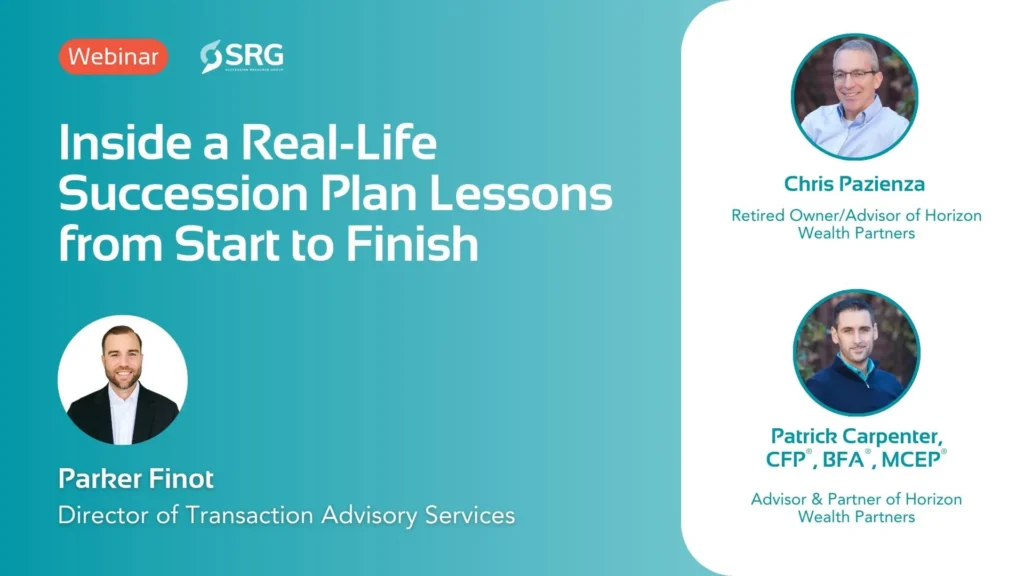
Why an Advisor Succession Plan Matter Real-Life Advisor Succession Plan: Lessons From Start to Finish is a complete, real-world case study showing how one multi-advisor firm moved through every step of a true advisor succession plan. You’ll see how the team handled valuation, financing, ownership changes, and client transitions from beginning to end—making this a practical example of a succession plan from start to finish. This session is built for financial advisors and firm owners who want proven, experience-based guidance. You will learn how to reward key team members, protect business value, structure a smooth transition, and prepare for a confident exit. You’ll also hear lessons from a real-life advisor succession plan that you can apply whether you’re planning an internal sale, grooming successors, or preparing your firm for the future. Speakers Host Parker Finot Director of Transaction Advisory Services Paper-plane Linkedin-in Guest Chris Pazienza Retired Owner/Advisor of Horizon Wealth Partners Guest Patrick Carpenter, CFP®, BFA®, MCEP® Advisor & Partner of Horizon Wealth Partners
Selling a Book of Business as a Financial Advisor | Complete Guide

Selling your book of business is one of the most significant financial decisions you will make as a financial advisor. Whether you are approaching retirement, exploring a strategic exit, or simply looking to capitalize on favorable market conditions, understanding the full process, from valuation to buyer selection to client transition, can mean the difference between a smooth, profitable handoff and leaving value on the table. The timing matters more than most advisors realize. Over half of active financial advisors are over age 50, and many still lack a formal succession plan. As retirements increase and deal volume continues to rise, consolidation across the wealth management space is accelerating. Rising taxes and interest rates, tighter regulations (think Reg BI), tech demands, and fee compression are all adding pressure and shrinking margins. For many advisors, this creates a tipping point, prompting them to explore exit options or sell their book of business. Adding to the urgency, private equity has become a major force in advisor M&A. PE-backed buyers are driving up headline valuations but often on less favorable terms for sellers — smaller cash down payments, more earn-outs, and equity in the buyer’s firm. Understanding this dynamic is critical to evaluating any offer you receive. In short: sellers will be plentiful, and timing will matter. This guide walks you through the full process of selling a financial advisory book of business, including when to sell, how to determine what yours is worth, how to find the right buyer, and how to protect your clients and your legacy along the way. When Is the Right Time to Sell? Timing is everything when it comes to selling your book of business, but the right time is not always obvious. Personal circumstances are rarely in perfect alignment with market conditions. Simply “wanting out” does not necessarily mean it is time to sell. If your revenue is declining, you just lost your largest client, or you have made major internal changes, you may not get the value you are hoping for or expecting from the financial advisory practice you have built. Retirement is an easier scenario for many advisors. If you set a target date a few years into the future, you can take the necessary steps to ensure you have maximized the value of your financial practice and positioned yourself to attract the best suitors. SRG’s succession planning engagements are specifically designed to help advisors build that runway. That said, you do not need to be on the verge of retirement to sell. Some advisors sell during a period of strong growth specifically because a growing practice commands a higher multiple. Others sell a portion of their book to reduce workload while staying active. The key is to sell from a position of strength rather than necessity. A few signals that the timing may be right: Your revenue has been stable or growing for at least two to three consecutive years You have recurring, fee-based revenue that makes your book predictable for a buyer Your client base skews younger (under 65), giving the buyer a longer revenue runway You have documented processes and systems that can transfer to a new owner You have started to think about what comes next — whether that is retirement, a new venture, or a reduced role If several of these apply, it is worth starting the conversation, even if you are not ready to list today. Preparation alone, understanding your valuation, cleaning up your operations, and exploring options — typically begins three to five years before the planned exit, though the most successful transitions start even earlier. According to SRG’s transaction data, the average succession plan spans 6.5 years. How to Value a Financial Advisor’s Book of Business Before you name your price, you need to understand how buyers are actually sizing up your business. The two most common valuation methods for financial service businesses are a market-based valuation using comparable transaction data and an income-based valuation that focuses on the business’s ability to generate profits. Neither of these is the correct solution 100% of the time; the best approach depends on the circumstances and size of the parties involved. Most sophisticated buyers will use more than one method. One important trend: as practices grow larger and more complex, valuations are increasingly based on earnings (EBITDA) rather than revenue multiples. Advisors planning an exit in the next few years should be paying close attention to their profitability, not just their top-line revenue. Revenue Multiplier Method The most widely referenced approach. Take your trailing twelve-month revenue and multiply it by an industry-standard factor. For RIAs and advisors with recurring revenue, that multiplier typically falls between 1.6x and 4.4x. When buyers outnumber sellers, it is common to see a well-positioned practice that has been prepped for sale exceed 3.0x on recurring revenue. In 2025, 39% of practices that transacted received a recurring revenue multiple of 3.5x or higher, according to SRG’s annual transaction data. Regional multiples ranged from 3.17x in the South to 3.48x in the Midwest — a tighter band than many advisors expect. What pushes you toward the higher end: strong recurring fee-based revenue, a younger client base, clean operations, and consistent growth. What pulls you toward the lower end: heavy reliance on commission-based income, an aging client book, or declining revenue trends. Earnings-Based Valuation (EBITDA / SDE) This method focuses on profitability rather than top-line revenue. Buyers look at earnings before interest, taxes, depreciation, and amortization (EBITDA) — or seller’s discretionary earnings (SDE) for smaller practices. For most practices, the industry standard multiplier is typically 4 to 8 times annual earnings, including reasonable owner’s compensation. However, larger firms with strong margins and sustainable growth are commanding multiples well above that range — SRG’s 2025 transaction data showed an average EBITDA multiple of 9.98x across the deals it tracked. This method is more common when the buyer will be assuming the seller’s overhead, and it is more reasonable to use a valuation method that focuses on profitability versus
Executing A Successful Internal Succession Plan In The Private Equity Era Of Advisor M&A

Watch the Replay Related Resources 2025 Advisor M&A Report Check Out our Press Release→ Succession Readiness Checklist Check Out the Checklist→ Selling Your Practice with Expert Advocacy Watch the Replay → Grab A Valuation We offer a variety of solutions and turnaround times to fit your needs. Join myCompass Our membership club grants you inside tips and opportunities to grow. Review our Seller Services We’re here to ensure you secure the best buyer, price and terms.
Three Major RIA Growth Mistakes to Avoid

For most advisors and RIAs who own their firms, growth is the ultimate goal, whether through organic strategies, M&A activity, or some combination thereof – and for good reason. Without growth, firms run the risk of losing clients they can’t replace, missing the chance to capitalize on massive opportunities like the great wealth transfer, and falling too far behind competitors to catch up. But with a few adjustments to right-size common mistakes, advisors can capture growth opportunities and set their firms up for future success, whether that means selling the business or passing it down to the next generation within the firm.
The Founder’s Exit Paradox with Jerome Myers (Ep.17)
