
Everything You Need To Understand Liquidation Rights

Liquidation rights, also known as liquidation preferences, are a key element in contract negotiations for mergers and acquisitions. They determine who gets paid and when should a company choose to sell or liquidate all its assets. With a merger, liquidation rights can be leveraged in the deal once the buyer figures out the breakdown of existing parties who need to get paid. For acquisitions, it’s all about properly allocating preferred stock and liquidation preferences to investors. Liquidation Rights and Organizational Hierarchy When a corporation is formed, it’s up to the board of directors to set up a stock structure that should include executive, preferred, and common stock. Each category awards the recipient with a certain number of votes per share and a place in the liquidation queue. If venture capital is used for start-up money, the venture capital firm will typically insist that they be the first to get paid in the event of liquidation or sale of the company, ahead of debt holders or other preferred stockholders. Common stockholders get paid last. Liquidation rights also come into play in the event of a bankruptcy. In this case, as in the case of a general liquidation or sale, a company liquidator needs to unwind the complexities of secured and unsecured debt, investor liquidation preferences, and preferred stockholder allocations. It’s important to understand that the organizational hierarchy of liquidation rights can be very different from the executive or even board hierarchy of the company itself. General employees are typically issued common stock and can walk away with nothing in certain scenarios. Liquidation Preference is a Key Element in M&A Deals Researching liquidation rights should be part of the due diligence process for any merger or acquisition. When there’s a change in ownership, certain obligations need to be attended to. Among those, there could be unresolved debt or repayments to investors. This is one of those areas that bringing in an experienced MA consultant will pay dividends for you. In most cases, it’s the seller’s responsibility to meet repayment of debt obligations before closing the deal, but the buyer may inherit some of those liabilities if they are not careful. Companies only need to sell 51% of their equity shares to transfer control to another business or private entity. The remaining shareholders keep their shares, some of which may be preferred stock that holds a liquidation preference. Your legal team needs to evaluate that. Liquidation Rights for Preferred Stockholders Issuing preferred stock to select investors or partners in the firm is not a guarantee of payment in the event of a sale or liquidation. It does, however, put them closer to the front of the line. Keep that in mind when structuring an acquisition contract. To ensure liquidation rights are clearly defined, it is recommended that you utilize different classes of preferred stock. Callable shares, which can be bought out by the company prior to the next acquisition or merger, are a sensible option if investors will go for it. Convertible preferred shares can be an attractive option also, and a good negotiating tool. They can be traded for common stock using a predetermined multiplier. Issuing these as part of an acquisition strategy can be a tradeoff for guaranteeing liquidation rights. Classes of preferred stock to avoid when drafting an MA contract are participatory preferred shares and cumulative preferred shares. They each offer dividend guarantees, which can be a slippery slope. There are better ways to ensure major investors make a profit. Liquidation Rights for Common Stockholders Holders of common stock only benefit from liquidation rights when the acquisition price exceeds the sum of the guarantees made to preferred stockholders and any debt payments that need to be made before the deal can be closed. Like preferred stock, common stock can be allocated into different classes, and liquidation rights can be assigned based on those classes. This is also how voting rights are awarded. When acquiring a new company, creating these classes is your responsibility. When assigning common stock to employees, make sure there’s a reasonable vetting schedule in place to protect the company. If things don’t go well in the first few years and you have to sell, this will eliminate any liquidation rights for common stockholders. Liquidation Preference for Founders with Capital Investment A founder investing his or her own money into a company is not the same as a venture capital firm making an investment. Founders don’t have a special liquidation preference. They’re treated the same as any other preferred stockholder. To alleviate concern over this, companies can create an “executive” class of preferred stock that has better voting rights and is higher up the chain for liquidation preference. This will usually guarantee some compensation after venture capital firms are paid. Liquidation Rules for Creditors and Debt Holders In cases of insolvency, there are rules for paying off creditors when a liquidation occurs. These don’t have to be included in an MA contract, but this list should be used when negotiating a purchase or sale. The following debts should be paid off in this order. Secured Creditors with a Fixed Charge Preferential Creditors Secured Creditors with a Floating Charge Unsecured Creditors Fixed charges are assets used to secure a loan that have a fixed value, such as property or equipment. An example of a floating charge is stock, which fluctuates (floats) in value, but fixes on the liquidation date. Unsecured loans have no collateral attached and can be saved for last.
From Siloed to Synergized: How to Form an Ensemble the Right Way
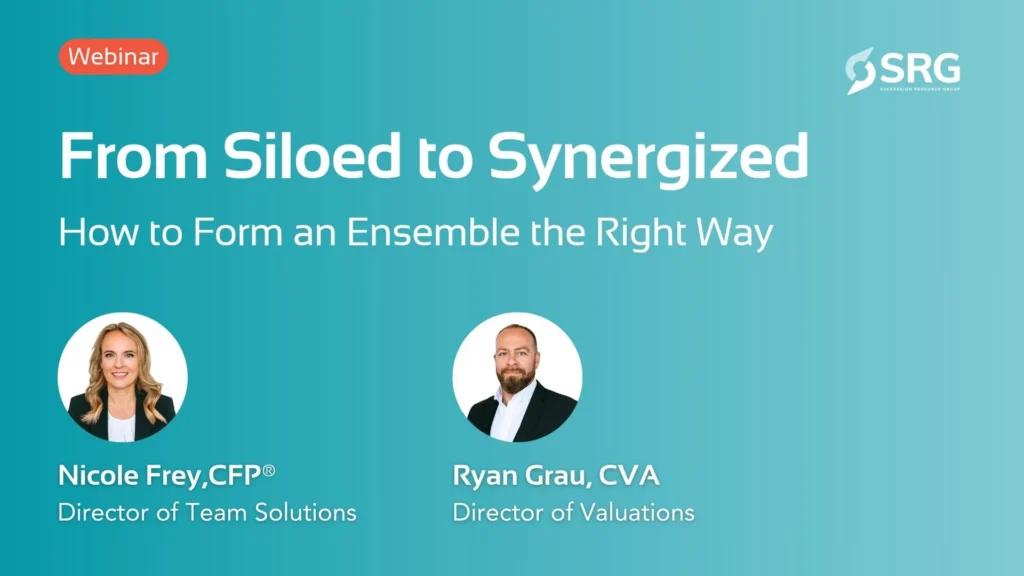
Watch the Replay What Does It Take to Build an Ensemble That Actually Works? In this NM-focused session, SRG’s Ryan Grau (Valuations Director) and Nicole Frey (Director, Team Solutions) walk advisors through merging or consolidating practices the right way—why to merge, how to divide ownership fairly, and how to design compensation that keeps everyone whole. They compare common starting points (expense-sharing vs. fully separate practices), show how an equity-centric ensemble drives scale, continuity, and talent retention, and stress starting with a formal valuation. For Northwestern Mutual specifically, they explain assigning W-2 risk revenue to the entity, “trigger-event” risk if an agent departs, and SRG’s with-and-without valuation model to handle renewals. The replay covers pre-/post-merger cash-flow analysis, quick wins (grid bumps, cost reductions), entity choices (LLC vs S-Corp) including a two-tier LLC/S-Corp structure, governance and voting design, and ongoing entity maintenance. Grab A Valuation We offer a variety of solutions and turnaround times to fit your needs. Join myCompass Our membership club grants you inside tips and opportunities to grow. Review our Seller Services We’re here to ensure you secure the best buyer, price and terms.
Organic & Inorganic Growth | How to be Successful with Both with Jeff Concepcion (Ep.26)

Organic and Inorganic Strategies for Financial Advisors In the fast-paced world of financial advisory, understanding the avenues toward sustainable business growth is crucial. The Fine Print Podcast recently featured an insightful discussion between David Grau Jr. MBA, President of Succession Resource Group, and Jeff Concepcion, Founder & CEO of Stratos Wealth Holdings. Their conversation explored the dynamic interplay of organic and inorganic growth, offering strategies and perspectives that every advisor striving for long-term success should consider. Introduction to Industry Challenges David Grau Jr. opened the dialogue by underscoring the importance of leveraging both organic and inorganic growth to build durable firms. Drawing from market valuation insights and succession planning, he highlighted how striking the right balance between these two growth engines can transform a practice from a traditional advisory business into a sustainable enterprise. Understanding Organic Growth Organic growth emerges from within a firm and relies on refining internal processes, optimizing referral marketing, and nurturing client relationships. Jeff Concepcion emphasized that organic growth should not be overshadowed by inorganic efforts. Instead, it should be treated as the foundation of a healthy business, with inorganic strategies serving as a complement. He also noted that organic growth can be a relatively low-cost, high-return strategy when firms apply discipline and creativity—whether through referrals, alliances, or using technology such as data analytics to uncover new opportunities. Inorganic Growth: The Acquisition Pathway The conversation then turned to inorganic growth, including mergers, acquisitions, and strategic partnerships. While this path often promises rapid expansion, Jeff Concepcion cautioned that it requires significant resources and should not serve as a substitute for organic growth. Rather, inorganic strategies are most effective when layered onto an already thriving business. Balancing the Two Growth Engines One of the most compelling points raised was the challenge of balancing growth strategies in the context of succession planning. David described how founders frequently worry that successors lack the ability to replicate their growth momentum. The solution, he argued, lies in preparing the next generation of advisors not just to maintain the status quo, but to innovate and lead new growth initiatives. Actionable Insights for Advisors Throughout the conversation, Jeff Concepcion shared practical advice for advisors looking to compete in today’s evolving marketplace. He stressed the importance of reinvesting in the business—whether through upgrading technology, acquiring top talent, or building infrastructure that supports scalable growth. By reinvesting strategically, firms can strengthen their organic growth engines while positioning themselves to take advantage of inorganic opportunities when they arise. This dual approach, he explained, is what ultimately creates enduring enterprise value. Conclusion: The Path Forward Looking to the future, Jeff Concepcion predicted increased concentration in the industry, with a small group of firms becoming notably large and influential. At the same time, he pointed out that new entrants continue to emerge, keeping the market vibrant and competitive. For advisors, this underscores the importance of tailoring growth strategies—both organic and inorganic—to their unique business models and long-term goals. The clear takeaway from this episode of The Fine Print: the path to building a successful advisory business is paved with intentional reinvestment and a balanced approach to growth. Whether through referrals, technology, or acquisitions, advisors who embrace both strategies will be best positioned to thrive in an ever-changing financial services landscape.
Legal/Tax/M&A: Where Your Professionals Fit Into Your M&A and Succession Plan
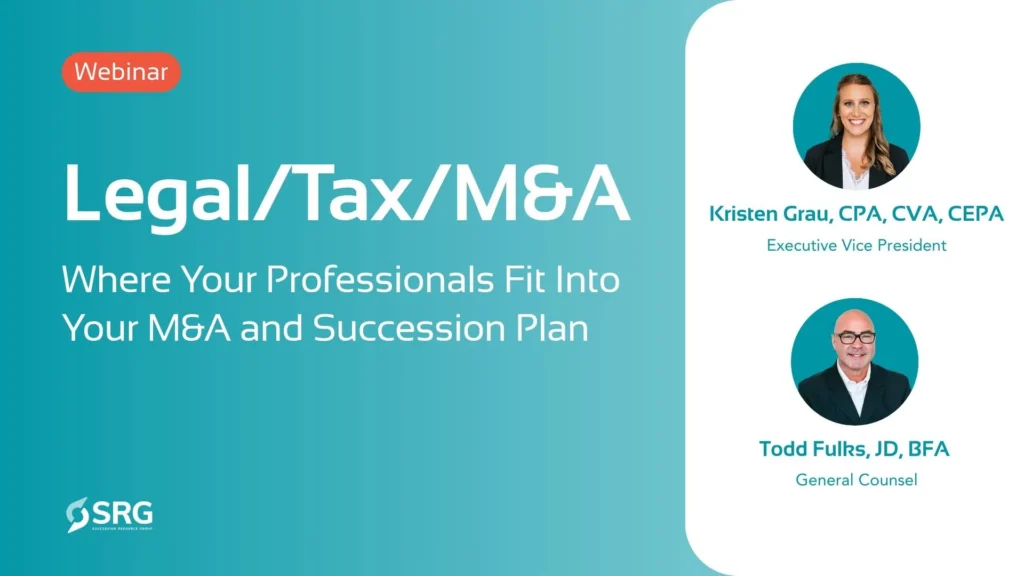
Discover how to align the right professionals with the right phase of your M&A or succession plan — without wasting time or money. This session delivers hard-earned insights from hundreds of real-world advisory firm transitions. Watch the Replay Host Kristen Grau, CPA, CVA, CEPA Executive Vice President Paper-plane Linkedin-in Host Todd Fulks, JD, BFA
What’s the Deal with PE and Aggregators! (Ep. 23)
Watch the Replay Related Resources 2025 Advisor M&A Report Check Out our Press Release→ Succession Readiness Checklist Check Out the Checklist→ Selling Your Practice with Expert Advocacy Watch the Replay → Grab A Valuation We offer a variety of solutions and turnaround times to fit your needs. Join myCompass Our membership club grants you inside tips and opportunities to grow. Review our Seller Services We’re here to ensure you secure the best buyer, price and terms.
Executing A Successful Internal Succession Plan In The Private Equity Era Of Advisor M&A

Watch the Replay Related Resources 2025 Advisor M&A Report Check Out our Press Release→ Succession Readiness Checklist Check Out the Checklist→ Selling Your Practice with Expert Advocacy Watch the Replay → Grab A Valuation We offer a variety of solutions and turnaround times to fit your needs. Join myCompass Our membership club grants you inside tips and opportunities to grow. Review our Seller Services We’re here to ensure you secure the best buyer, price and terms.
2025 Advisor M&A Highlights

Please enable JavaScript in your browser to complete this form.Please enable JavaScript in your browser to complete this form. Name * FirstLast Phone Work Email *How Did You Hear About SRG? *— Select Choice —ConferenceDirect MailExisting/Past ClientGoogle AdWordsOtherReferralSocial MediaSeminar/WorkshopWebinarWebsite Download Originally released on January 22, 2025, Succession Resource Group’s 9th annual Advisor M&A Review provides guidance to thousands of financial advisors and RIAs preparing to value, improve, protect, grow, and exit their advisory firms. This report’s findings are based upon 176 peer-to-peer deals completed from January through December of 2024 with over $13.3 billion in total assets under management transferred. This exclusive report, provided by Oak Street Lending, PPC Loan, Skyview Partners, and Succession Resource Group, provides unparalleled insights based on actual transactions that are being directly facilitated by the aforementioned firms. Unlike general industry reports or self-reported survey data, this report offers a deep dive into the real-time opportunities, challenges, and emerging trends within the wealth management sector. By focusing on live, active deals, this report not only reflects the current market landscape but also sheds light on the evolving dynamics that shape decision-making and strategy in the industry.
2025 Advisor M&A Review
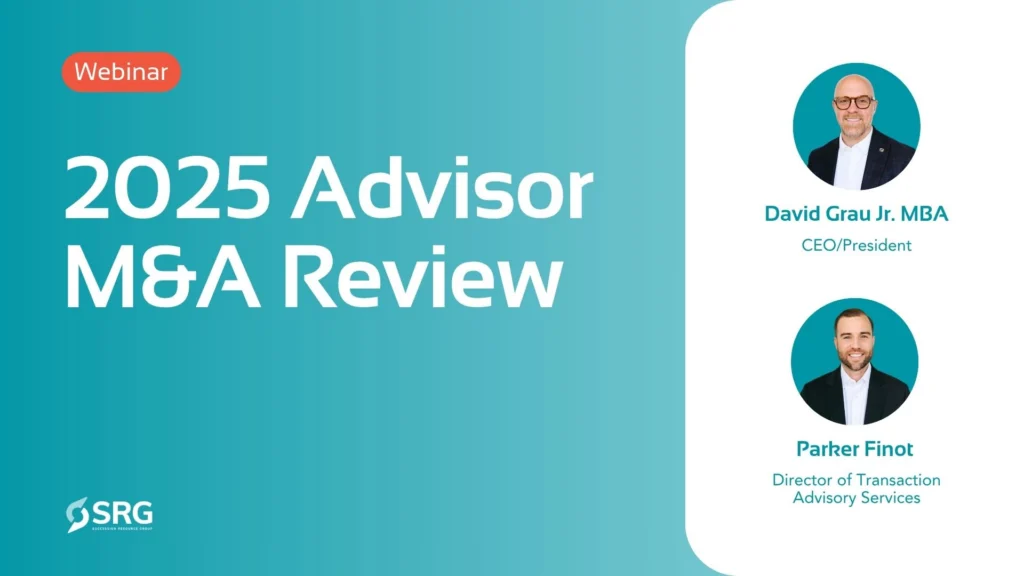
Watch the Webinar Replay 2026 Advisor M&A Market Insights: What Actually Happened in Advisor M&A In its 9th annual Advisor M&A Review, Succession Resource Group breaks down what actually happened in mergers, acquisitions, and succession planning across the financial advisory industry. The session draws on the industry’s most comprehensive dataset of 176 verified, closed transactions, along with a succession survey of 301 firm owners, to deliver decision-ready benchmarks that go well beyond self-reported figures. Viewers will learn where recurring revenue and EBITDA multiples landed, how those multiples vary by region, and why sellers who use open-market advocacy tend to command higher prices and stronger terms. David Grau, Jr., MBA and Parker Finot also unpack the deal structures that determine what sellers actually take home, including down payments, seller financing, retention clauses, and lender holdbacks. The review closes with SRG’s predictions for the year ahead, covering succession readiness, buyer competition, and the continued shift toward team-based compensation. Whether you are preparing to grow, buy, sell, or plan an internal succession, this recording offers a data-backed view of the market to help inform your next move. Host David Grau Jr. MBA CEO/President Paper-plane Linkedin-in Host Parker Finot Director of Transaction Advisory Services Paper-plane Linkedin-in Data Contributors
The Psychology of Dealmaking in Advisory RIA M&A Transactions

Navigating Emotional & Behavioral Triggers for Success
Three Major RIA Growth Mistakes to Avoid

For most advisors and RIAs who own their firms, growth is the ultimate goal, whether through organic strategies, M&A activity, or some combination thereof – and for good reason. Without growth, firms run the risk of losing clients they can’t replace, missing the chance to capitalize on massive opportunities like the great wealth transfer, and falling too far behind competitors to catch up. But with a few adjustments to right-size common mistakes, advisors can capture growth opportunities and set their firms up for future success, whether that means selling the business or passing it down to the next generation within the firm.