
Inside SRG’s Talent Strategy Report: Compensation Benchmarks for Advisors
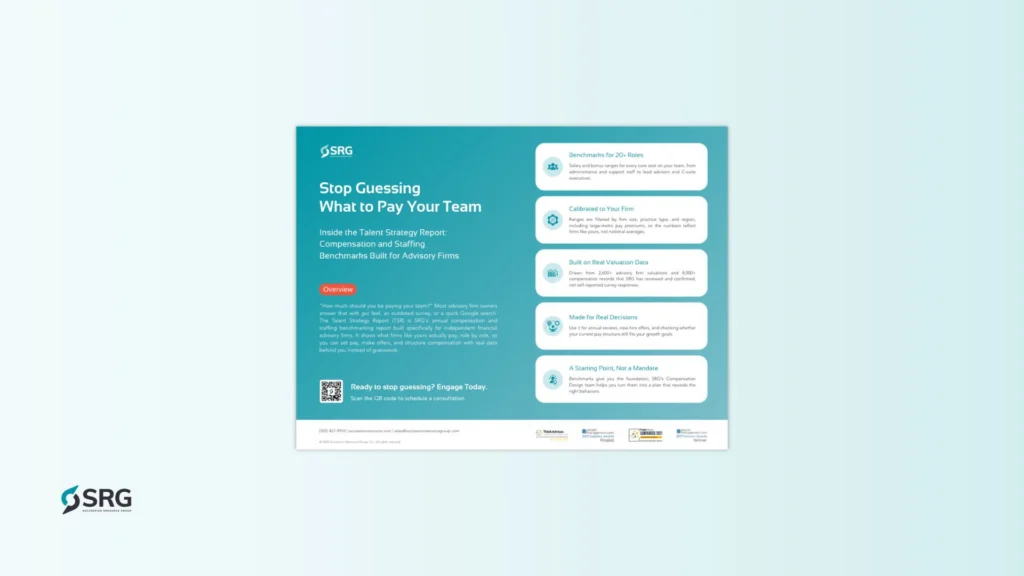
The Talent Strategy Report at a Glance The Talent Strategy Report (TSR) is SRG’s annual compensation and staffing benchmarking report built for independent financial advisory firms. This infographic breaks down what’s inside, how the data is sourced, and what makes it different from the generic salary surveys most firms rely on. If you’re making compensation decisions this year, start here. Download Infographic
How to Make a Merger a Growth Move: A 5-Step Roadmap for Advisory Firms

Last Updated: August 25, 2026 Author “What comes next?” For many financial advisory firm owners, growth eventually hits a ceiling. Organic client acquisition slows, operational demands pile up, and the question surfaces: what comes next? Mergers have become one of the most effective strategies for advisory firms looking to scale, reduce risk, and build long-term enterprise value. But a merger done poorly can create more problems than it solves. The difference between a merger that accelerates your business and one that stalls it comes down to preparation, process, and the right professional guidance. In a recent SRG webinar, Nicole Frey, CFP®, Director of Team Solutions, and Ryan Grau, CVA, CBA, Director of Valuations, walked through the full merger lifecycle for advisory firms. Below is a summary of the key takeaways. You can also watch the full webinar recording here. Why Advisory Firms Pursue Mergers Advisory firms explore mergers for a range of reasons, and the right motivation depends on where you are in your business lifecycle. Some of the most common drivers include: Faster growth. Rather than relying solely on organic growth, merging with a partner who brings their own book of business can accelerate your trajectory. SRG’s AcquireEdge program helps firms identify and evaluate acquisition and merger opportunities with this goal in mind. Greater scale and efficiency. When two firms combine, revenue may grow at a faster rate as the combined firm expands its client base, referral network, service capacity, and opportunities to capture additional wallet share. Expenses often increase at a slower rate because core infrastructure, technology, compliance, management, and administrative costs can be spread across a larger revenue base, creating margin improvement as the firm scales. Risk reduction and continuity. Sole proprietors face significant key-person risk. Adding a partner means your clients are protected if something happens to you. It also opens the door to better succession planning and contingency planning options. (For more on why contingency planning matters in the context of M&A, see Contingency Planning: A Key to Acquisition Success.) Expanded capabilities. A merger can help you offer new services, diversify your client demographics, enter new geographic markets, or create a one-stop shop by combining with complementary practices like CPA firms. For firms thinking about strategic direction at this level, SRG’s enterprise consulting services can help map the path forward. Talent attraction. In an aging industry, larger combined firms can offer more defined career paths and specialized roles, making it easier to recruit and retain talented professionals. Improved negotiation power. Operating at a larger scale gives you leverage when negotiating vendor contracts, payout grid rates, and fee structures with broker-dealers or custodians. Step 1: Get Your Entity Structure Right Before you start looking for a merger partner, your own house needs to be in order. Your entity structure — the legal form, tax status, and organizational setup of your firm — directly impacts how a merger can be executed. SRG’s entity support services are designed to help firms get this foundation in place. (For a deeper dive, download Your Guide to Proper Entity Structure.) The two most common legal forms in the advisory space are corporations and LLCs. Frey noted that LLCs taxed as partnerships offer significantly more flexibility for mergers. In a partnership structure, a new partner can contribute their book of business in exchange for ownership without triggering a taxable event. In an S-corporation, by contrast, that same contribution is often treated as a sale by the IRS, creating an immediate tax liability even though no cash changed hands. For firms that want the flexibility of an LLC partnership and the FICA tax savings of an S-Corp election, there is a hybrid solution: an LLC taxed as a partnership at the operating level, with each partner holding their interest through an individual S-Corp holding company. It adds complexity, but it gives you the best of both worlds. The takeaway: address your entity structure before the merger conversation heats up. Trying to restructure and merge simultaneously can be overwhelming. If your entity is already in place, SRG’s entity maintenance program ensures your governance documents and compliance stay current as the business evolves. For more on how entity structure supports growth, see Set Your Firm Up for Success — Using Entity Structure to Unleash Growth. Step 2: Define Your Ideal Merger Partner Not every merger is a good merger. As Frey put it during the webinar, a merger is “almost like a marriage, just on a business level.” You want to build trust and rapport before proposing anything formal. Finding the right partner requires honest self-assessment and intentional criteria. Your ideal merger partner should be similar or complementary to your business. Frey recommended evaluating potential partners across several dimensions: Revenue sources and service model compatibility. If one firm operates primarily through in-person client meetings and the other runs on virtual engagement, there needs to be a plan to reconcile those models or you risk losing clients during the transition. Client types and demographics. Complementary client bases can be a strength, but mismatched expectations around client service intensity can become a source of tension. Growth goals. If one partner is aggressively pursuing growth while the other is winding down toward retirement, that misalignment needs to be addressed through compensation structures rather than equity adjustments, which can create IRS audit complications. Once you have identified a potential partner, start by networking through broker-dealers, professional conferences, centers of influence, and business coaches. Build the relationship before introducing formal merger conversations. (For practical guidance on early-stage partnership conversations, see Teaming Advice When Preparing for a Merger.) When the time is right, sign an NDA and begin sharing financial information through a structured due diligence process. At minimum, you should be requesting three years of financial history with a deep dive on the trailing 12 months, a breakdown of the client base (demographics, asset distribution, concentration risk), staffing levels and compensation commitments, any existing equity-sharing or profit-sharing promises, major contract terms and expiration dates, and each owner’s goals —
The Exchange: Selling Your Advisory Business and What Every Owner Needs to Know (Ep. 33)
Navigating the Noise When It’s Time to Sell When you decide to sell your advisory business, you will be approached from every direction; aggregators, PE firms, broker dealers, and peers all ready to make an offer. The question isn’t whether demand exists. It’s whether you have the right team to make sure you’re getting the most out of it. In this episode of The Fine Print, David Grau Jr., MBA is joined by Kristen Grau CPA, CVA, CEPA, Parker Finot, and Ryan Grau CVA, CBA to break down what seller advocacy really means, where self-negotiated deals tend to fall short, and what advisors should look for when choosing an intermediary. You will hear why great offers never show up in the first draft, what the “auction” label gets wrong about the listing process, how some intermediaries secretly work both sides of the deal, and why getting a valuation three years before you’re ready to sell can change everything. Show Notes The noise every seller has to cut through. Aggregators, PE firms, broker dealers, peer buyers, and DIY platforms are all competing for your attention. The real question isn’t which offer to take — it’s whether you have the right expertise on your side to evaluate them properly. The risks of going it alone. Self-negotiated deals often skip NDAs, skip proper due diligence, and rely on one-page agreements that banks won’t underwrite. Sellers narrow their options to one or two familiar names and leave significant value on the table before negotiations even begin. Fit vs. price: the conversation has shifted. The industry long put fit above everything else. That’s changing. Price, terms, and taxes are increasingly driving decisions — and advisors who sell to the first familiar face often sacrifice all three without realizing it. Great offers never show up in the first draft. Eye-catching multiples often mask back-end payments tied to growth targets the seller has never come close to hitting. Knowing what to look for — and what questions to ask — is the difference between a good deal and a great one. The “auction” label is a buyer’s talking point. What sellers call a listing process, buyers call an auction to make it sound unappealing. In reality it is a confidential, structured process that lets sellers compare qualified buyers, protect their identity, and make a decision based on actual fit rather than whoever showed up first. Not all intermediaries are working for you. Some firms charge sellers a retainer while simultaneously collecting fees from buyers — limiting the pool presented and skewing the outcome. Ask who your intermediary is getting paid by and how many times they have transacted with the same buyers. Get your valuation done three years out. Waiting until you are ready to sell leaves no runway to improve your numbers, clean up your financials, or understand your KPIs. A valuation three years prior gives you time to act on what it tells you. Your business is your most valuable asset. Whether you plan to sell in two years or ten, giving the process the time and attention it deserves — with the right team in your corner — is one of the most consequential decisions you will make for yourself, your clients, and your family. Hosted By David Grau Jr., MBA (Founder / CEO) Kristen Grau, CPA, CVA, CEPA (Executive Vice President) Ryan Grau, CVA (Director of Valuations) Parker Finot (Director of Transaction Advisory Services)
Grow Your Advisory Firm Without Limiting Your Exit Options

Last Updated: August 25, 2026 Authors Growth builds momentum. It creates new opportunities, expands your client base, and can increase enterprise value. But growth also forces us to build structure. Over time, that structure shapes your future transition options. Decisions around equity, compensation, leadership, client relationships, and governance can either expand your optionality, or quietly limit it. Advisors make decisions about their firm, often without thinking about the downline impact. Without intentional planning, it is easy to paint yourself into a corner through years of choices, and end up with only one viable exit option. Think of it this way: if a client walked into your office with $5 million to invest, but told you they were retiring in six days, you could still help them. But, imagine how much more you could have done if they had come to you five or ten years earlier. The same principle applies to your business and planning for your eventual exit. The firms that get the highest valuations are not simply the fastest growing. They are the ones built to be scalable, transferable, and adaptable, giving them multiple transition options. The Earlier You Start, The More You Control Every business owner will exit at some point. The question is not “if,” but “how,” and how well. The earlier you begin planning, the more control you retain over that outcome: Earlier planning leads to more transition options More options create a stronger negotiating position Better preparation leads to maximum value for the founder This is why the best-prepared firms often begin planning 10 or more years in advance. Without that runway, decisions become reactive. With it, you can build intentionally while preserving flexibility. And regardless of which path you eventually choose, internal succession, merger, private equity partnership, or external sale, the foundation you build today will determine the options available to you tomorrow. Universal Do’s and Don’ts to Preserve Optionality For advisors who are still evaluating their long-term direction, the goal is to have options and remain flexible. That means avoiding decisions that unintentionally lock the business into a single outcome, or making decisions that will provide you options. Across firms, a consistent set of patterns either supports or limits future flexibility. Ownership Structure Do: Understand how your entity structure and equity design impact future transition options. Many firms are operating with the same entity they set up when they first launched, which was adequate at the time. But, what worked then may not serve you now or in the future. As your firm grows, revisit your entity structure to ensure it is still optimal for your short and long-term succession and growth goals. Most of the time, what you had twenty years ago isn’t ideal for where you are today. Don’t: Distribute equity without buyback or bring-along provisions. If you share equity, make sure your agreements preserve the flexibility to steer the business in the direction you choose. Client Relationships Do: Delegate client service work to your team, freeing you up to mentor, train, manage, and grow the business. Also – as you hand off client relationships, ensure you have appropriate protections in place so team members can leave and take your clients. Non-competes are difficult to use and hard to enforce – there are other better ways to protect your practice. Don’t: Overcommit ownership or transition expectations without formal agreements in place. Informal arrangements may feel sufficient today, but they create significant complications during a disagreement or transition event. Financials Do: Maintain clean and clear financials over multiple years and invest in scalable growth. Predictable financials, where the chart of accounts doesn’t shift dramatically year to year, are essential for any planning or transaction process. Know your P&L. Don’t: Compensate employees at levels that undermine owner economics. A common pitfall: team members receiving variable, revenue-based compensation without bearing the risk or downside of ownership. When it comes time for those team members to buy in, the math (especially when risk-adjusted) simply doesn’t work. There is no faster way to decimate your value than to pay your advisors using a percentage of revenue on clients you assigned to them. Organizational Resilience Do: Build a team that allows the business to grow beyond the founder. Gen1 mentors and trains Gen2. Gen1 and Gen2 work to mentor and train Gen3, and so on. Whether you plan to sell internally to your team, or to a competitor, a well-staffed firm that can operate independent of the founder will unlock the best outcomes. Don’t: Assume the right transition option will materialize without preparation or that qualified team members automatically want to be successors. Desire and capability are two different things, and you need both. Legal and Compliance Do: Keep entity documents, employment agreements, and compliance records current. Every team member, especially client-facing advisors, should have a formal agreement in place. Don’t: Wait until due diligence to address gaps. Problems discovered at the ninth inning are far more expensive and stressful to resolve than those addressed years in advance. Understanding the Four Primary Transition Options Most financial service firm transitions pursue one of four paths. Each requires different preparation, timelines, and trade-offs. Internal Succession Typical timeline: 5 to 10 years (from the first sale to the last) Internal succession focuses on transitioning ownership and leadership to the next generation within the firm. To do this effectively, firms must: Recruit and retain quality advisors and leaders Mentor and train employees to become viable successors Develop leadership capabilities over time Implement equity sharing plans as part of the career track Gradually transition client relationships before the founder’s exit One of the most important things to clarify early is your “why.” Internal succession typically prioritizes legacy, continuity, control, and minimizing disruption for clients. It is unlikely to produce the highest value for the founder, compared to an external transaction, but for many founders, value is not the primary goal. “When it comes to internal succession, you should be convicted in the outcome — transferring the business to your successors
Your 5-Step Merger Roadmap for Advisory Firms
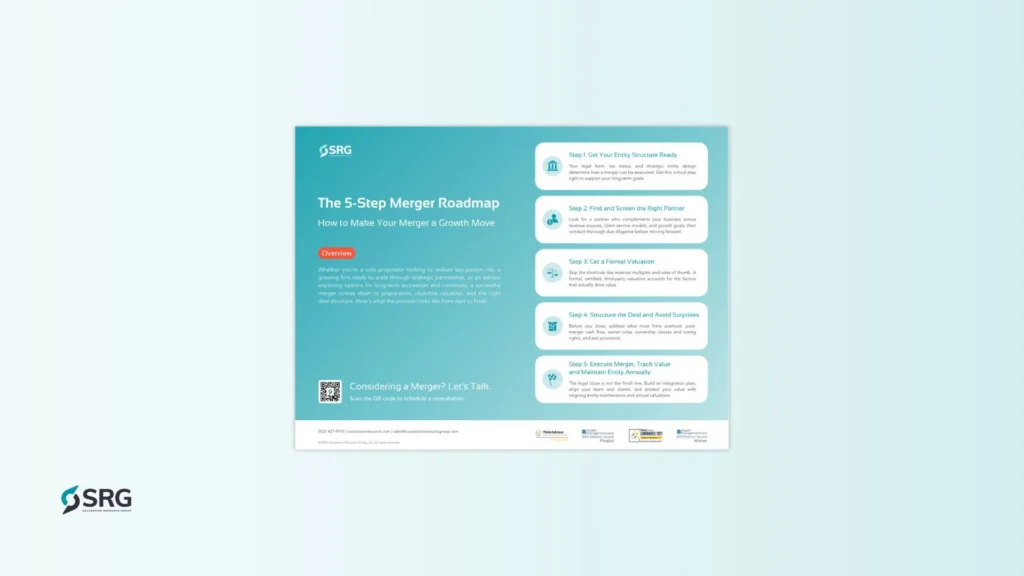
The 5-Step Merger Roadmap for Advisory Firms Considering a merger but not sure where to start? This free infographic breaks down the five steps every advisory firm should follow — from strategic entity preparation to post-merger integration. Based on insights from SRG’s Stronger Together webinar with Nicole Frey, CFP® and Ryan Grau, CVA, CBA, it’s a practical, one-page reference you can keep on hand as you explore your options. Please enable JavaScript in your browser to complete this form.Please enable JavaScript in your browser to complete this form. Name * FirstLast Phone Work Email *How Did You Hear About SRG? *— Select Choice —ConferenceDirect MailExisting/Past ClientGoogle AdWordsOtherReferralSocial MediaSeminar/WorkshopWebinarWebsite Download
What to Expect from M&A in 2026 (Ep. 32)
What to Expect from M&A in 2026 Valuations are at record highs, private equity is changing the game, and deal structures look nothing like they did five years ago. In this episode of The Fine Print, David Grau Jr. digs into the real numbers from 2025 and breaks down what they mean for advisors navigating M&A in 2026. Show Notes RIA valuations continue climbing. Revenue multiples averaged 3.27x in 2025, with 38% of deals closing above 3.5x. EBITDA multiples have reached nearly 10x. But higher valuations are coming with different terms than the industry is used to. Higher profits do not always mean higher multiples. Firms with 45-50% margins often get lower multiples (6-7x EBITDA) because those margins signal underinvestment. The firms earning 11-13x are the ones reinvesting in staff, capacity, and growth — even though their margins sit closer to 25-30%. Private equity is moving downstream. PE-backed aggregators are now making offers to firms doing as little as $2 million in revenue. The typical deal structure: 40% cash at close, 30% performance-based payments (tied to 10-20% CAGR targets), and 30% rolled equity in the aggregator. The headline multiple is not the whole story. A 12x or 13x offer from PE sounds compelling, but only about 40% arrives as cash at closing. The rolled equity may be illiquid and aggressively valued. The real question: five years post-closing, did you actually come out ahead? Internal equity sales hit record highs. Nearly a third of all transactions in 2025 were internal fractional sales — up from single digits historically. Financing was split roughly 50/50 between seller-financed and externally financed deals. Phantom equity is surging. Stock appreciation rights (SARs) and liquidation rights are becoming mainstream succession tools, even for firms as small as $2 million in revenue. They help attract and retain talent, seed the next generation with economic value, and make future partners more bankable when it comes time to buy in. Compensation models are shifting. Larger advisory enterprises are moving away from grid-based payouts toward base-salary-plus-bonus structures that better fit service-oriented teams. Deal volume is expected to rise. Elevated multiples and increased PE activity are pulling more advisors off the fence. If you are a buyer, get your house in order. If you are a seller, treat your business like a home going on the market — make sure the curb appeal is there. Hosted By David Grau Jr., MBA (Founder / CEO)
SRG’s Ensemble Process for Northwestern Mutual Teams
A step-by-step guide to forming a structured, scalable ensemble practice within Northwestern Mutual. This resource outlines SRG’s four-phase process, covering independent practice valuations, ownership and compensation strategy, legal documentation, and implementation, designed to help NM advisor teams move from individual practices to a formally structured ensemble with defensible equity, clear roles, and governing agreements in place. Please enable JavaScript in your browser to complete this form.Please enable JavaScript in your browser to complete this form. Name * FirstLast Phone Work Email *How Did You Hear About SRG? *— Select Choice —ConferenceDirect MailExisting/Past ClientGoogle AdWordsOtherReferralSocial MediaSeminar/WorkshopWebinarWebsite Download
Mergers and Acquisitions 101: M&A for Financial Advisors

Last Updated: August 25, 2026 Originally Published on November 18, 2020 Author What Exactly Is M&A? The term “mergers and acquisitions” (M&A) broadly refers to the process of one company combining with another; however, the method and legality of how these terms are processed are slightly different. Mergers occur when two organizations join together, and both parties remain active and involved on an ongoing basis. This can be done by subsequently forming a new legal entity under a single corporate name, or more simply by an existing advisor joining forces with a peer and contributing his or her book of business in exchange for a proportional share of value in the receiving party’s business. In many cases, mergers occur between two entities of approximately the same size. This allows the two organizations to combine forces and market share instead of directly competing against each other. For instance, in 2015 H.J. Heinz Company and Kraft Foods merged together to establish themselves as one of the largest food and drink companies in the world. After merging, their new business entity was named The Kraft Heinz Company. While this is obviously a much larger transaction, it is indicative of why many advisors consider merging. Acquisitions, on the other hand, are when one company purchases another entity outright and establishes itself as the new owner. This can come in the form of buying another advisor’s book of business (an asset purchase) or alternatively, buying the exiting advisor’s equity in their business. Legally, the target advisor that was acquired no longer exists, but its brand (name, website, logo, phone number, etc.) may still remain post-sale to ensure the retention of clients. An example of this is when Morgan Stanley MS acquired E*TRADE Financial in 2020 in an all-stock deal worth $13 billion. This effectively solidified Morgan Stanley amongst the leaders in the wealth management industry and gave them more technology assets, customers, and recurring revenue streams. There are a multitude of transaction structures for mergers and acquisitions. A merger may provide each advisor with partial ownership and control of the newly merged organization. Compare that with an acquisition, which results in the selling advisor being retained for a period, but usually as an employee or contractor of the acquiring firm. The lines between merger and acquisition terminology are often blurred in public-facing communications because the goal is to ensure there is a seamless transition from the client’s perspective. Who Deals With Mergers and Acquisitions? The responsibility of who manages the merger and acquisition process may vary depending on the size of the companies involved and their experience with such activities. But, it is a good idea to ensure you have a neutral intermediary, or buy and sell-side representation to usher the deal towards close and ensure all the moving pieces are being managed and discussed. It is also common to have the assistance of external counsel, such as lawyers and accountants, to conduct a final review of the transaction and documents. It is important to ensure that as the owner buying, selling, or merging, that you actively manage your external professional counsel and set clear expectations. This is critical to ensure you don’t spend weeks working with an intermediary and craft a well thought out strategy, only to have your counsel review and begin renegotiating on your behalf, resulting in you losing a deal. Attorneys and CPAs are tremendous resources, but it is most effective to ensure you have a knowledgeable industry expert who works with mergers and acquisitions daily to help the parties make fully informed decisions and avoid reinventing the wheel. Why Do Advisors Merge and Buy/Sell? The reasons for companies pursuing mergers or acquisitions will vary, but most are motivated by improving long-term prospects and potential for their business. Factors to consider when pursuing a merger or acquisition may include the ability to create a competitive advantage, diversify the customer base, expand service offerings, reduce operating costs, expand to new geographies, increase capabilities and assets, and more. In many cases, the reason to move forward with a deal would be a combination of several factors. Here are some of the most common motivations for moving forward with a merger or acquisition: Growth: Mergers and acquisitions can be a shortcut of sorts, allowing a business to expand its operations effectively overnight. Whether looking to merge or acquire strategically (expanding new service offerings for example through a merger or purchase) or economically (merging or acquiring a firm that will add more of the same type of revenue), mergers and acquisitions can quickly increase market share. Eliminate Competition: By merging with or acquiring a target company that is a competitor in an industry, a business can effectively increase their market share and potential customer base. Synergies: Mergers or acquisitions of a complementary business allows companies to combine their strengths, business activities, and differentiators to bolster their offerings and potentially lower costs. How Long Does an Acquisition Take? The acquisition process is detailed and complex; it requires many steps along the way. While each deal is different, acquisitions can often take anywhere from a few weeks (in a best-case scenario) to several months to complete. Much of the timing relies on how well both parties are aligned and how efficiently they are able to work together to move the process along. There are several factors that can impact the timeline of any given acquisition: Decisiveness: The decision-making process can take time. Each owner involved in the transaction wants to have full confidence that this is the best move to make, that the deal is fairly priced, and that there are no better options available. If there is hesitation on either side of the deal, more time and research will likely be needed to help it progress. Complexity: The transaction timeline can be impacted depending on if the target company is generally similar or different to the acquiring company, and also the level of complexity in the business structure of the company being acquired. Management: Willingness
2026 Advisor M&A Highlights Infographic
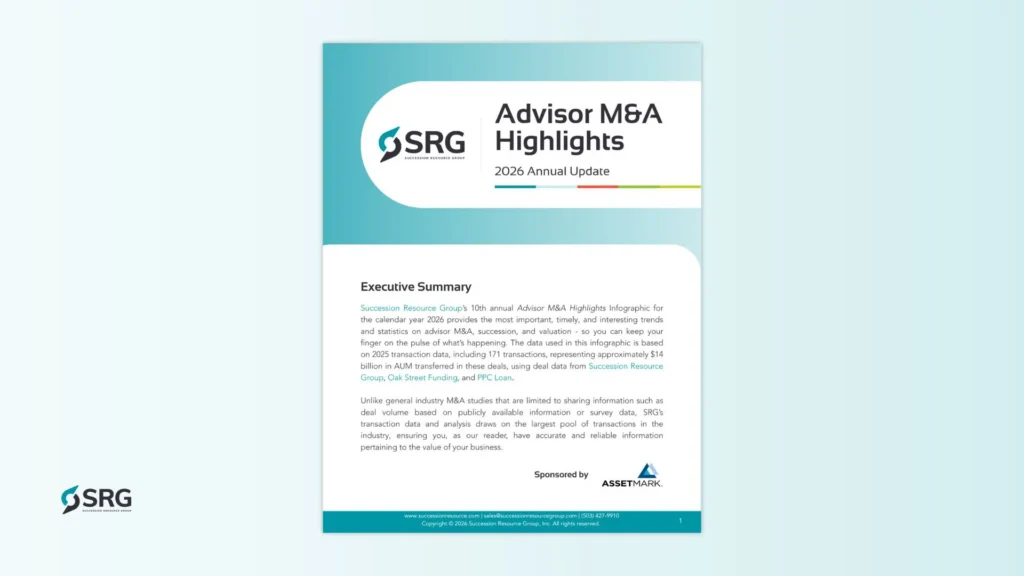
Webinar Recordings Download the Infographic Please enable JavaScript in your browser to complete this form.Please enable JavaScript in your browser to complete this form.First Name *Last Name *Phone * Work Email * Would you like to join SRG's newsletter to receive industry updates and other webinar opportunities? Yes No Download 2026 Advisor M&A Market Insights: What Actually Happened in Advisor M&A Powered by SRG’s 10th annual review of completed M&A transactions, this report distills what actually happened in the advisor M&A market into clear, decision-ready insights for RIAs and financial advisors. Built on one of the industry’s most comprehensive datasets of verified, closed transactions, the report highlights where valuations are trending, what buyers are prioritizing, and how deal structures are evolving. It also breaks down the valuation metrics advisors care about most, including revenue multiples versus EBITDA multiples, and explains when each applies based on business model, size, profitability, and growth profile. Beyond valuation benchmarks, the report explores the deal terms that ultimately determine what sellers take home, including cash at close, seller financing, contingencies, and other structural components that influence real outcomes. Whether you are preparing to build value, buy, sell, or accelerate growth, these insights provide practical benchmarks to help you position your business for stronger results in today’s market. Sponsored by Data Contributors Share: Related Content Sign Up to Our Newsletter Copyright This resource provided by Succession Resource Group, Inc. (“Provider”) is intended solely for informational purposes and general guidance on a variety of situations and may not be suitable for all advisors. This resource is provided “AS IS” and “AS AVAILABLE,” without warranty of any kind, express or implied, including but not limited to warranties of merchantability, fitness for a particular purpose, non-infringement, accuracy, completeness, or reliability, and should not be relied upon as legal, tax, financial, investment, or other professional advice. Provider makes no representation that the information is current, complete, or applicable to any particular situation. This resource cannot and does not account for the unique circumstances of each specific situation and must be reviewed by your own independent attorney, CPA, and other relevant professional advisors prior to beginning any due diligence process or taking any action in reliance on this resource. You expressly acknowledge and agree that no attorney-client relationship, fiduciary relationship, advisory relationship, or any other professional relationship of any kind is created, intended, or implied through the provision, access to, or use of this resource, and that Provider owes no duty of care or professional obligation to User. Succession Resource Group, Inc. and its affiliates, officers, directors, employees, agents, contractors, licensors, and representatives (collectively, “Provider Parties”) make no claims, promises, representations, or guarantees whatsoever, whether express or implied, regarding the accuracy, completeness, timeliness, reliability, suitability, adequacy, currentness, or fitness for any particular purpose of the information contained herein, and expressly disclaim all such warranties and representations to the maximum extent permitted by applicable law. Provider Parties specifically disclaim any warranty that the resource will meet User’s requirements, be uninterrupted, timely, secure, or error-free. Nothing in this resource should be construed as a recommendation. By accessing, downloading, or utilizing these materials in any manner, you: (i) assume full responsibility for any loss, damage, liability, cost, or expense (including reasonable attorneys’ fees, paralegal fees, expert witness fees, court costs, and all other costs and expenses of litigation or dispute resolution) resulting from or in any way connected to the access to, use of, reliance upon, or inability to use, this resource; and (ii) release, waive, defend, indemnify and hold harmless Succession Resource Group, Inc., its affiliates, officers, directors, employees, authors, contributors, agents, licensees, successors, and assigns from any and all known or unknown claims, demands, damages, losses, liabilities, costs, or causes of action that may arise, at any time, out of or relating to your use of or reliance upon this resource.
2026 Advisor M&A Review
Webinar Recordings Watch the Webinar Replay 2026 Advisor M&A Market Insights: What Actually Happened in Advisor M&A Powered by SRG’s 10th annual review of completed M&A transactions, our Flagship webinar distills what actually happened in the market into clear, decision-ready benchmarks for RIAs and financial advisory firms. Built on the industry’s most comprehensive dataset of verified, closed transactions, this session delivers highly accurate valuation benchmarks and deal insights that go far beyond self-reported surveys. You will learn what is driving multiples, where buyer demand is strongest, and how terms are shifting as the market evolves. We will also break down the valuation metrics advisors care about most, including revenue multiples versus EBITDA multiples, and explain when each applies based on business model, size, profitability, and growth profile. Valuation is only part of the story. This webinar also dives into the deal structures that determine what sellers actually take home, including cash at close, seller notes, and other components that can significantly impact real outcomes. You will leave with clarity on what buyers are prioritizing, what quality firms are commanding in today’s market, and how to position your business for a stronger result. Led by David Grau, Jr. MBA (CEO) and Parker Finot (Director of Transaction Advisor Services), this is a data-backed, practical session designed to help you make smarter decisions with more confidence. Whether you are preparing to build value, buy, sell, or accelerate growth, this will be one of the most actionable hours you can invest in your 2026 planning. Get the Presentation Deck Download Download the Infographic Please enable JavaScript in your browser to complete this form.Please enable JavaScript in your browser to complete this form.First Name *Last Name *Phone * Work Email * Would you like to join SRG's newsletter to receive industry updates and other webinar opportunities? Yes No Download Speakers Host David Grau Jr. MBA CEO/President Paper-plane Linkedin-in Host Parker Finot Director of Transaction Advisory Services Paper-plane Linkedin-in Sponsored by Data Contributors Transcript 100:00:06.580 –> 00:00:25.530David Grau: All right. Good afternoon, everybody. Welcome to Succession Resource Group’s 10th Annual 2026… well, it’s not the 10th annual 2026 review, but it’s our 10th annual review of the M&A data. This is our 2026 edition. Really excited to have you join us here today. We… 200:00:26.020 –> 00:00:45.119David Grau: we like being able to pause in January, aggregate all the deal data, all the succession data, everything that we have seen happening in the prior year, and try to feed that back to you, us, as an industry, just to be able to keep our collective fingers on the pulse of what’s happening out there for buying and selling practices. 300:00:45.310 –> 00:00:58.569David Grau: This is probably not your first rodeo, I know there’s a bunch of you that join us every year for this, as well as listen to us occasionally at the custodial, broker-dealer conferences, FPA meetings around the country throughout the year. 400:00:58.740 –> 00:01:09.049David Grau: We want to try to help you stay abreast of this, because at the end of the day, big firm, small firm, RIA, duly registered, whatever the label is that you are wearing today. 500:01:09.490 –> 00:01:25.569David Grau: Your business, your advisory practice, is probably your most valuable asset, and we want to make sure, whether you’ve done a valuation or not, you can at least have a number next to it on your personal balance sheet, because it has such substantial value, and frankly, today, it’s harder to understand than ever before. 600:01:25.940 –> 00:01:41.339David Grau: Right? You read the trade publications, the press releases out there about deals, it’s enough to make your head spin. So, we’re gonna try to share that data with you here today, but also carve out time to answer your questions, which hopefully you either A showed up with some, or B, 700:01:41.410 –> 00:01:45.949David Grau: We’re going to prompt some, just organically, as we progress through the slides here today. So. 800:01:46.730 –> 00:01:50.170David Grau: Couple boring administrative things to knock out first. 900:01:50.610 –> 00:01:55.019David Grau: The housekeeping items… Watch the chat. 1000:01:55.020 –> 00:02:15.710David Grau: There’s a chat feature in here. Granted, it’s a one-way chat feature, but there you go, see? There’s information that will be dropping in there for you, so it should be helpful. Use the Q&A feature. There’s a Q&A panel here, I promise you, we will actively watch it. If you have technical issues, that won’t be Parker and I, we’ve got Guy here, our amazing moderator, that will help with that stuff, but if you have questions. 1100:02:15.780 –> 00:02:17.830David Grau: As we progress through the slides. 1200:02:18.410 –> 00:02:30.529David Grau: We will make sure we either answer them organically as we progress, because Parker and I will be watching the Q&A panel, or we’ll answer it towards the end, because we are planning to reserve 15-20 minutes for that specifically. So… 1300:02:30.530 –> 00:02:40.079David Grau: Beyond that, there is a poll question we’re gonna pop up. This just helps us have a better idea, better understanding of you as our audience, where you’re at. 1400:02:40.080 –> 00:02:48.589David Grau: what’s relevant and interesting to you, so you’ll see that pop up here momentarily. We’ll take it down, and won’t get in the way. You know, Zoom, presumably, it’s off to the side. 1500:02:48.890 –> 00:03:01.649David Grau: So, you’ll see the poll question pop up, case in point. So there’s a poll question, if you would participate, that would be lovely. If you don’t, we’ll just leave it up forever. So, a couple other easy ones. We always get questions on slide availability. 1600:03:01.680 –> 00:03:11.309David Grau: These slides are available. Our team will be reaching out to you after we get done with the session here today, either tomorrow or certainly early next week, if you want a copy of the slides. 1700:03:11.440 –> 00:03:17.069David Grau: Just let Craig, Sabrina, Nikki, and our team know, and they will happily share them