
Carson Group Hires Former Envestnet Executive as CTO
March 10, 2025 Ramesh Vaswani will take over as Carson Group CTO, which has been run by a technology council for the past year and a half. Carson Group, the mega-RIA based in Omaha, Neb., has snagged a senior-level Envestnet executive to run its technology operations after it had been overseen by a “technology council” over the past couple of years. Ramesh Vaswani had been the global group head of engineering, overseeing a team of more than 250 people and reporting directly to Envestnet CTO Robert Coppola. Now, he’ll be joining the $41 billion Carson Group to develop and executive technology strategy across its network of roughly 50 advisor offices and 150 partnered advisories through Carson Partners, its RIA channel, the firm announced Monday. Vaswani is the second senior executive from Envestnet Carson has hired in the past two years. In April 2024, the firm hired former Envestnet chief strategy officer Dani Fava to take the same role at Carson Group, replacing now-CEO Burt White. While Vaswani’s CTO role is not new, he will be the first sole leader of tech operations in about a year and a half. Carson’s first-ever CTO, Nimesh Patel, was hired in 2022 but left in the summer of 2023 for RIA Corient in a move that Carson described as a “mutual separation.” Since then, the firm’s technology capabilities have been run by a four-person “technology council.” Now, Carson execs have decided they’d like a CTO leader to help give its advisors and advisor network access to the best wealth management technology and ensure recruiting competitiveness. “Our mission is first and foremost to create ease and confidence for advisors, and we are building a tech stack and broader technology strategy with that mission at its core,” Fava said via email. “We want to be known as a curator and integrator of the best technology solutions to support our advisors and our technology strategy is designed to do just this.” She added that Vaswani’s career has been focused on “aligning technology goals with business goals for financial institutions, and he has a proven track record of turning those ideas into reality.” David Grau, founder and CEO of advisor consultancy Succession Resource Group, said Carson is a firm that seems to have managed leadership succession planning well, including last year when founder Ron Carson stepped down to be replaced by then-managing partner and chief strategy officer White. Having smooth leadership exchanges is “so impactful to the culture and operations of the firm, and their ability to continue recruiting,” Grau said. “All of those roles require proactive succession planning, especially at a firm of Carson’s size.” Vaswani is leaving an organization going through its own transformation. Envestnet, one of the industry’s largest technology providers, was taken private last year through an acquisition led by Bain Capital. Vaswani had been with Envestnet for over nine years. As group head, he oversaw a team of developers, architects, and analysts focused on automation and efficiency projects, including the adoption of artificial intelligence. In a statement, Vaswani said of the move to Carson: “I’m passionate about aligning business and technology to drive results and I see an incredible opportunity to integrate technology in a way that promotes growth and creates ease and confidence for our advisors.” Former Carson CTO Patel has since moved on to the technology-focused custodian Altruist. In February, tech-focused RIA Savvy Wealth, which recently topped $1 billion in AUM, hired its first CTO with Eric Hurkman, formerly of valuation software firm Carta. Disclaimer This article was first published by Alex Ortolani. The original article can be found here. All rights to the original content are held by wealthmanagement.com.
Wealth management’s evolving take on ‘location, location, location’
February 28, 2025 Wealth management’s geographic landscape is shifting from big cities to the entire country, according to one of the industry’s top dealmakers. Despite the higher shares of population and wealth that drive the number of financial advisors, asset levels and property values in places like New York, California and Florida and other big metropolitan areas, the traditional and simple industry emphasis on cities that have National Football League teams is falling by the wayside, said Jim Cahn, the chair of the Investment Committee and chief strategy officer with Wealth Enhancement. The private equity-backed, Plymouth, Minnesota-based acquirer of registered investment advisory firms has topped $96 billion in client assets while altering its approach to the geographic factors in dealmaking and new client lead generation in particular regions, Cahn said in an interview. “We went to Chicago first, and we also had concentrations on the East Coast, because that’s where there were concentrations of people,” he said. “There are wealth management clients in all parts of the country. You have a lot more advisors, but you also have a lot more people who need advisors. The truth is, there really isn’t a bad market.” However, the location of an advisory firm is one of many factors driving how much potential buyers are willing to pay to acquire it, according to a webinar held last month by M&A consultancy Succession Resource Group on its annual study of RIA transactions. Regional variance in RIA M&A deal prices, 2020-2024 Source: “The Succession Resource Group 2025 Advisor M&A Report” Out-of-state buyers carried out a third of transactions last year, which is a larger share than in 2023, and they paid purchase prices that were 11% higher than the amount forked over by those from the same state. The out-of-state premium was even larger, at 16%, in deals struck between 2020 and 2024, Parker Finot, Succession Resource‘s director of transaction advisory services, noted during the webinar. During that span, RIAs in the Northeast fetched the highest average price multiple compared to yearly revenue, 3.09x, followed by the South (3.07x), the West (2.9x) and the Midwest (2.7x). “We have observed some shifting in a reduction to southern multiples over time, and the multiples of the West and the Midwest regions increasing over time,” Finot said. “That out-of- state price premium does still exist during this time frame. In fact, it was elevated to compared to what we’ve seen in 2024, and we’ve really determined that that was driven by higher price asymmetry in ’21 and ’22 during that period of time when the world was really reacting and acclimating to the post-pandemic reality, working from home, office closures, all of those types of things. There was just a little bit more fervor for these remote acquisitions. But it’s cooled slightly since then.” Regardless, those figures reflected “a broad brush, and individual results are going to vary from across the region, state, county and city levels,” Finot said. How housing data can shed a light on RIA growth A ranking of metropolitan areas with the largest number of homes of above average value per square mile might, then, offer a more precise geographic lens for potential RIA acquisitions or prospective customers. Using data from real estate databases, luxury bathroom product firm Badeloft found last month that Miami had more than double the number of high-value homes per square mile than any other metro area, with 105.44. The other cities in the top 10 — New York (38.03), Las Vegas (26.08), Philadelphia (23.93), Washington, D.C. (17.93), Boston (14.42), San Antonio (14), Detroit (13), Chicago (12.12) and Honolulu (12.08) — had far fewer. Beyond the property-tax ramifications to client’s plans and an understanding of local real estate dynamics, the value of an area’s housing stock won’t sway wealth management dealmakers very much or offer advisors many hints about where to approach prospective customers, Cahn said. Perhaps using publicly available data tracking a home’s value compared to the size of the mortgage could suggest some trends relevant to finding out which households have a large number of savings and investable assets, he suggested. The high property values in an area like Miami may also come with high rates of foreclosure in the bursting of a real estate bubble. And Wealth Enhancement’s clients tend to focus much more on their families, careers, emotional state and involvement in their communities than on buying a pricey home, Cahn said. “How people live doesn’t tell you as much about their investable assets as you might expect,” he said. “For the types of wealth management clients that we’re serving, I don’t think we can rely on a sort of mansion index.” The exurban trend in wealth management On the other hand, Cahn has noticed more deals involving advisory practices from exurban areas and those with local and regional expertise that are sought by clients. For example, Wealth Enhancement’s vast and growing network of independent advisory teams include at least a couple catering to Mandarin speakers in parts of California and Texas, and he recalled how a radio show that was successful in generating new customer leads in Minnesota “didn’t have the outcomes we expected” in Connecticut. The exurban trend extends to areas that are about a two to four hours’ drive from cities like Atlanta or regions such as upstate New York and Charleston, West Virginia that “still identify with the city, but they also have their own identity,” he said. The residents likely root for the city’s NFL team and tell those from outside of the area that they’re from there. Some of those parts of the country are “maybe a little underserved, or have smaller firms that don’t have the depth of resources that we have,” Cahn said. “Understanding your community, understanding how to market your community,” is a critical part of advisors’ value to clients and possible acquisition partners alike, he said. “Being part of the community — not just someone who uses the community — is really critical.” Disclaimer This article was first published by Tobias Salinger. The original article can be found here. All rights to the
Putting Your Equity to Work

Watch the Replay Related Resources 2025 Advisor M&A ReportCheck Out our Press Release→ The Why Who & How of Equity SharingCheck Out the eBook→ 12 Key Reasons to Assess Your Practice’s Value Annually Read the Article → Carrot and the StickListen to this Podcast→ Grab A Valuation We offer a variety of solutions and turnaround times to fit your needs. Join myCompass Our membership club grants you inside tips and opportunities to grow. Review our Seller Services We’re here to ensure you secure the best buyer, price and terms.
12 Key Reasons to Assess Your Practice’s Value Annually

An RIA firm owner’s roadmap to increasing your firm’s value in a sustainable way that enhance your firm’s market value now and in the long-run. Succession Resource Group shares six ways firms can carve a path towards smarter growth, identifying levers for better business decisions that retain talented employees as well as ideal profit margins.
Trust Isn’t a Strategy: Protecting Your Practice and Unlocking Growth with Employment Agreements

An RIA firm owner’s roadmap to increasing your firm’s value in a sustainable way that enhance your firm’s market value now and in the long-run. Succession Resource Group shares six ways firms can carve a path towards smarter growth, identifying levers for better business decisions that retain talented employees as well as ideal profit margins.
5 Reasons Why Business Owners Avoid Formal Employment Agreements

Based on SRG’s recent survey of over 500 financial service businesses—ranging from small single-owner practices to larger multi-owner firms—we uncovered a surprising vulnerability: 17% reported having formal employment agreements in place, while 83% admitted they did not. If your business falls into the latter category, you may be exposing yourself to unnecessary risks and potentially diminishing the value of your firm. Why Employment Agreements Matter Your employees are the driving force behind your success and play a critical role in the long-term viability of any succession or growth strategy. Without proper agreements in place, your business could face challenges in protecting its interests and maintaining stability. Employment agreements help define expectations, protect confidential information, and secure the foundation of your firm’s future. If you currently lack formal agreements or believe yours could be improved, Succession Resource Group can help. We provide essential employment resources to guide you in implementing best practices for team development while safeguarding your business. Why Business Owners Avoid Formal Employment Agreements Informality and Trust: Small practices often rely on close-knit, informal environments. Employers may trust that mutual understanding negates the need for formal agreements. Cost and Complexity: Agreements are seen as costly and administratively burdensome. Lack of Awareness: Many owners are unaware of the benefits formal agreements can provide. Preference for Flexibility: Verbal or informal agreements feel more adaptable to changing needs. Short-Term Roles: Part-time or temporary roles may not seem to warrant a full employment agreement. Protecting Your Business with Formal Agreements Formal agreements set clear expectations for roles and responsibilities, outline behavioral standards, and align employees with your company’s mission and vision. They also protect intellectual property, ensure client confidentiality, and provide a critical layer of security for your business. Don’t leave your firm exposed. Let Succession Resource Group equip you with the tools to build a secure foundation for your team and your future success.
2025 Advisor M&A Review
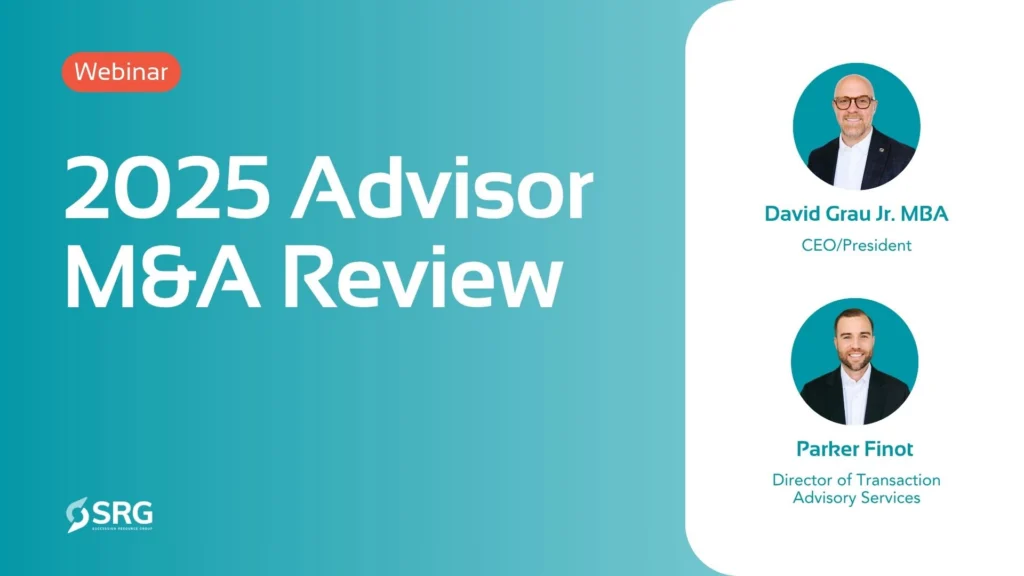
Watch the Webinar Replay 2026 Advisor M&A Market Insights: What Actually Happened in Advisor M&A In its 9th annual Advisor M&A Review, Succession Resource Group breaks down what actually happened in mergers, acquisitions, and succession planning across the financial advisory industry. The session draws on the industry’s most comprehensive dataset of 176 verified, closed transactions, along with a succession survey of 301 firm owners, to deliver decision-ready benchmarks that go well beyond self-reported figures. Viewers will learn where recurring revenue and EBITDA multiples landed, how those multiples vary by region, and why sellers who use open-market advocacy tend to command higher prices and stronger terms. David Grau, Jr., MBA and Parker Finot also unpack the deal structures that determine what sellers actually take home, including down payments, seller financing, retention clauses, and lender holdbacks. The review closes with SRG’s predictions for the year ahead, covering succession readiness, buyer competition, and the continued shift toward team-based compensation. Whether you are preparing to grow, buy, sell, or plan an internal succession, this recording offers a data-backed view of the market to help inform your next move. Host David Grau Jr. MBA CEO/President Paper-plane Linkedin-in Host Parker Finot Director of Transaction Advisory Services Paper-plane Linkedin-in Data Contributors
How to Land a Great Successor for your RIA

An RIA firm owner’s roadmap to increasing your firm’s value in a sustainable way that enhance your firm’s market value now and in the long-run. Succession Resource Group shares six ways firms can carve a path towards smarter growth, identifying levers for better business decisions that retain talented employees as well as ideal profit margins.
How to find the right RIA successor
January 9, 2025 Finding the successor to a financial advisor’s practice requires a complicated mix of the right personality, skills, capital, compensation and — most importantly — time, experts said. The consensus for an adequate number of years to ensure a healthy transition among succession-savvy advisors and M&A experts interviewed by Financial Planning amounted to about five, or even longer when taking into account the difficulties of picking the successor. That’s why more registered investment advisory firms and wealth management companies of all types are devoting resources to developing their talent in-house rather than recruiting it. “This is a big challenge for our industry. The other big challenge for our industry is attracting talent into our industry. So succession planning is key,” said Pradeep Jayaraman, president of Bluespring Wealth Partners, the RIA M&A arm of Austin, Texas-based wealth management firm Kestra Holdings. Jayaraman joined the firm in September after prior tenures with Focus Financial Partners and Goldman Sachs. New tactics for a familiar problem Estimates that more than 100,000 advisors comprising more than a third of the industry’s ranks will retire over the next decade are prompting more firms to consider how they can find successors or carry out M&A deals that lay out the future of their businesses when they’re gone. Besides the structure of the transaction, the thorny and often emotional process for advisors to step down from a business they’ve built over decades and the necessity of capital financing, the choice of the right successor looms as one of the most important questions for all plans and one with massive stakes for client retention. “There’s a lot of succession that’s going to continue to happen across the industry,” said Kris Carroll, a managing director in the Carolinas region of Plymouth, Minnesota-based RIA aggregator Wealth Enhancement Group. In addition to being an adjunct professor at Winthrop University and a second-generation advisor, Carroll has led in-house training efforts at the firm through its “Wealth Enhancement Group University” and a current role coaching practice founders on their succession planning. “The best thing and the thing people need to hear over and over again is, just because you’re not ready to retire doesn’t mean you shouldn’t be thinking about it,” he said. “It’s so interesting that we help other people retire all the time and yet don’t think about the finer points of our own retirements.” To that end, the best time for advisors to begin thinking about their successor isn’t right when they launch their firm — but probably “shortly thereafter,” according to David Grau, founder and CEO of M&A and succession consulting firm Succession Resource Group. Grau also frequently reminds advisors that “you can’t just go recruit it and find a mini-me” to get their successor, he said. In fact, advisory practices that have reached $2 million in revenue or above usually need at least two or even three specialists in particular areas rather than one successor. That means that they should think in terms of a career track similar to those of accounting and law firms and seek interns directly from local colleges who can grow into those roles over time. The next generation of advisors and wealth management professionals “want something to believe in, something to buy into literally and figuratively,” Grau said. In that vein, equity-based compensation can retain advisors for longer-term careers with the firm. The last five years have seen “mass adoption of phantom or synthetic equity plans” aiding founders and successors in addressing a key financial challenge: less-tenured advisors don’t usually have the capital on hand to buy an advisory practice and their more experienced counterparts are often wary at the thought of handing over their firms, Grau said. Deferred compensation based on the value of the company reduces the obligation to get outside capital. “As the firm grows in value they can capture a small portion of that,” Grau said. “They’ve got the ability to buy a little bit of equity or have a down payment without having to pull out of their personal savings.” Lessons from the field Some founders no longer have enough time to work with to set up a successor in that way, though. About nine months ago, a sole practitioner working with 220 client households and about $80 million in assets under management had agreed to a succession deal with Fairfield, New Jersey-based advisory practice U.S. Financial Services. It’s one of 25 advisory practices owned by Bluespring, and the firm has picked two junior partners as its successors while acquiring two other books of business in the past five years, according to U.S. Financial Partner and Managing Director Steven Gallo. Its most recent succession deal presented challenges. “He had an administrative assistant and no other staff,” Gallo continued. “Unfortunately, just as we were getting ready to close the deal, he suddenly passed away. Taking over a practice without the retiring advisor available is an extremely difficult process. Still, we have been able to retain 95% of the clients to date, and we believe that we will continue to grow this practice as we can offer many additional benefits and services to these clients.” Ideally, the outgoing advisors ought to expect a runway of two to three years after the deal — but not much more than that, according to Jayaraman. On the one hand, they’ll want to be introducing the clients to their successor as a way of “being very thoughtful about this on a post-transaction basis and not just saying, ‘OK, I sold my business,’ and checking out,” he said. On the other, founders who wait too long to leave their firms and don’t delegate enough on their way out are falling into what Jayaraman views as the two biggest pitfalls in succession. To smooth the process of going from the first generation to the second (or from “G1” to “G2” as industry experts refer to it), Bluespring has created a “successor academy,” which is a two-year program for about eight to 12 advisors from across its firms who learn together through case studies, coaching sessions, webinars and other content. “Sitting where we are, we do get a good sense of what’s working and what’s not and we’re
Selling My RIA: How I Found Peace Of Mind In the Process
An RIA firm owner’s roadmap to increasing your firm’s value in a sustainable way that enhance your firm’s market value now and in the long-run. Succession Resource Group shares six ways firms can carve a path towards smarter growth, identifying levers for better business decisions that retain talented employees as well as ideal profit margins.