
What’s the Deal with PE and Aggregators! (Ep. 23)
Watch the Replay Related Resources 2025 Advisor M&A Report Check Out our Press Release→ Succession Readiness Checklist Check Out the Checklist→ Selling Your Practice with Expert Advocacy Watch the Replay → Grab A Valuation We offer a variety of solutions and turnaround times to fit your needs. Join myCompass Our membership club grants you inside tips and opportunities to grow. Review our Seller Services We’re here to ensure you secure the best buyer, price and terms.
Breaking the Cycle | Compensation Strategies That Protect Value & Drive Growth
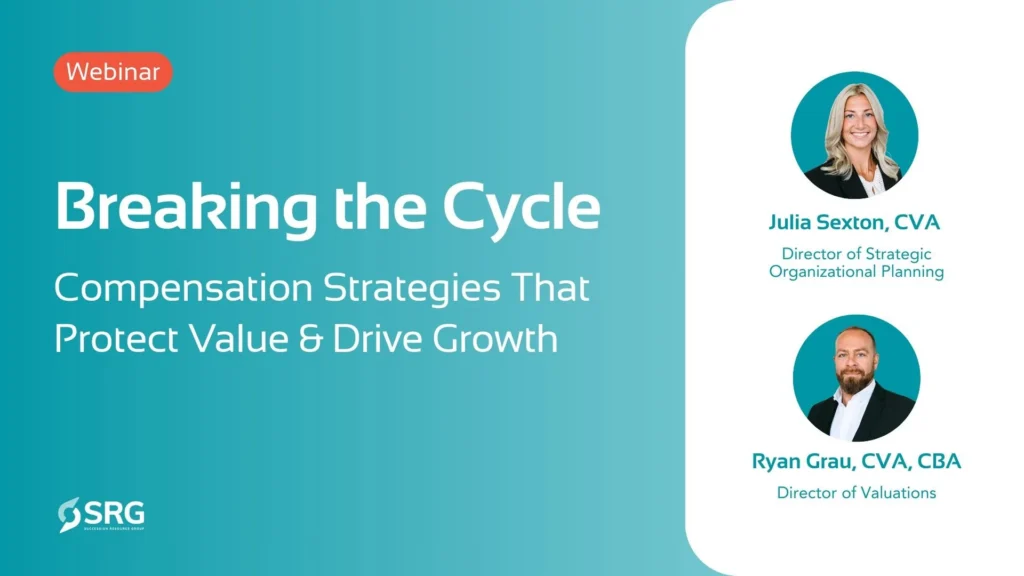
Valuation expert Ryan Grau, CVA, CBA, and compensation strategist Julia Sexton, CVA, reveal the most common comp mistakes—and how to fix them. Learn how to build pay models that drive growth, retain talent, and preserve business value. Watch the Replay Host Julia Sexton, CVA Director of Strategic Organizational Planning Paper-plane Linkedin-in Host Ryan Grau, CVA, CBA Director of Valuations Paper-plane Linkedin-in
5 Must Have Items for Your Equity Grant Plan

Granting equity is one of the most impactful — and complex — decisions a business owner can make. SRG’s “Top 5 Must-Have Items in Your Equity Grant Plan” infographic outlines the essential elements every advisor should include to protect, structure, and maximize their firm’s value. From corporate authorization and valuation to vesting terms and share class, this guide simplifies a process that can otherwise be overwhelming. Whether you’re granting equity for the first time or refining your existing plan, this resource ensures you’re covering every critical detail. Download the infographic today to learn how to build a strong, compliant equity plan that supports growth, rewards key talent, and safeguards your firm’s future. Please enable JavaScript in your browser to complete this form.Please enable JavaScript in your browser to complete this form. Name * FirstLast Phone Work Email *How Did You Hear About SRG? *— Select Choice —ConferenceDirect MailExisting/Past ClientGoogle AdWordsOtherReferralSocial MediaSeminar/WorkshopWebinarWebsite Download
Executing A Successful Internal Succession Plan In The Private Equity Era Of Advisor M&A

Watch the Replay Related Resources 2025 Advisor M&A Report Check Out our Press Release→ Succession Readiness Checklist Check Out the Checklist→ Selling Your Practice with Expert Advocacy Watch the Replay → Grab A Valuation We offer a variety of solutions and turnaround times to fit your needs. Join myCompass Our membership club grants you inside tips and opportunities to grow. Review our Seller Services We’re here to ensure you secure the best buyer, price and terms.
Webinar Questions
Have questions about the upcoming webinar? We encourage you to share your thoughts, ideas, or any questions you have ahead of time! Whether you’re curious about the topic, looking for more in-depth insights, or just seeking clarity on something specific, we want to hear from you. During the live event, we’ll do our best to address as many questions as possible. Our goal is to make the session as interactive and informative as possible. However, if we can’t get to your question during the webinar, don’t worry—we’ll make sure to follow up with you personally via email afterward. Your input helps us make our webinars even more valuable, so don’t hesitate to reach out. We appreciate your engagement and look forward to discussing your questions and thoughts!
Sample Valuation Reports
Our Sample Valuation Reports We provide sample valuation reports to give prospective clients a clear view of the quality, structure, and insights they can expect from our work. These examples demonstrate our thoughtful, thorough approach to each engagement and highlight how we tailor our analysis to the unique context of each business. They’re designed to build trust and help clients understand the value we bring to the decision-making process. Sample Starter Valuation Download Sample Premium Valuation Download Sample Elite Valuation Download
Why RIAs are Giving Synthetic Equity a Hard Look
March 28, 2025 First-generation RIA owners like those at CGN Advisors increasingly use synthetic or phantom equity structures to give employees access to a firm’s growth while deferring actual ownership. Justin Nichols, managing principal at CGN Advisors in Manhattan, Kan., and his two partners were looking for ways last year to give employees access to the firm’s growth without the “complexities” of making them owners or asking them to pony up what would be steep buy-ins. With the help of a consultant, they decided to set up a program to provide so-called “synthetic” or “phantom” equity, in which employees are guaranteed a share of the firm’s growth at a future date or around a triggering event, such as a sale of the firm, a founder leaving or the firm merging with another RIA. Similar to a deferred compensation program, such as when publicly traded companies issue restricted shares, the setup can also provide a pathway for a younger advisor to eventually put accrued equity toward purchasing a stake in the firm. “We have a bunch of great employees, and we really want to retain them,” Nichols said. “This was another tool in the toolkit to retain and even attract talent in the long term.” According to Nichols, the competition for RIA talent in Manhattan, Kan., is no joke. The firm of 16 people with about $1.6 billion in client assets is located about 45 minutes from Overland Park, Kan., home to mega-RIAs including Creative Planning and Mariner. David Grau, CEO and founder of Succession Resource Group, worked with CGN on the program. The succession consultant said he has been advising on synthetic equity structures for larger RIA firms for years but that it has more recently moved downstream to smaller RIAs. “Now, we’re working with five and 10-person teams, and they’re doing phantom equity,” he said. “They’re contemplating these equity structures that, 10 years ago, would have made their eyes roll into the backs of their heads.” Grau said the landscape has shifted to a place where advisors understand there is value in their firms that they can sell. However, giving ownership stakes, and often voting rights, is not always a fit, particularly if the owners don’t feel ready to cede those things to younger advisors. He said it can also go the other direction, by which a younger advisor doesn’t feel ready to put up a large share of cash to buy in but wants that opportunity in the future. “Talk about your quintessential golden handcuffs,” Grau said. “In an industry where we are all fighting to attract and retain great young talent, you can build a phantom equity plan where they can start to accrue $10,000, $20,000 or $30,000 worth of an equity balance.” The owners can also set the vesting schedule for the equity, meaning it can be flexible in terms of how long it will be illiquid for employees and when it will become a liquid asset. There are also clauses for payouts should an RIA sell to a private equity firm or some other triggering event occur. To be fair, Grau and other consultants are interested in these setups as well because they are complicated and require guidance. However, other consultancies reiterated that they have seen growth in interest and uptake for these types of deferred ownership programs as the RIA market has matured and continues to see waves of capital driving competition for talent. Real Growth Eric Leeper, CFO and principal with consultancy FP Transitions, said synthetic equity is still in its “relative infancy.” However, it is increasingly being used to solve RIA compensation structures that have historically been based on “eat what you kill,” where the advisor is often responsible for business development and serving clients. Today, Leeper sees two factors changing the efficacy of that model. One is that larger RIAs are running more like businesses—with advisors still wanting to be compensated well for their work—and new advisors, on the other hand, prioritizing financial planning and working with clients over business development. “There’s a major issue that the industry has with the division of the role of the advisor being a planner and the advisor being a salesperson,” he said. Advisories must set up structures such as bonuses or deferred compensation to move away from the “eat what you kill” model. The synthetic equity model can provide a middle ground while both owners and advisors prepare for real ownership. “You have an issue of affordability for next-generation talent at the company,” Leeper said. “This is where we really started to lean into synthetic equity.” Leeper said that equity is almost always based on a percentage. For example, a contract might offer 5% of company profits so long as the advisor is a member of the firm in good standing. To design the equity, however, a firm may target a capital value of, for instance, $100,000 five years out and calculate the percentage that would most likely get them to that amount. Leeper also noted the employees could gain a tax advantage from the setup, as synthetic equity is not taxed on issuance as company stock or capital ownership would be. The model, however, does come with some complexity. Synthetic equity structures are regulated under the Internal Revenue Service’s 409A, or nonqualified deferred compensation, which requires specific plan documentation and compliance oversight. On the positive side, Leeper noted, it does not show up as a “contingent liability” on the balance sheet of the issuing firm, as it would if it were a defined benefit or guaranteed payout. That can be particularly attractive for a firm that, at some point, may be looking to sell and wants to show buyers a strong bottom line. Recruiting Tool Brandon Kawal, partner with Advisor Growth Strategies, said his firm has worked with about 24 clients on synthetic equity programs over the past year. He ties the current interest in the structure partly to the aggregators backed by private equity money going after advisor talent at independent RIAs. “Compensation, and then
2025 Advisor M&A Highlights

Please enable JavaScript in your browser to complete this form.Please enable JavaScript in your browser to complete this form. Name * FirstLast Phone Work Email *How Did You Hear About SRG? *— Select Choice —ConferenceDirect MailExisting/Past ClientGoogle AdWordsOtherReferralSocial MediaSeminar/WorkshopWebinarWebsite Download Originally released on January 22, 2025, Succession Resource Group’s 9th annual Advisor M&A Review provides guidance to thousands of financial advisors and RIAs preparing to value, improve, protect, grow, and exit their advisory firms. This report’s findings are based upon 176 peer-to-peer deals completed from January through December of 2024 with over $13.3 billion in total assets under management transferred. This exclusive report, provided by Oak Street Lending, PPC Loan, Skyview Partners, and Succession Resource Group, provides unparalleled insights based on actual transactions that are being directly facilitated by the aforementioned firms. Unlike general industry reports or self-reported survey data, this report offers a deep dive into the real-time opportunities, challenges, and emerging trends within the wealth management sector. By focusing on live, active deals, this report not only reflects the current market landscape but also sheds light on the evolving dynamics that shape decision-making and strategy in the industry.
How to Get 10x for Your Advisory Practice
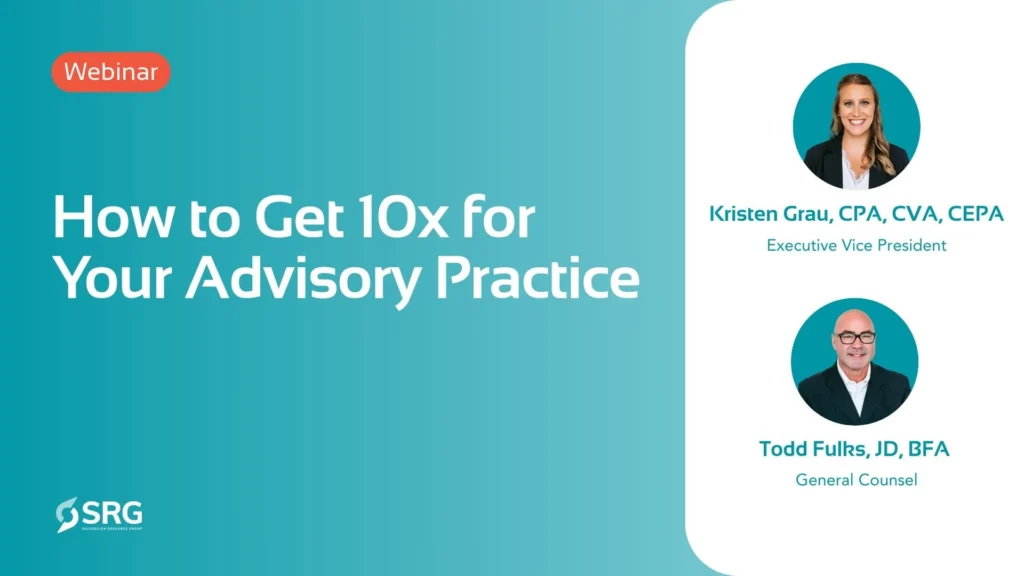
Advisory M&A experts Kristen Grau, CPA, CVA, CEPA and Todd Fulks, JD, BFA unpack what goes into building a firm worth top-tier multiples. From growth strategies to value drivers, learn how to position your practice for maximum return—whether you’re selling soon or planning ahead. Watch the Replay Host Kristen Grau, CPA, CVA, CEPA Executive Vice President Paper-plane Linkedin-in Host Todd Fulks, JD, BFA
Spring Clean Your Business | Annual Entity Maintenance Checklist

An RIA firm owner’s roadmap to increasing your firm’s value in a sustainable way that enhance your firm’s market value now and in the long-run. Succession Resource Group shares six ways firms can carve a path towards smarter growth, identifying levers for better business decisions that retain talented employees as well as ideal profit margins.