
Selling My RIA as a Financial Advisor, Prioritizing Client Fit Over Highest Offer

John’s Journey John Gunn was the Managing Principal of John L. Gunn & Associates, LLC, a Portland-based Registered Investment Advisory firm, prior to selling to Mainsail Financial Group. In his practice, John advised high-net-worth individuals, foundations, and pension plans, bringing decades of business experience and a reputation for excellence. He has been recognized as a Five Star Wealth Manager in Portland Monthly Magazine and served as a long-time member of the American Institute of CPAs National Financial Planning Insights Panel. “When it came time to sell my firm, I engaged SRG’s Seller Advocacy services to guide the process. For me, this decision wasn’t just about securing the best offer — it was about protecting my clients, ensuring continuity, and preserving the legacy I had built.” Selling My RIA: How I Found Peace Of Mind In the Process For many business owners, the thought of selling the company they’ve poured their lives into is overwhelming. I get it – for me, when thinking of selling my RIA, there was more to consider than just the financials. It was a deeply emotional process, one that required balancing personal priorities, finding the right partner, and ensuring that my clients and legacy were left in good hands. As the former owner of an RIA who recently went through this very journey, I thought it might be useful to share some powerful lessons about the experience, and how I made peace with my decision to sell. My story is unique to me, but not far removed from that of many financial advisor business owners who will all eventually ponder this same leap in the coming decade. The Moment I Realized What Truly Matters For years, I had juggled the demands of my business with my personal life, always trying to give everything I could to both. While I was still healthy and could likely continue, my wife’s health began to decline. There came a point when I had to ask myself a hard question: What am I willing to sacrifice? For me, the answer was clear. I couldn’t sacrifice my relationship with my wife. As much as I cared about my clients, my family had to come first. I realized, “I can’t do right by my wife and do right by my clients. One of them has to give, and it’s not going to be my wife. And so then the anxiety I had was simply about the fact that I didn’t know if I’d be able to find people that I would feel good about handing my clients off to.” That realization was a turning point. It wasn’t easy to admit that I couldn’t do it all anymore, but I knew I had to take a step back to honor the people who mattered most. If you’re in a similar place—feeling torn between your personal and professional obligations—let me assure you: it’s okay to choose your family. It’s okay to step back and say, “I’ve given all I can, and now it’s time for a new chapter.” This was the first step in my exit planning journey, and while it brought anxiety, it also brought clarity. Building Confidence in the Process Once I made the decision to sell my RIA, the next challenge was finding the right buyer—someone I could trust to take care of the clients I’d built relationships with over the years. That uncertainty weighed on me. How could I be sure I’d find the right people? At first, I wasn’t sure I would. But as I worked with my advisors and started the process, something shifted. I began to see that there were good buyers out there, people who shared my values and who I’d feel proud to recommend to my clients. “Once we went through the process far enough for me to realize that I am going to find somebody… SRG did a good job of generating interested parties…And then together we narrowed that list down. And, you know, coming to the realization that, yes, there are good people here that I will be absolutely delighted to write strong recommendations to my clients saying, these are good people and they’ll take care of you.” That was a game-changer for me. I went from feeling anxious about selling to feeling confident that I was doing the right thing, not just for myself, but for my clients. If you’re considering selling, my advice is simple: Trust the process. Start early, work with people you trust, and take the time to really evaluate your options. The right partner is out there, you just have to be willing to find them. Why Fit Matters More Than the Highest Offer When it came time to choose the buyer, I had one priority: I needed to know, without a doubt, that my clients would be in good hands. “My only real priority was I needed to have somebody that I could feel confident handing my friends and clients off to, knowing they’d be well taken care of. The vetting process was about understanding their investment process, but most importantly, who they were as people. Can I trust them to truly put my clients’ interests first? Are they personable enough to make my clients comfortable? That became the lead criteria for me. Ultimately, I chose the buyer who fit these values, even though their offer wasn’t the highest, because it was the best fit. And everything I’ve seen in the past year proves I was right.” In the end, I didn’t choose the highest offer. I chose the buyer who aligned with my values, someone I trusted to care for my clients and carry on the legacy I’d built. A year later, I can say with confidence that I made the right call. For anyone going through this process, let me share this: Fit matters. Numbers are important, of course, but they aren’t everything. When you’re handing over something as personal as your business, you want to know it’s going to the right people. Trust your
New York State Society of Certified Public Accountants: Structuring the Deal: Taxation When Selling Your Financial Service Business

December 15, 2020 By: David Grau Jr., MBA, and Nicole Frey, CFPPublished Date: Oct 1, 2020 For professionals planning to purchase or sell a financial services book of business, the most common negotiating points are the purchase price, deal structure, timeline, and financing considerations. These are critical points to discuss and finalize before signing on the dotted line. It’s also important to be aware of the effect of the tax treatment on the deal and know the different tax structures commonly employed. If not structured purposefully, the tax treatment of a deal may unintentionally favor either the seller or the buyer and can have a significant impact on the total value received/paid. Depending on what’s been negotiated, the majority of the sale proceeds may be classified as ordinary income or long-term capital gains. Negotiating this early in the process will ensure that the purchase price can be adjusted up or down to balance the benefit. As a result, the tax allocation of the sale proceeds is one of the key elements of a deal structure and should be considered carefully by both parties. Potential Deal Structures To decide which tax structure works best for the deal, the parties will enjoy some level of flexibility as long as they remain within the boundaries of current tax laws and the objectives of the transaction. The first decision that must be made is what exactly is to be sold (assets and/or equity) before discussing how the purchase price should be allocated to a particular asset or equity or both. The following are the two most common considerations: Asset sale In an asset sale, the buyer selects certain individual business assets to be purchased from the seller, with each asset having a specific dollar amount of the purchase price paid for it and allocated as such in the purchase agreement. This includes the following primary categories (in addition to any tangibles that may be acquired): Personal goodwill: client relationships, rights to revenue, the reputation of the business (i.e., the book of business) Restrictive covenants: nonsolicitation, noncompete, and/or no-serve agreement with the seller. Post-closing transition assistance: services provided by the seller, such as assistance with client meetings, phone calls, emails, letters, etc. Equity (stock) sale Rather than buying individual assets, the buyer and seller may elect to make the seller’s business entity (e.g., corporation or LLC) the subject of the transaction and enter into a sale of the seller’s ownership interest in the entity. The transfer of the ownership in the entity allows the seller to transition all assets and the liabilities of the business to the buyer, including all— contracts, permits, licenses, and registrations. Since both an asset sale or stock sale may ultimately result in long-term capital gains tax treatment for the seller, the choice is influenced greatly by the buyer’s preferences and whether there’s perceived value in buying the business entity. Asset Sale: Categories and Tax Treatment The most common deal structure when buying or selling a financial services practice is a sale of assets, versus an equity-based sale. This does vary based on the size of the transaction; deals involving larger firms will more often employ an equity-based strategy to ensure the acquired business remains a going concern. When purchasing the assets from a seller, it’s important to ensure that both buyer and seller agree on how the purchase price will be allocated for tax purposes, and such meeting of the minds should be included in the purchase and sale contracts. Personal goodwill The majority of the purchase price is typically allocated to personal goodwill—an IRC section 197 intangible asset consisting of the seller’s client relationships, reputation, expertise, and abilities. Year-to-date 2020, the average transaction for financial service professionals allocated 93% of the purchase price to personal goodwill, up from 91% in 2019. For the seller, the sale of personal goodwill should generate long-term capital gains tax treatment and be amortizable over 15 years by the buyer. Post-closing transition support Depending on the extent of the seller’s services to the buyer post-closing, compensation for these services can be either included in the purchase price (typically for limited services such as introducing the buyer to the transferred clients) or be paid in addition to the purchase price (for the seller’s expanded involvement post-closing beyond just transitioning clients). As shown in Figure 1, the average transaction allocated 3% of the purchase price to the seller’s post-closing support, though this allocation tended to be greater on smaller deals. For the seller, they want to ensure only a de minimis portion of the purchase price is paid for their transition assistance, as this portion is labor and taxed as ordinary income, subject to Social Security and Medicare taxes. The buyer, however, generally seeks to allocate more of the purchase price to the transition support, as this portion provides them a tax write-off in the allocated amount, pro-rated for the year in which the services were provided. Restrictive covenants To protect the buyer’s investment, the seller will commonly be required to enter into a restrictive covenants agreement (similar to personal goodwill, this too is an IRC section 197 intangible asset), whereby they promise not to compete with the buyer, solicit the buyer’s employees or vendors, or serve any of the clients the buyer purchased from the seller. In exchange for this promise, the seller will receive a portion of the purchase price as consideration, resulting in ordinary income for the seller and a 15-year amortization by the buyer. Because this asset doesn’t produce a tax-favorable outcome for buyer or seller (relative to the alternatives previously described), neither party seeks to allocate any more than would be required to ensure the buyer has an enforceable contract. Year-to-date 2020, the average transaction allocated 3% of the purchase price to restrictive covenants. Not allocating a portion of the purchase price to restrictive covenants may render the provisions unenforceable and otherwise confuse the intended tax
Balancing Act | Exploring Value and Terms in Deals (Ep. 24)

Pathways to Advisor Growth & Succession
Unable to join us? Book a time below to discuss your business goals! Schedule a Call Schedule a Call Schedule a Call
The Seller’s Playbook What to Know Before You Let Go

Learn what it takes to successfully sell your financial advisory practice. This session walks through the key steps to prepare your business, navigate the sale, transition clients and staff, and avoid common mistakes. Whether you’re planning to exit soon or just getting started, this webinar offers practical guidance to help you plan with confidence. Watch the Replay Host David Grau Jr. MBA CEO/President Paper-plane Linkedin-in Host Kristen Grau, CPA, CVA, CEPA Executive Vice President Paper-plane Linkedin-in
Empowering Advisors, Enhancing Transitions

Download Your eBook! Please enable JavaScript in your browser to complete this form.Please enable JavaScript in your browser to complete this form. Name * FirstLast Phone Work Email *How Did You Hear About SRG? *— Select Choice —ConferenceDirect MailExisting/Past ClientGoogle AdWordsOtherReferralSocial MediaSeminar/WorkshopWebinarWebsite Download Empowering Advisors, Enhancing Transitions Discover how SRG helps institutions support advisor growth and retention through expert guidance, seamless transitions, and strategies that reduce lift on your internal teams.
Selling to Your Kids? Why Family Deals Demand Extra Scrutiny

Selling your RIA practice to a son, daughter, or other family member might feel like a natural, low-stress transition, because there’s trust and familiarity. Many advisors assume they don’t need the same level of formality required of an outside RIA sale transaction. As a result they may skip a formal valuation, because they aren’t aiming for full value, or considering gifting equity. But this relaxed approach can open the door to tax exposure, compliance pitfalls, and long-term misunderstandings. In fact, intra-family sales demand more structure and care—not less—from both a practical and technical perspective. Here are five details and considerations to keep in mind that make these deals uniquely complex and why they deserve extra attention: 1. Third-Party Opinion of Value Is Non-Negotiable Family transactions are subject to close IRS scrutiny, especially when there are gifts involved or the sale price appears below fair market value. A credible, independent valuation is critical for: Establishing a supportable value of the business. Reporting a defensible value for gift tax purposes Supporting installment sale terms Managing the optics with non-involved heirs or business partners Using a third-party valuation firm ensures the agreed-upon price holds up under audit and provides a solid foundation for tax planning strategies. There are still tools at one’s disposal to influence or control the value, but doing so with an objective starting place—and with the correct strategy—will help ensure the RIA for sale is not recharacterized post-transition. Even if valuation isn’t the founder’s focus, it is still advisable to receive a formal valuation to avoid common post-sale pitfalls. Occasionally, advisors operating under an independent broker-dealer (IBD), inquire about simply ‘putting’ the business in the name of their son or daughter for no additional compensation to avoid formally “selling” or gifting. While it is possible to do at the IBD level, transferring an advisory business that has produced hundreds of thousands or millions of dollars of taxable income over the past decades, especially in an industry with a very active and well-known M&A market, is simply asking to be audited. 2. Alternative Financing Solutions For family business sales, there are unique financing options that can and should be considered. Self-Cancelling Installment Notes (SCINs) can be a powerful estate planning tool when selling to a family member. These notes are similar to a traditional promissory note, with the buyer/family member making payments of principal and interest out of cash flow, over some agreed-upon period. But, SCINs have a unique feature – the note can automatically terminate upon the seller’s death, potentially removing any unpaid balance from the seller’s taxable estate, without creating a tax liability for the buyer (the remaining debt outstanding at the seller’s passing isn’t forgiven, it simply terminates and ‘goes away’). SCINs can be a useful tool for family succession, but their structure must be airtight: SCINs need to include a “mortality risk premium” to offset the note’s cancelable feature – for example, a slight premium on the interest rate The valuation of the premium must be actuarially sound and based on health-adjusted life expectancy The term of the SCIN should be within the actuarial life expectancy of the seller – for example, a note shouldn’t be 20-years for a seller that is 85 years old The SCIN should be properly documented in value. The IRS will challenge and recharacterize notes that lack documentation or are undervalued For sellers with impaired health or shorter life expectancy, this can be an efficient way to reduce estate tax exposure, but it must be coordinated with a valuation professional and tax counsel. 3. Gifting Equity to a Family Member – Employee Gifting the business, partial or full, to a child who is also a key employee raises serious issues under both the gift tax rules and compensation regulations. To qualify as a gift by the IRS, the gift should be detached and disinterested generosity – a tough argument to make when the family member is on payroll. If an owner gave equity to anyone else on payroll, it would clearly be treated as a grant, thus making the argument that a grant to an employee related to the owner should in fact qualify as a “gift” is problematic/risky. Key considerations for gifting: Is the equity truly a gift, deferred compensation, or a grant of non-cash compensation? Is the employee/family member receiving equity for “less than adequate consideration?” Can the gift be split with your spouse? Can a minority interest be applied? Many family businesses are surprised by the gifting/granting considerations and thus get blindsided. Even well-intentioned, informal transfers can trigger unintended tax consequences if not properly documented. 4. Formal Governance Protects Relationships and the Business A key mistake in family transitions is letting relational trust substitute formal governance. When sharing ownership, with ANYONE (especially family), you need: A detailed Partnership Agreement, Operating Agreement, or Shareholder Agreement A buy-sell agreement with clear terms Defined roles and responsibilities for both generations A succession plan that survives death, disability, or divorce Mechanisms for resolving disputes (especially if other siblings are involved) Even if the culture is close-knit, legacy issues, entitlement perceptions, and money create a combustible mix. The hope is that you will never need to consult any of these agreements, whether selling to a family member or anyone else, but it is advisable to have well-thought-out governance documents you don’t need, than the inverse. Clear documentation avoids family blowups later. 5. Don’t Assume One Buyer = One Option In some cases, it may be advantageous to split ownership. For example, gifting minority interests over time while selling controlling interest later or using a grantor retained annuity trust (GRAT) or family limited partnership (FLP) structure to transition wealth gradually while maintaining control. Each of these has technical hurdles but can open up estate planning advantages that a straight sale misses. Bottom Line: Treat a Family Sale Like the High-Stakes Business Deal It Is Selling an RIA to a family member is not a shortcut—it’s a high-wire act, with an audience
Advisor Succession Plan: Inside a Real-Life Succession Plan
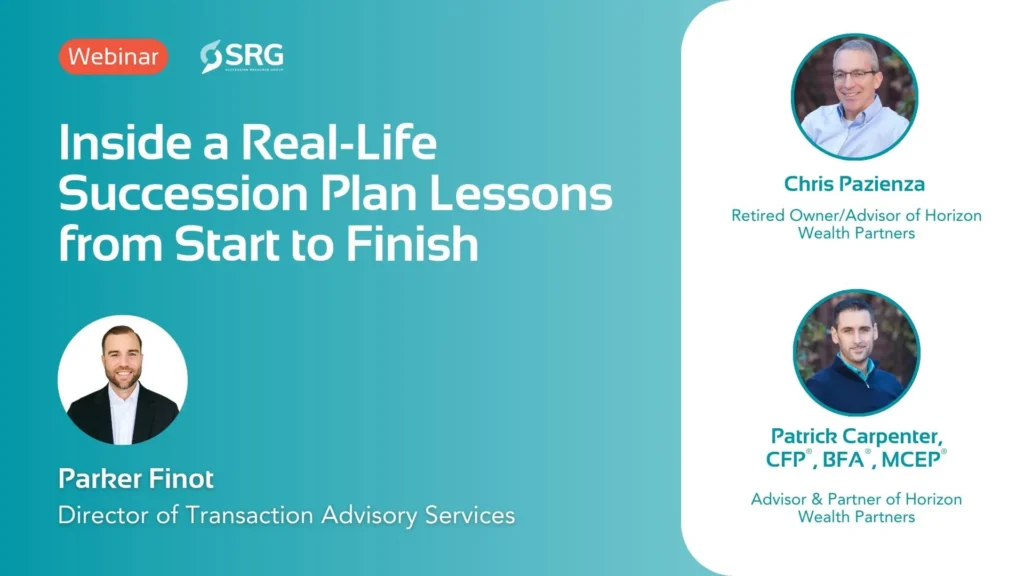
Why an Advisor Succession Plan Matter Real-Life Advisor Succession Plan: Lessons From Start to Finish is a complete, real-world case study showing how one multi-advisor firm moved through every step of a true advisor succession plan. You’ll see how the team handled valuation, financing, ownership changes, and client transitions from beginning to end—making this a practical example of a succession plan from start to finish. This session is built for financial advisors and firm owners who want proven, experience-based guidance. You will learn how to reward key team members, protect business value, structure a smooth transition, and prepare for a confident exit. You’ll also hear lessons from a real-life advisor succession plan that you can apply whether you’re planning an internal sale, grooming successors, or preparing your firm for the future. Speakers Host Parker Finot Director of Transaction Advisory Services Paper-plane Linkedin-in Guest Chris Pazienza Retired Owner/Advisor of Horizon Wealth Partners Guest Patrick Carpenter, CFP®, BFA®, MCEP® Advisor & Partner of Horizon Wealth Partners
Protecting Your Practice Against the Unexpected – David Grau Jr.
Access the Slides From the Session Download View our 2025 M&A Infographic Download Schedule a Call With Our Team Download Founder / CEO Paper-plane Linkedin-in Twitter Areas of Expertise: Advisor SuccessionSmall Business SuccessionFamily Business TransitionM&A Tax Strategies, NegotiationFinancing, Financial AnalysisRIA and IBD Rep Valuation, Continuity/ContingencyAdvisor M&A, Business PlanningRIA Buy-Side & Sell-Side Representation David Grau Jr., MBA David Grau Jr. is the founder and CEO of Succession Resource Group, a succession and M&A consulting company for advisors. Prior to launching SRG, David was the leading M&A consultant for a well-known succession planning firm to advisors where he led and developed numerous programs for RIAs. Prior to this role, David served in the United States Navy. David is a published author and accomplished speaker and has been interviewed and cited in dozens of publications over the last decade. He is currently one of the leading speakers in the financial services industry on M&A and next-gen building strategies, with over 200 presentations to his credit. In the past five years, he has spoken at a variety of the industry’s leading firms, including LPL Financial Services, Wells Fargo, Ameriprise Financial, ING, Independent Financial Group, Geneos, Swan Global, Advisor Group, Fidelity, Jackson National, Prudential, Raymond James, and regularly volunteers his time speaking for the Financial Services Institute (FSI) and FPA chapters around the country. David holds a Bachelor’s Degree from Portland State University and has a Master’s Degree from Willamette University’s Atkinson Graduate School of Management. David, his wife Kristen and their three children are long-time residents of Portland, Oregon, but take every opportunity to travel. Fun Facts: David enjoys spending time with his family, reading, running, is an avid wine enthusiast and developing a taste for cigars, loves traveling, reading, he also enjoys snow and water sports and loves basketball (playing or watching). Prior to having three children and starting a business David had a beautiful head of hair. Now he doesn’t.
Selling a Book of Business as a Financial Advisor | Complete Guide

Selling your book of business is one of the most significant financial decisions you will make as a financial advisor. Whether you are approaching retirement, exploring a strategic exit, or simply looking to capitalize on favorable market conditions, understanding the full process, from valuation to buyer selection to client transition, can mean the difference between a smooth, profitable handoff and leaving value on the table. The timing matters more than most advisors realize. Over half of active financial advisors are over age 50, and many still lack a formal succession plan. As retirements increase and deal volume continues to rise, consolidation across the wealth management space is accelerating. Rising taxes and interest rates, tighter regulations (think Reg BI), tech demands, and fee compression are all adding pressure and shrinking margins. For many advisors, this creates a tipping point, prompting them to explore exit options or sell their book of business. Adding to the urgency, private equity has become a major force in advisor M&A. PE-backed buyers are driving up headline valuations but often on less favorable terms for sellers — smaller cash down payments, more earn-outs, and equity in the buyer’s firm. Understanding this dynamic is critical to evaluating any offer you receive. In short: sellers will be plentiful, and timing will matter. This guide walks you through the full process of selling a financial advisory book of business, including when to sell, how to determine what yours is worth, how to find the right buyer, and how to protect your clients and your legacy along the way. When Is the Right Time to Sell? Timing is everything when it comes to selling your book of business, but the right time is not always obvious. Personal circumstances are rarely in perfect alignment with market conditions. Simply “wanting out” does not necessarily mean it is time to sell. If your revenue is declining, you just lost your largest client, or you have made major internal changes, you may not get the value you are hoping for or expecting from the financial advisory practice you have built. Retirement is an easier scenario for many advisors. If you set a target date a few years into the future, you can take the necessary steps to ensure you have maximized the value of your financial practice and positioned yourself to attract the best suitors. SRG’s succession planning engagements are specifically designed to help advisors build that runway. That said, you do not need to be on the verge of retirement to sell. Some advisors sell during a period of strong growth specifically because a growing practice commands a higher multiple. Others sell a portion of their book to reduce workload while staying active. The key is to sell from a position of strength rather than necessity. A few signals that the timing may be right: Your revenue has been stable or growing for at least two to three consecutive years You have recurring, fee-based revenue that makes your book predictable for a buyer Your client base skews younger (under 65), giving the buyer a longer revenue runway You have documented processes and systems that can transfer to a new owner You have started to think about what comes next — whether that is retirement, a new venture, or a reduced role If several of these apply, it is worth starting the conversation, even if you are not ready to list today. Preparation alone, understanding your valuation, cleaning up your operations, and exploring options — typically begins three to five years before the planned exit, though the most successful transitions start even earlier. According to SRG’s transaction data, the average succession plan spans 6.5 years. How to Value a Financial Advisor’s Book of Business Before you name your price, you need to understand how buyers are actually sizing up your business. The two most common valuation methods for financial service businesses are a market-based valuation using comparable transaction data and an income-based valuation that focuses on the business’s ability to generate profits. Neither of these is the correct solution 100% of the time; the best approach depends on the circumstances and size of the parties involved. Most sophisticated buyers will use more than one method. One important trend: as practices grow larger and more complex, valuations are increasingly based on earnings (EBITDA) rather than revenue multiples. Advisors planning an exit in the next few years should be paying close attention to their profitability, not just their top-line revenue. Revenue Multiplier Method The most widely referenced approach. Take your trailing twelve-month revenue and multiply it by an industry-standard factor. For RIAs and advisors with recurring revenue, that multiplier typically falls between 1.6x and 4.4x. When buyers outnumber sellers, it is common to see a well-positioned practice that has been prepped for sale exceed 3.0x on recurring revenue. In 2025, 39% of practices that transacted received a recurring revenue multiple of 3.5x or higher, according to SRG’s annual transaction data. Regional multiples ranged from 3.17x in the South to 3.48x in the Midwest — a tighter band than many advisors expect. What pushes you toward the higher end: strong recurring fee-based revenue, a younger client base, clean operations, and consistent growth. What pulls you toward the lower end: heavy reliance on commission-based income, an aging client book, or declining revenue trends. Earnings-Based Valuation (EBITDA / SDE) This method focuses on profitability rather than top-line revenue. Buyers look at earnings before interest, taxes, depreciation, and amortization (EBITDA) — or seller’s discretionary earnings (SDE) for smaller practices. For most practices, the industry standard multiplier is typically 4 to 8 times annual earnings, including reasonable owner’s compensation. However, larger firms with strong margins and sustainable growth are commanding multiples well above that range — SRG’s 2025 transaction data showed an average EBITDA multiple of 9.98x across the deals it tracked. This method is more common when the buyer will be assuming the seller’s overhead, and it is more reasonable to use a valuation method that focuses on profitability versus