
Why Every Financial Advisor Needs Annual Entity Maintenance

Authors Annual entity maintenance is the difference between a business structure that protects you and one that quietly exposes you to personal liability, IRS scrutiny, and deal-killing complications. Most financial advisors set up an LLC or S-Corp when they launch their practice, file the paperwork, and never look at it again. That gap between formation and ongoing upkeep is where the real risk lives. If you own an RIA or operate under a broker-dealer with your own entity, the structure you created on day one does not stay current on its own. State filing requirements change. Ownership shifts happen. Revenue flow documentation falls out of date. Operating agreements stop reflecting how the business actually runs. And when it comes time to bring on a partner, sell your practice, or defend your setup in an audit, a neglected entity can cost you far more than it would have cost to maintain. This article walks through what annual entity maintenance involves for financial advisors, why the industry has unique requirements that generic small-business guidance does not cover, and what a practical maintenance routine looks like. What Is Annual Entity Maintenance for Financial Advisors? Annual entity maintenance is the process of reviewing and updating the legal, financial, and operational components of your business entity on a recurring basis. For most small businesses, this means filing an annual report with the state and keeping licenses current. For financial advisors, it means considerably more. Financial advisory firms operate under regulatory constraints that most businesses do not face. If you hold securities licenses under FINRA Rule 2040, your broker-dealer pays you personally regardless of whether you have a business entity. If you elected S-Corp tax status, the IRS requires you to pay yourself a reasonable W-2 salary and maintain specific documentation around how revenue moves from your personal accounts into the entity. If you have business partners, your operating agreement needs to reflect current ownership percentages, voting rights, and buy-sell terms. Annual entity maintenance addresses all of these layers: state compliance, IRS documentation, governance updates, financial reconciliation, and strategic readiness. It is the ongoing work that keeps your entity doing what you set it up to do. Why Do So Many Advisory Firms Skip Entity Maintenance? The most common reason is that nobody told them it was necessary. Many advisors form an entity with help from a local attorney or online filing service, receive their articles of organization, open a business bank account, and assume the work is done. The entity exists on paper, so it must be working. This is especially common with single-owner firms. When you are the only decision-maker, the formality of annual resolutions, meeting minutes, and ownership ledger updates can feel unnecessary. There is no partner to negotiate with, no equity to divide, and no one asking to see your governance documents. The problem is that neglected entities accumulate risk quietly. A missed annual report filing can result in administrative dissolution. Outdated governance documents can block a transaction months or years later. Revenue flow arrangements that were set up correctly at formation can fall out of compliance if business circumstances change and the documentation does not keep pace. In SRG’s experience working with hundreds of advisory firms nationwide, the majority of advisors who come to us with an existing entity have significant gaps in their documentation and compliance. For some, they filed with the state, received their articles, opened a bank account, and moved on. For others, a local attorney filed the entity and provided simple governance documents. In either case, the critical steps remain incomplete. What Happens When Your Entity Falls Out of Compliance? The consequences of neglected entity maintenance vary in severity, but they tend to surface at the worst possible time: when you are trying to complete a transaction, defend yourself in an audit, or navigate a partnership dispute. Personal Liability Exposure One of the primary reasons advisors form an entity is to separate personal assets from business liabilities. That separation depends on what attorneys call “maintaining the corporate veil.” If you commingle personal and business finances, fail to keep proper records, or let your entity lapse with the state, a court can “pierce the veil” and hold you personally liable for business obligations. This means your personal assets, including your home, savings, and investment accounts, could be at risk. Nicole Frey, CFP®, SRG’s entity support lead, emphasizes this point with clients: the entity creates a wall between your personal and professional life, but that wall requires maintenance. If you are not keeping company and personal affairs separate, including using distinct bank accounts for personal income, entity operations, and profit distributions, you may be undermining the very protection you set the entity up to provide. IRS Audit Risk and Revenue Flow Issues Financial advisors face a unique IRS challenge that most business owners never encounter. Because broker-dealers and corporate RIAs pay licensed professionals directly under FINRA Rule 2040, advisors must move that income from their personal tax return to the entity’s tax return. The IRS has historically challenged this arrangement under what is known as the “fruit and tree doctrine,” which holds that taxes must be paid by the person or entity that controls the source of the income. The 2016 Tax Court case Fleischer v. Commissioner illustrates the risk. A Nebraska-based financial advisor working under an independent broker-dealer set up an S-Corporation and assigned his payments to it. The IRS challenged the arrangement, and the Tax Court agreed, resulting in over $40,000 in taxes, penalties, and interest. The court outlined specific deficiencies in Fleischer’s setup, all of which could have been addressed with proper documentation and ongoing compliance. To satisfy the IRS that your entity is the legitimate source of income, three factors need to be in place and documented: control over the revenue (demonstrating that no single owner has sole control over how income is handled), a contractual obligation to move revenue from your personal account to the entity, and a reasonable W-2 salary if an
How to Make a Merger a Growth Move: A 5-Step Roadmap for Advisory Firms

Last Updated: August 25, 2026 Author “What comes next?” For many financial advisory firm owners, growth eventually hits a ceiling. Organic client acquisition slows, operational demands pile up, and the question surfaces: what comes next? Mergers have become one of the most effective strategies for advisory firms looking to scale, reduce risk, and build long-term enterprise value. But a merger done poorly can create more problems than it solves. The difference between a merger that accelerates your business and one that stalls it comes down to preparation, process, and the right professional guidance. In a recent SRG webinar, Nicole Frey, CFP®, Director of Team Solutions, and Ryan Grau, CVA, CBA, Director of Valuations, walked through the full merger lifecycle for advisory firms. Below is a summary of the key takeaways. You can also watch the full webinar recording here. Why Advisory Firms Pursue Mergers Advisory firms explore mergers for a range of reasons, and the right motivation depends on where you are in your business lifecycle. Some of the most common drivers include: Faster growth. Rather than relying solely on organic growth, merging with a partner who brings their own book of business can accelerate your trajectory. SRG’s AcquireEdge program helps firms identify and evaluate acquisition and merger opportunities with this goal in mind. Greater scale and efficiency. When two firms combine, revenue may grow at a faster rate as the combined firm expands its client base, referral network, service capacity, and opportunities to capture additional wallet share. Expenses often increase at a slower rate because core infrastructure, technology, compliance, management, and administrative costs can be spread across a larger revenue base, creating margin improvement as the firm scales. Risk reduction and continuity. Sole proprietors face significant key-person risk. Adding a partner means your clients are protected if something happens to you. It also opens the door to better succession planning and contingency planning options. (For more on why contingency planning matters in the context of M&A, see Contingency Planning: A Key to Acquisition Success.) Expanded capabilities. A merger can help you offer new services, diversify your client demographics, enter new geographic markets, or create a one-stop shop by combining with complementary practices like CPA firms. For firms thinking about strategic direction at this level, SRG’s enterprise consulting services can help map the path forward. Talent attraction. In an aging industry, larger combined firms can offer more defined career paths and specialized roles, making it easier to recruit and retain talented professionals. Improved negotiation power. Operating at a larger scale gives you leverage when negotiating vendor contracts, payout grid rates, and fee structures with broker-dealers or custodians. Step 1: Get Your Entity Structure Right Before you start looking for a merger partner, your own house needs to be in order. Your entity structure — the legal form, tax status, and organizational setup of your firm — directly impacts how a merger can be executed. SRG’s entity support services are designed to help firms get this foundation in place. (For a deeper dive, download Your Guide to Proper Entity Structure.) The two most common legal forms in the advisory space are corporations and LLCs. Frey noted that LLCs taxed as partnerships offer significantly more flexibility for mergers. In a partnership structure, a new partner can contribute their book of business in exchange for ownership without triggering a taxable event. In an S-corporation, by contrast, that same contribution is often treated as a sale by the IRS, creating an immediate tax liability even though no cash changed hands. For firms that want the flexibility of an LLC partnership and the FICA tax savings of an S-Corp election, there is a hybrid solution: an LLC taxed as a partnership at the operating level, with each partner holding their interest through an individual S-Corp holding company. It adds complexity, but it gives you the best of both worlds. The takeaway: address your entity structure before the merger conversation heats up. Trying to restructure and merge simultaneously can be overwhelming. If your entity is already in place, SRG’s entity maintenance program ensures your governance documents and compliance stay current as the business evolves. For more on how entity structure supports growth, see Set Your Firm Up for Success — Using Entity Structure to Unleash Growth. Step 2: Define Your Ideal Merger Partner Not every merger is a good merger. As Frey put it during the webinar, a merger is “almost like a marriage, just on a business level.” You want to build trust and rapport before proposing anything formal. Finding the right partner requires honest self-assessment and intentional criteria. Your ideal merger partner should be similar or complementary to your business. Frey recommended evaluating potential partners across several dimensions: Revenue sources and service model compatibility. If one firm operates primarily through in-person client meetings and the other runs on virtual engagement, there needs to be a plan to reconcile those models or you risk losing clients during the transition. Client types and demographics. Complementary client bases can be a strength, but mismatched expectations around client service intensity can become a source of tension. Growth goals. If one partner is aggressively pursuing growth while the other is winding down toward retirement, that misalignment needs to be addressed through compensation structures rather than equity adjustments, which can create IRS audit complications. Once you have identified a potential partner, start by networking through broker-dealers, professional conferences, centers of influence, and business coaches. Build the relationship before introducing formal merger conversations. (For practical guidance on early-stage partnership conversations, see Teaming Advice When Preparing for a Merger.) When the time is right, sign an NDA and begin sharing financial information through a structured due diligence process. At minimum, you should be requesting three years of financial history with a deep dive on the trailing 12 months, a breakdown of the client base (demographics, asset distribution, concentration risk), staffing levels and compensation commitments, any existing equity-sharing or profit-sharing promises, major contract terms and expiration dates, and each owner’s goals —
SRG Entity Support: More Than an Entity Filing
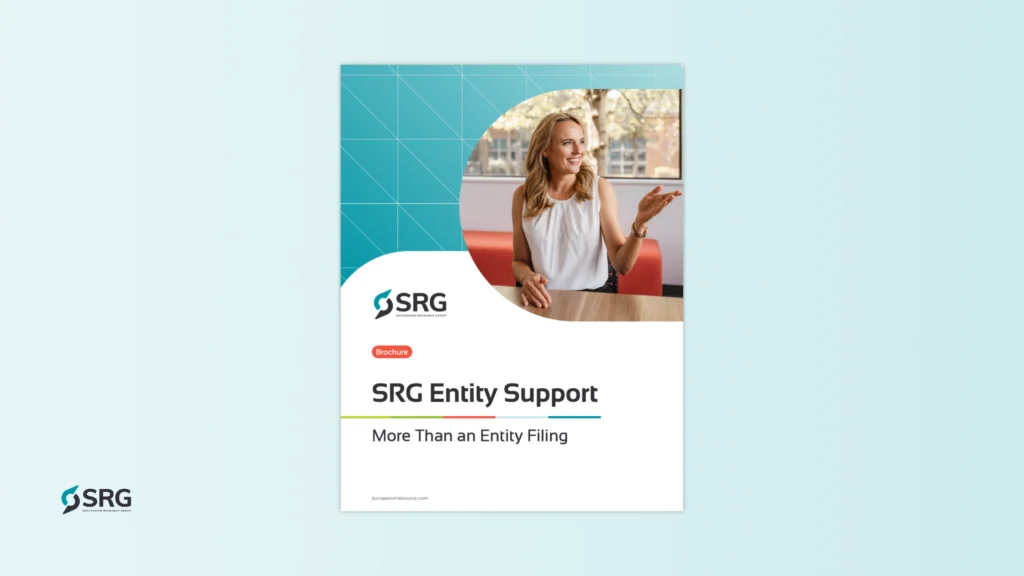
Many financial advisors assume entity formation is a simple filing, but the decisions made at the ownership, tax, and governance level have long-term consequences for how a business operates, grows, and transitions. SRG’s “Entity Support: More Than an Entity Filing” brochure breaks down the 12 areas of value included in every entity support engagement, from goal-based entity strategy and tax-focused coordination to revenue-flow design, buy-sell planning, and broker-dealer compliance support. Whether you are forming your first entity or restructuring an existing one, this resource shows how SRG’s consultant-led, industry-specialized approach helps financial professionals build a business structure designed to protect enterprise value and support long-term strategic flexibility. Download the brochure to see what a comprehensive entity engagement looks like and how it compares to a standard filing. Please enable JavaScript in your browser to complete this form.Please enable JavaScript in your browser to complete this form.First Name *Last Name *Phone Work Email * Would you like to join SRG’s newsletter to receive industry updates and other webinar opportunities? Yes No Download
Equity Explained: How to Incentivize, Retain, and Transition Ownership
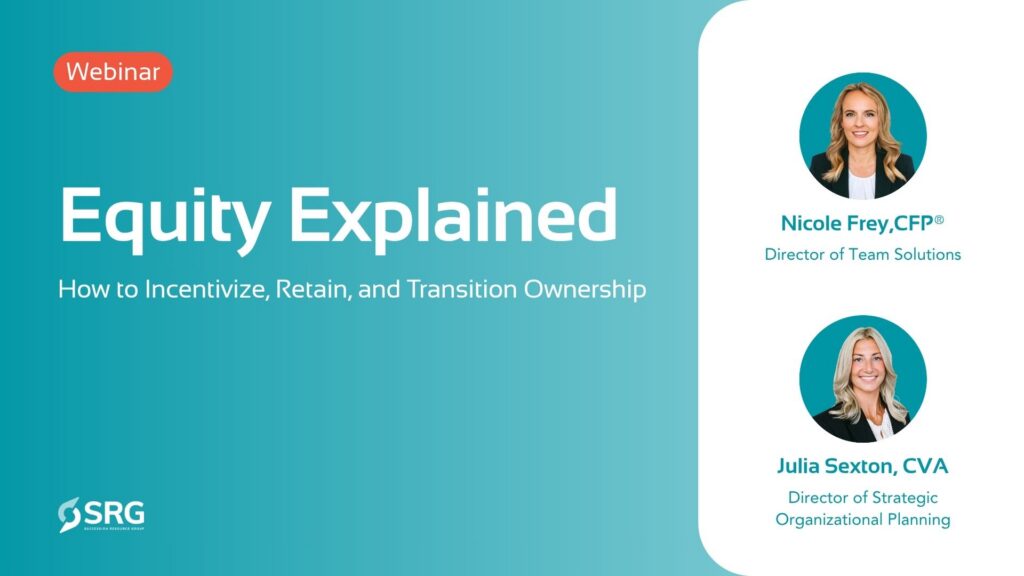
Watch the Replay Please enable JavaScript in your browser to complete this form.Please enable JavaScript in your browser to complete this form. Name * FirstLast Phone Work Email *How Did You Hear About SRG? *— Select Choice —ConferenceDirect MailExisting/Past ClientGoogle AdWordsOtherReferralSocial MediaSeminar/WorkshopWebinarWebsite Access Recording What’s the Best Way to Use Equity to Reward, Retain, and Transition Key Talent? In this webinar, Succession Resource Group’s Nicole Frey, CFP®, and Julia Sexton, CVA, break down how advisory firms can use equity more strategically to retain talent, develop future leaders, and plan for succession. The session covers the key differences between phantom and true equity, how to reward performance without creating ownership friction, and the valuation and tax considerations that come with grants, purchases, and swaps. Whether you’re evaluating equity for a key employee or rethinking your firm’s ownership structure altogether, this conversation will help you make more intentional decisions that support the long-term health of your practice. Host Nicole Frey, CFP® Director of Team Solutions Paper-plane Linkedin-in Host Julia Sexton, CVA Director of Strategic Organizational Planning Paper-plane Linkedin-in
Equity Explained: How to Incentivize, Retain, and Transition Ownership
Watch the Replay What’s the Best Way to Use Equity to Reward, Retain, and Transition Key Talent? In this webinar, Succession Resource Group’s Nicole Frey, CFP®, and Julia Sexton, CVA, break down how advisory firms can use equity more strategically to retain talent, develop future leaders, and plan for succession. The session covers the key differences between phantom and true equity, how to reward performance without creating ownership friction, and the valuation and tax considerations that come with grants, purchases, and swaps. Whether you’re evaluating equity for a key employee or rethinking your firm’s ownership structure altogether, this conversation will help you make more intentional decisions that support the long-term health of your practice. Download the Presentation Deck Here Download Speakers Host Nicole Frey, CFP® Director of Team Solutions Paper-plane Linkedin-in Host Julia Sexton, CVA Director of Strategic Organizational Planning Paper-plane Linkedin-in Transcript 100:00:05.800 –> 00:00:07.949Julia Sexton: Hello, and welcome, everyone. 200:00:08.220 –> 00:00:10.239Julia Sexton: Thanks for joining today. 300:00:10.730 –> 00:00:14.850Julia Sexton: I will let everyone settle in. 400:00:15.340 –> 00:00:20.190Julia Sexton: stall for a minute or two. I know it takes everyone a second to… 500:00:20.560 –> 00:00:39.150Julia Sexton: get their cameras and screens straightened out, but we’re pretty excited to spend some time today talking through one of the hottest topics, or we like to think, and most important, strategic conversations, that advisory firms are having right now, and that’s how to share equity. 600:00:40.220 –> 00:00:50.520Julia Sexton: So, maybe you are tuning in today thinking about how to build better retention strategies, or how to kickstart succession planning for your firm. 700:00:50.700 –> 00:01:06.179Julia Sexton: Maybe you’re thinking about how to reward your future leaders better, or just create some better long-term enterprise value. But, lucky you’re here, because equity sharing plays a major role in helping you accomplish any and all of these goals. 800:01:07.830 –> 00:01:20.560Julia Sexton: My name is Julia Sexton, I am the Director of Strategic Organizational Planning here at SRG, and I will be your host for today’s webinar and conversation all about equity. 900:01:21.660 –> 00:01:25.480Julia Sexton: Supporting today’s topic is my colleague. 1000:01:25.510 –> 00:01:41.939Julia Sexton: An industry expert, Nicole Fry. Nicole is SRG’s Director of Team Solutions, and she brings a wealth of knowledge and experience, leading all things to do with operating entities. So, that includes strategy development, the initial setup. 1100:01:42.090 –> 00:01:46.819Julia Sexton: Restructuring, formalizing of partnership governance. 1200:01:46.920 –> 00:01:49.800Julia Sexton: Merging major operations, you name it. 1300:01:50.150 –> 00:01:59.740Julia Sexton: But Nicole and I work closely together, helping teams build equity-sharing plans, and setting up the right foundation to support 1400:01:59.970 –> 00:02:02.109Julia Sexton: Teams Equity Sharing Goals. 1500:02:02.440 –> 00:02:13.849Julia Sexton: So, our goal today is to make this topic maybe a bit more approachable, practical, and hopefully give you some ideas, and strategies that you can apply to your own business. 1600:02:14.640 –> 00:02:32.000Julia Sexton: So, we will try to keep this topic as light as possible. Nicole and I were just joking before we jumped on. There’s a lot of technical material to cover when it comes to equity sharing and entity structuring or building those foundations for equity sharing. 1700:02:32.040 –> 00:02:48.700Julia Sexton: So, feel free to send some questions into the Q&A chat throughout the presentation. We’ll do our best to address them either throughout, or maybe we’ll have some time reserved at the end. If you’re not comfortable with 1800:02:48.780 –> 00:03:00.050Julia Sexton: Dropping your questions into the chat. Feel free to send any questions in through the survey that we’ll launch at the end of the presentation, and we’ll be happy to get back to you. 1900:03:00.350 –> 00:03:02.300Julia Sexton: So we will be… 2000:03:02.450 –> 00:03:16.140Julia Sexton: sharing our slide deck, after the presentation as well, so no need to whip out your phones for pictures or screenshots, as good as I know our decks are. Just check your email inbox within 24 hours of today’s session. 2100:03:20.160 –> 00:03:39.110Julia Sexton: Before we get into it, we do have some upcoming webinars in June, and July, as you can see. So if you would like the links to register, we will send those in the chat. Those will be available on our website as well, and check social medias, including LinkedIn. 2200:03:39.270 –> 00:03:56.280Julia Sexton: But please make sure you register for those. Next month’s is co-hosted by myself, and my colleague Parker, and then in July, we have our president and founder, David, leading a presentation on PE value. 2300:03:59.330 –> 00:04:11.590Julia Sexton: Before we get into content today, for those listening that maybe aren’t as familiar with who we are, or maybe you just need a good reminder of all the things that we offer and where our expertise is focused. 2400:04:11.660 –> 00:04:27.769Julia Sexton: We have been guiding advisors in the independent space, both broker-dealer affiliated and RIAs of various sizes over the past 14 years. And our team brings together professionals who specialize in everything from valuations and value building. 2500:04:27.770 –> 00:04:32.390Julia Sexton: Initiatives, like equity sharing and compensation design. 2600:04:32.570 –> 00:04:40.100Julia Sexton: To things like equity planning and entity strategy and planning, as well as maintenance on those topics. 2700:04:40.570 –> 00:04:47.450Julia Sexton: And we’ve completed several thousands of valuations and M&A deals, hundreds of succession plans. 2800:04:49.360 –> 00:04:59.419Julia Sexton: And we’re here to help you make informed decisions about your own business, because at the end of the day, our goal is pretty simple. We want to help you build a strong and lasting business. 2900:05:01.300 –> 00:05:04.410Julia Sexton: So, we just launched a couple of poll questions. 3000:05:05.030 –> 00:05:07.949Julia Sexton: As we continue to let people… 3100:05:08.190 –> 00:05:18.899Julia Sexton: trickle in here, briefly introducing a little bit of a bit more about myself, and Nicole in terms of, you know, why we are leading today’s conversation. 3200:05:19.190 –> 00:05:33.669Julia Sexton: I am leading today’s conversation, frankly, because I sit in the seat
The Exchange: Entity Structure and Why It’s The Backbone of Your Advisory Firm (Ep. 28)
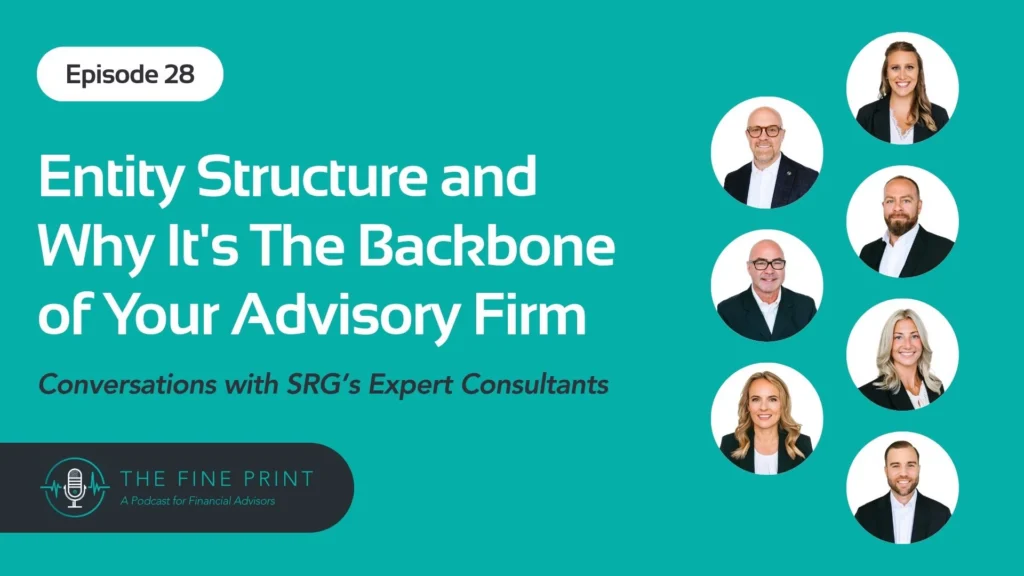
Entities and Entity Maintenance Entity structure is not just a legal formality. It plays a major role in how an advisory firm grows, shares ownership, and transitions leadership. In this episode of The SRG Exchange, SRG’s consulting team and general counsel unpack why entities have moved from a “set it and forget it” task to a core piece of business strategy. You will hear how entity decisions influence everything from equity sharing and internal succession to mergers, lending, disputes, and value building. Why entities are now strategic, not administrative The team discusses how entities used to be treated as a quick setup for liability and taxes, but have become foundational for firms with growth plans, W2 employees, equity sharing, and long-term succession goals. Why entities are now strategic, not administrative The team discusses how entities used to be treated as a quick setup for liability and taxes, but have become foundational for firms with growth plans, W2 employees, equity sharing, and long-term succession goals. Entity structure supports retention and equity pathways A properly structured entity can create divisible ownership units or shares, enabling retention strategies and giving next-gen leaders a pathway to buy, earn, or convert into real equity. S-corp versus LLC taxed as partnership The group compares the tradeoffs of rigidity and flexibility across entity types. An S-corp can be effective in specific scenarios, but many firms pursuing mergers or complex ownership structures benefit from the flexibility of an LLC taxed as a partnership. Entity structure impacts M&A, mergers, and equity swaps Entities do not only matter for succession and equity sharing. They also shape peer-to-peer acquisitions, mergers, partner buyouts, and equity swaps. Poor structure or conflicting agreements can reduce tax strategy options and create deal friction. Why entity maintenance matters Entity documents need to reflect reality. The team shares how outdated operating agreements and inconsistent ownership schedules can create serious issues during valuations, due diligence, disputes, or even basic financing. What maintenance actually includes Maintenance is more than annual state filings. It includes documenting changes, capturing ownership updates, maintaining minutes, and ensuring titles and governance terms stay consistent over time. The real risk: it is not an issue until it is The group explains why entity problems often stay hidden until a triggering event happens, such as an owner dispute, a loan request, a merger, or litigation. When that happens, outdated documents become evidence. In the context of succession planning Rather than doing entity work in isolation, the team recommends aligning structure with the firm’s goals first. That includes what the founder wants to do long-term, whether the path is internal succession, external sale, mergers, or ensemble building. Who is Featured in This Episode Nicole Frey, CFP® David Grau Jr., MBA Julia Sexton (Sullivan), CVA Ryan Grau, CVA, CBA Kristen Grau, CPA, CVA, CEPA Parker Finot Key Takeaway Entity design and maintenance are foundational. When done strategically, they make it easier to share equity, retain talent, execute transactions, and protect long-term value. When ignored, they create friction at the exact moments when a firm needs clarity the most.
Year-End Entity Maintenance Checklist: Position Your Business for a Stronger Year Ahead

An RIA firm owner’s roadmap to increasing your firm’s value in a sustainable way that enhance your firm’s market value now and in the long-run. Succession Resource Group shares six ways firms can carve a path towards smarter growth, identifying levers for better business decisions that retain talented employees as well as ideal profit margins.
Entity Health Check: Is Your Structure Supporting or Hindering Your Growth
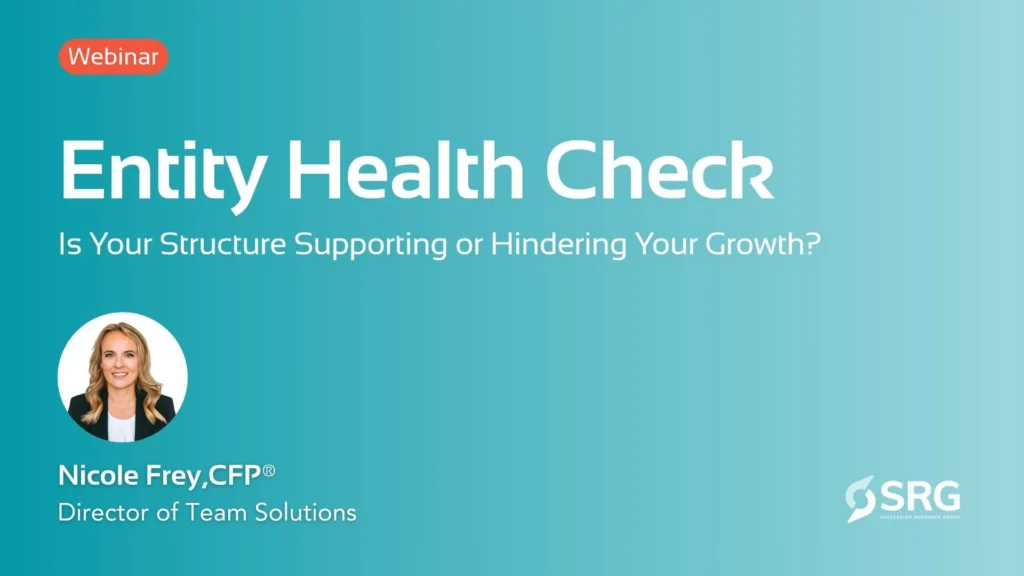
In this replay, Nicole Frey, CFP®, walks through how your firm’s entity structure affects growth, compliance, and succession readiness. Use the Health Scorecard to follow along in real time and see if your business is Optimized (22), Healthy (17–21), or Needs Improvement. Watch the Replay Get Your Entity Health Score Card A simple, actionable tool to evaluate your firm’s structure Your entity structure is more than paperwork — it’s the foundation of your business. The Entity Health Score Card helps you quickly assess how well your current structure supports growth, compliance, and succession readiness. Answer a few questions, calculate your score, and uncover clear next steps to protect and optimize your firm. DOWNLOAD NOW
Entity Health Check: Is Your Structure Supporting or Hindering Your Growth

In this replay, Nicole Frey, CFP®, walks through how your firm’s entity structure affects growth, compliance, and succession readiness. Use the Health Scorecard to follow along in real time and see if your business is Optimized (22), Healthy (17–21), or Needs Improvement. Watch the Replay Get Your Entity Health Score Card A simple, actionable tool to evaluate your firm’s structure Your entity structure is more than paperwork — it’s the foundation of your business. The Entity Health Score Card helps you quickly assess how well your current structure supports growth, compliance, and succession readiness. Answer a few questions, calculate your score, and uncover clear next steps to protect and optimize your firm. DOWNLOAD NOW
New York State Entity Publication Guide

Overview Congratulations on forming your LLC with the New York Secretary of State! To help you meet the state’s requirements, we’ve outlined the steps below to guide you through the mandatory publication process. Legal Requirement Under New York Limited Liability Company Law §206, within 120 days of formation or authorization, an LLC must publish a notice once each week for six consecutive weeks in two newspapers—one daily and one weekly—designated by the county clerk of the county in which the LLC’s office is located. A list of available publishers can be obtained from the county clerk’s website. Publication Timeline Within 120 days after filing the Articles of Organization or Application for Authority with the New York Department of State, the entity must publish a notice in two newspapers. These newspapers are designated by the county clerk of the county where the entity’s office is located, as stated in the Articles or Application. Newspaper Specifications One daily and one weekly newspaper must be used Publications must run for six successive weeks. The content must be either a copy of the Articles of Organization or Application for Authority or a notice containing its substance. Proof of Publication Obtain affidavits of publication from both newspapers. Complete a Certificate of Publication, which can be found on the following website: Link to Certificate of Publication Form. Mail these affidavits along with the Certificate of Publication and a check of $50 for the filing fee to: New York Department of State Division of Corporations One Commerce Plaza 99 Washington Avenue, Suite 600 Albany, NY 12231 For further details, visit the New York Department of State Division of Corporations website. Are you interested in entity support? Let’s Talk. SRG handles this entire process: setting up the publications, securing affidavits, and preparing the Certificate of Publication form, so all you have to do is submit it to the NY Department of State. Book a consultation with our team today and let’s get started.