The Future of Business Growth with Julia Sexton (Ep. 13)

Creating a Winning Compensation Plan (Ep. 10)
The Financial Advisor’s HR Toolkit
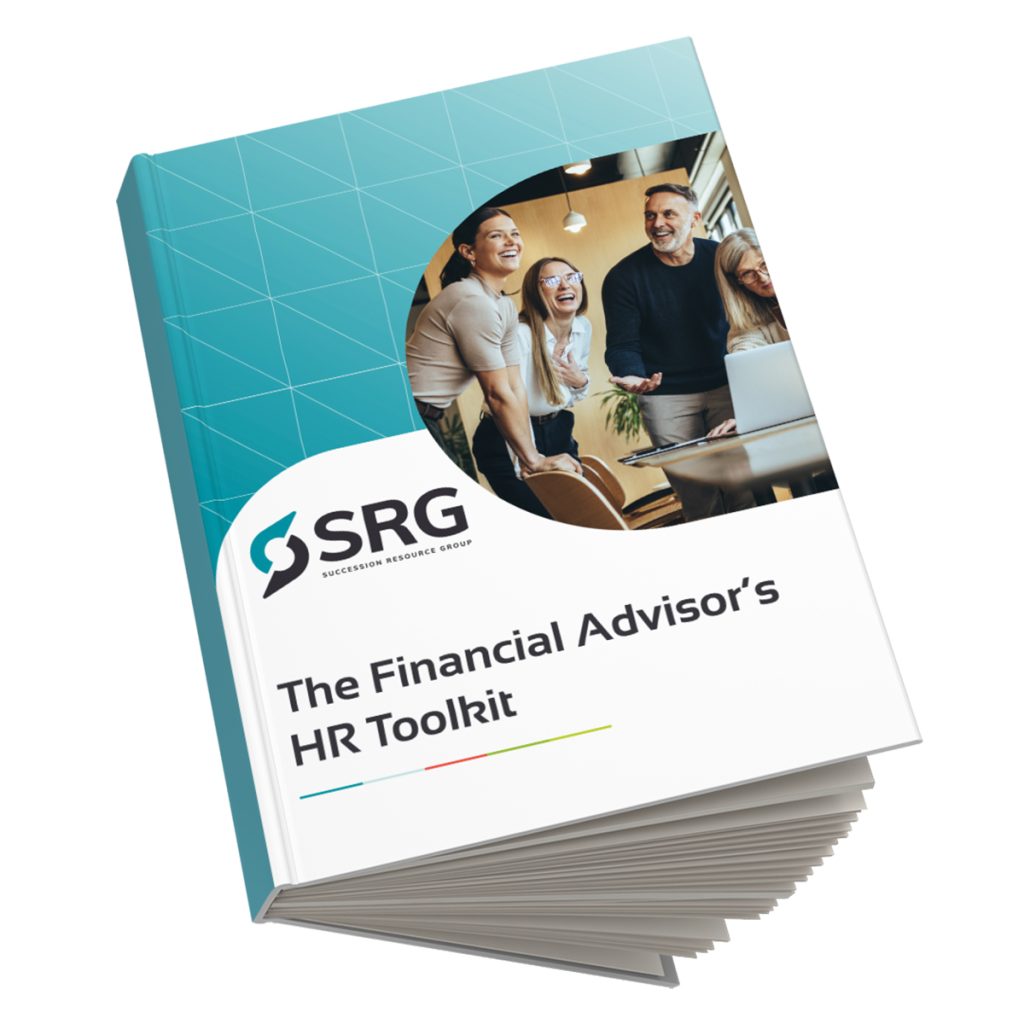
Download Your eBook! Please enable JavaScript in your browser to complete this form.Please enable JavaScript in your browser to complete this form. Name * FirstLast Phone Work Email *How Did You Hear About SRG? *— Select Choice —ConferenceDirect MailExisting/Past ClientGoogle AdWordsOtherReferralSocial MediaSeminar/WorkshopWebinarWebsite Download Streamline Your Practice with These Essential Tools Effective personnel management, including formalized employee agreements, equity sharing, and compensation plans, is equally crucial to the success of your financial practice as well as that of your team. Our toolkit is designed with all the essentials you need to manage your HR processes effectively, saving you time and increasing your efficiencies. Here’s what you’ll find inside: Expert recommendations on employment agreements Best practices for compensation Key elements for clear job role descriptions Guidance for creating a career path for your team Our toolkit is designed to help you improve your employee satisfaction, increase retention, and better align employee compensation plans with business initiatives. Complete the form to receive your free HR Toolkit today! Learn more about SRG’s Employment Resources and Equity Sharing services. Schedule your free consultation below!
SRG Off Script: Advisor Compensation
In the latest of SRG’s monthly webinar series, SRG Off Script, David Grau Jr. and Nicole Frey, CFP® address the topic of employee compensation and talent retention in your business. SRG Off Script is a monthly webinar series hosted by President David Grau Jr. David along with other industry experts provide insight and address questions related to all stages of managing a financial practice. Have a request for future SRG Off Script session topics? Let us know at registration or email marketing@successionresourcegroup.com Watch Recording Resources Five Best Practices To Create An Effective Compensation Plan → Five Building Blocks of an Attractive Compensation Model → Learn more about SRG’s Employment Resources service. Schedule your free consultation below! Presenters David Grau Jr., MBA President/Founder Nicole Frey, CFP® Project Manager
Five Best Practices To Create An Effective Compensation Plan

Many companies have spent significant time and effort in recent years to move away from the traditional one-size-fits-all type compensation plans and instead favor a more customized solution. However, the challenge to achieve desired results in attracting and retaining talented workers, within company means, remains prevalent. While at times the issue may be poor job role, poor culture fit, or external circumstances beyond the employer and/or the employee’s control, more often than not the lack of success is the result of a misalignment of the compensation plan with the worker’s role in the company and incorrect implementation practices. Most of these occurences can be avoided if the following best practices are maintained: 1. Tailor the Compensation to the Employee’s Specific Role To create a compensation plan that achieves the desired results, it is important to provide compensation elements that incentivize certain behaviors. Here, the focus should be on an employee’s particular role and strengths as well as the company’s needs to maximize the return for the expended efforts and the compensation paid. For example, if an employee excels at business development, the bonus structure should reward him or her for new business brought to the firm rather than for a certain quantity of financial plans produced or client meetings held. If, on the other hand, an employee is skilled at client service but, typically, does not bring in a lot of new business, the bonus structure should emphasize the service element such as the number of financial plans produced, and pay an attractive bonus. It is important to keep in mind that additional bonuses may still be paid on other activities that are beneficial to the company but do not pertain to the employee’s particular job role or strengths. However, such bonuses should not be the main element of the compensation plan. 2. Communicate Expectations and Results A compensation plan is only as good as the company’s communication of its expectations and intended results. Such communication is more effective if it acknowledges a reciprocal relationship between an employee and the company and therefore includes the expectations and results for both parties. This is typically accomplished by outlining the employee’s qualifications and responsibilities as well as the company’s commitment to career progression and compensation in a career path summary for a particular job role. The details outlined in the career path summary should then correspond with the elements of a compensation plan that is specifically tailored to a particular job role level. Both career path and compensation plan should be reviewed periodically and potentially adjusted to make sure they are clear and achieve the desired results. 3. Use SMART Goals As an employee’s goals are determined, it is best practice to set SMART goals to maximize his or her performance and promote job satisfaction. SMART goals are: Specific (direct/detailed) Measurable (quantifiable) Attainable (realistic) Relevant (aligning with the company’s mission) Time-based (deadline driven) Using these metrics will ensure that team members do not feel overwhelmed and challenge themselves to achieve their goals. 4. Align Performance & Compensation When it comes to using compensation as a means to incentivize performance, timing is everything! For best results, compensation should closely follow performance. This ensures that the employee associates the reward with their behavior and is more likely to repeat the desired behavior. The more time passes, the weaker this association will be. 5. Stay Within Company Means The pressure on companies to offer attractive compensation plans is tremendous given today’s competition for talented workers. As a result, many companies use compensation studies to determine how much they will need to pay an employee to beat the competition. Compensation studies, however, should be used with caution since they can include a broad range of participants and often communicate only one particular aspect of the employment relationship – compensation – and they might therefore lack information with respect to required work hours, level of skills and responsibilities, other perks, etc. For some firms, the use of compensation studies can put significant strain on the company’s financial health if the compensation benchmarks exceed the company’s financial resources. To avoid profitability issues, it is therefore important to ensure that: Revenue ranges are determined based on the company’s financial means, Any overlap in compensation is eliminated (i.e., paying multiple bonuses for the same activity), and The calculation of the bonus amount is predictable. To avoid profitability issues, some companies are inclined to impose caps on bonuses paid. However, depending on the circumstances and the type of bonus paid, the bonus amount may not need to be capped, for example, if the generating capacity of any new business sourced by the employee exceeds the bonus payment. A bonus cap has the tendency to restrict high performers and slow down company growth. In summary, for a compensation plan to yield the desired results, the process should start with the end goal in mind and then focus on how each employee can help reach such goal based on their particular job role. Once the goal for the company and the associated goals for the employees have been established, a compensation plan can be created that drives the behaviors needed to accomplish the company goal by tying behavior to compensation.
Five Building Blocks of an Attractive Compensation Model

Hiring and retaining talented employees is a top priority for most business owners. Effectively doing so has become increasingly difficult in the financial services industry. The number of advisors approaching retirement and exiting the industry far outweighs the number of new advisors joining. This gap is further exacerbated by the Great Resignation. As a result, organizations are struggling to find the human capital needed to grow their business and plan their internal succession.
How Does Equity Compensation Work?

Companies offer a wide range of employee compensation methods. Generous salaries, healthcare plans, and PTO are among the most common, but many companies also offer compensation that doubles as an incentive for high performance and long-term commitment. Equity compensation is just one example — but it takes a lot of different forms that are worth exploring.
Advisor to CEO: Best Practices for Your Growing Enterprise

https://youtu.be/-rL2IYZ0PKE The transition from advisor to how to be a CEO Your first job as a new advisor was to understand the industry and products, then get clients. Here you are, years later – you have great clients, you’re growing, and you’ve hired a good team. Whether by design or by default, you now find yourself in the role of both advisor AND CEO. This webinar will walk you through some tips on how to make that transition and prepare you on how to be a CEO. Now that you’ve gone from advisor to business owner, there are new best practices to consider to ensure you continue to be successful. Join us as we talk about the most interesting and compelling topics for successful business-owner advisors: Equity sharing strategies for your key people How to set up and properly leverage an entity and organizational structure How your organizational structure impacts value, employment agreements and restrictive covenants The right way to compensate your team Employment Resources Join David Grau Jr. from Succession Resource Group as he shares mission-critical considerations that will either drive or detract from the value of your enterprise. About David Grau, Jr., MBA:David Grau Jr. is the founder and CEO of Succession Resource Group. He is currently one of the leading speakers in the financial services industry on mergers and acquisitions of independently owned financial services firms, as well as valuation strategies and practice continuity issues, with over 200 presentations to his credit. In the past five years, he has spoken at variety of the industry’s leading firms, including LPL Financial Services, Wells Fargo, Ameriprise Financial, MetLife, ING, AIG, Fidelity, Jackson National, Prudential, FSI and at many FPA chapters around the country. As an expert on advisor valuation, acquisition and succession planning, David has assisted hundreds of advisors and other professionals buy, merge, sell, and craft their transition plan for the sale of their business over the last decade.
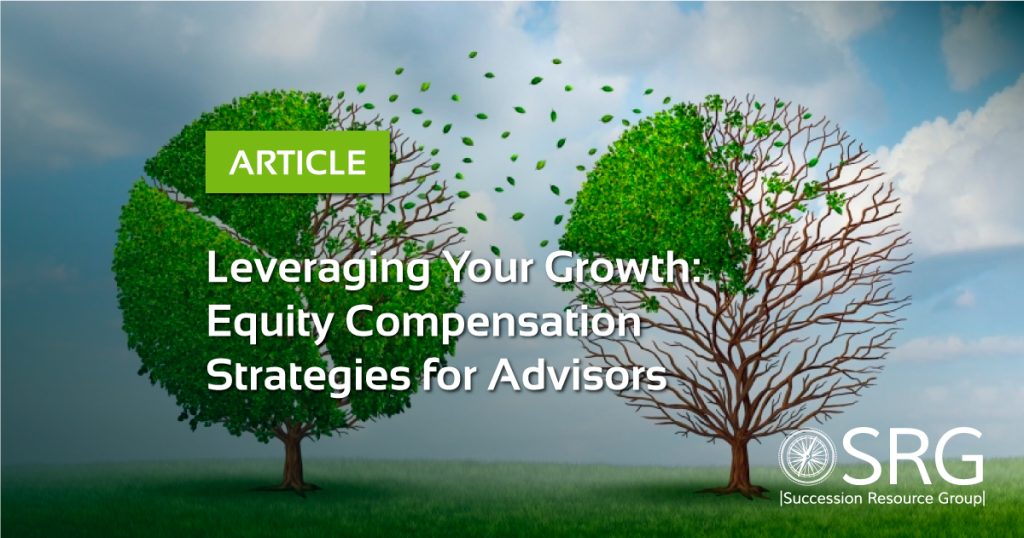
Leveraging Your Growth: Equity Compensation Strategies for Advisors
Most financial advisors are aware that a succession plan is important to their business and clients. Based on the last study done by InvestmentNews in 2012, 94% of respondents acknowledged the need for a plan, yet only 7% of those respondents actually had a plan.