
Advisor Compensation Plans: The B.B.P. Model for RIAs

Authors “Firms rely on an outdated playbook.” Most advisory firms still pay advisors on decades-old revenue-based models designed for solo producers, not the integrated teams they are building today. That mismatch is compressing margins, stalling succession plans, and destroying enterprise value. A modern framework built around base salary, targeted bonuses, and profit participation aligns incentives with the business you are trying to build. Why Is Advisor Compensation Broken at So Many Firms? Growing teams, rising M&A activity, and continued industry consolidation are reshaping independent wealth management. Scale, next-generation advisors, growth, and enterprise value are now the industry’s central conversation. As professional service businesses, client-facing advisors are central to delivering on those objectives, making advisor compensation more important than ever. Firms are trying to balance profitable growth and increasing enterprise value with the need to retain and attract talent through competitive compensation. Over- or under-compensating advisors, or misaligning incentives, can have long-term consequences that quietly undermine margins, culture, and value. The core problem is straightforward: teams, roles, and growth strategies have evolved faster than the compensation models behind them. Drawing on more than 2,000 firm valuations, with compensation data covering tens of thousands of professionals, SRG compensation specialists are seeing more advisors form and grow true teams. Not just loose groups sharing back-office costs, but integrated firms with unified service models, investment strategies, and operations. At the same time, this research shows that most firms are still compensating advisors using models that have remained largely unchanged for decades. In roughly 95% of the teams that SRG works with, the stated goal is to create collaboration and work as a team within an ensemble structure. Yet the compensation model still rewards individual production. That gap between what firms say they want (efficiency, growth, and continuity) and how they pay advisors continues to widen. The result is margin compression, confused career paths, frustrated owners, and suppressed enterprise value. How Does the Traditional Revenue-Based Model Work? The most common approach, across independent RIAs and dually registered teams alike, is to pay advisors a “salary” that is calculated as a direct percentage of the revenue or AUM they service. Advisors are typically paid anywhere from 30% to 90% of revenue, depending on the support received, and are responsible for sourcing and servicing their own clients. This model works well for its original purpose: rewarding advisors focused on building and servicing their own books of business. These are the “hunters.” If they grow, they earn more. If they don’t, compensation adjusts accordingly. It is a clean model: recruit producers, provide infrastructure, and share in the upside. Advisors who thrive here value autonomy and unlimited upside in exchange for risk. The revenue-based model originated decades ago in wirehouses and banks, where advisors received a 30% to 40% payout and the house provided the office, desk, and clients. When advisors went independent, the structure came with them, only the payout jumped to 80% or 90%. The mechanics stayed the same: pay for production. That structure still has a place. But it was designed for a world of solo practitioners building individual books, not for the ensemble firms dominating the industry today. What Happens When You Pay Farmers Like Hunters? Where the traditional model breaks down is in growing firms that are no longer hiring hunters but instead are recruiting and training younger professionals to service assigned client households. These are the “farmers.” They are hired to create capacity, deliver a standardized service model, and support firm-level growth, not to source business independently. Paying farmers the same way hunters are paid creates increasing tension for firm owners, as compensation grows rapidly over time without a corresponding increase in workload or responsibility. Consider a simple example. An advisor is hired at $250,000 plus modest bonuses to service 100 households representing $100 million in AUM. Seven years later, that advisor is still servicing those same 100 households. Market appreciation has doubled the assets and fees, but not the scope of work. The advisor’s compensation is now $500,000 for effectively the same role.The math gets worse at scale. If an advisor is assigned 100 households, each with $1 million in investable assets at a fee of 100 basis points, they are managing $100 million in AUM, or $1 million in annual fees, with a salary of 50%, or $500,000 annually. Ten years later, the markets have done reasonably well, and the advisor has not lost any clients. The firm is now paying that advisor $1 million annually to do effectively the same job and take care of the same 100 households. For most RIAs, this is simply unsustainable. Margin Compression and Owner Pay Inversion You cannot build a scalable ensemble using a compensation system designed to reward individual autonomy and production. Revenue-based payouts become the equivalent of a cost of goods sold on the P&L, taking dollars right off the top before the firm even starts the day. What makes this especially painful is that in many cases, the top advisors end up making more than the business owner. The owner may earn the highest total, but they always get paid last, after all operating expenses. Convincing an advisor who takes a percentage off the top line to buy in and trade that for a percentage of the bottom line is one of the hardest conversations in succession planning. Good luck convincing your highest-paid team member to reduce their guaranteed percentage so they can become an owner and take on more risk. That is the trap revenue-based compensation creates for internal succession plans. What Is the Base, Bonus, Profit (B.B.P.) Compensation Model? B.B.P. stands for Base, Bonus, and Profit. It is SRG’s proprietary compensation framework, derived from the largest and most successful advisory firms in the industry and tested and proven to help attract and retain talent more successfully and efficiently than the traditional production-based model. The model incentivizes the right behaviors while maintaining a team focus. The framework has three components, each calibrated differently depending on whether the advisor’s primary
How to Get “PE Value” With or Without PE
Watch the Replay https://vimeo.com/1208241907?share=copy&fl=sv&fe=ci Can You Get Private Equity Value Without Selling to Private Equity? In this session, Succession Resource Group’s David Grau, Jr., MBA, unpacks how advisory firm owners can pursue private equity-level value whether or not they sell to private equity. The webinar breaks down the difference between direct PE investment and PE-backed aggregators, how headline multiples of up to 15x EBITDA translate into the 9x to 11x most sellers actually realize once deal terms are accounted for, and why the definition of a seller has shifted toward owners who sell and continue to run their firm. David also reviews the four variables that shape the right path, including practice size, timeline, buyer universe, and long-term priorities, along with the deal structures that decide what an owner takes home, from the traditional 80/20 down payment to today’s 40/30/30 split of cash, rolled equity, and earnouts. He then shows how internal succession and peer-to-peer sales can close the value gap and approach PE-level outcomes when firms start early, keep growth in focus, and sell in tranches. Advisors weighing an exit in the next three to ten years, evaluating an unsolicited offer, or planning an internal succession will find this a practical, data-backed guide to their options. Host David Grau Jr. MBA CEO/President Paper-plane Linkedin-in Transcript 00:00:06.000 –> 00:00:18.000Good afternoon, everyone. David Grau Junior, President of Succession Resource Group here, welcoming you to our session today. As you can hopefully see on screen titled how to get PE value 00:00:18.000 –> 00:00:39.000With or without PE obviously getting PE value from PE is much easier, but we want to certainly unpack what’s happening out there right now, private equity, private equity backed aggregators, but also how those values, terms, deals in general compare to internal succession or external. Basically, by the time we’re done here today. 00:00:39.000 –> 00:00:57.000Either through the content or your questions, hopefully through both, we’ve been able to plant the seed. Get you a little bit better educated on your options because the world of M&A, I’m not going to say it was ever simple, but by comparison, I look back 10 years compared to where we are today 00:00:57.000 –> 00:01:05.000And it is exponentially more complicated. And so we want to try to make sure that, especially if you are contemplating 00:01:05.000 –> 00:01:11.000selling and might even redefine what a seller is a bit today, putting together as a team 00:01:11.000 –> 00:01:17.000If you’re contemplating selling in the next, I don’t know, 12 months, 5, 10 years. 00:01:17.000 –> 00:01:20.000your options are 00:01:20.000 –> 00:01:27.000Are what you want them to be, right? If you call us and say, I want to be done in 12 months, we can help you. If you say, I want to be done in 12 years. 00:01:27.000 –> 00:01:42.000We can also help you, and you’ll have more and different options. So there is no wrong answer necessarily unless it’s not congruent with the outcome that you’re driving towards. That’s what we ultimately want to drive towards today in our session. So we will make sure we carve out time to say we 00:01:42.000 –> 00:01:48.000Collectively, you may carve out time for some Q&A towards the end, in case there are questions that come up. 00:01:48.000 –> 00:02:02.000There was a Q&A panel, and if you are good about using it, I promise I would be good about watching it, and we’ll try to maybe even answer those questions organically as they come in. That way it’s a little more topical for the portion of the presentation that I’m on, and I do have the slide deck up that I’ll share with you 00:02:02.000 –> 00:02:11.000If you want a copy of that slide deck, our team will be reaching out to you after the webinar here today. So just let them know you’d like a copy of that deck. It is available. 00:02:11.000 –> 00:02:24.000We didn’t intentionally try to build a little bit more content into some of the slides so that 6, 12 months from now, you could look at it and with a little bit of background, have it still be useful to you because not all just pretty pictures and diagrams. 00:02:24.000 –> 00:02:37.000Beyond that, if you would like a copy of the recording session is being recorded. We record all of these, and we’ll send that out to you, I believe, automatically. That should come probably tomorrow. If you are registered and not attending 00:02:37.000 –> 00:02:47.000you’ll know when you receive the email. You’re not here. And if you are registered and attended and you want to rewatch it, rewatch any portion of it, share it with somebody you know that needs to hear this message, feel free 00:02:47.000 –> 00:02:58.000And last but not least, we’re not going to bury you with a bunch of poll questions here today, but I’m going to start out with one at the very beginning that’ll have our moderator here put up. 00:02:58.000 –> 00:03:01.000It just frankly helps us dial in the content 00:03:01.000 –> 00:03:06.000I’m pretty good doing some of the stuff on the fly, but certainly for future sessions that we have coming up 00:03:06.000 –> 00:03:17.000And also make sure we can get you the best and most relevant content. We’ve got a lot of articles, white papers, resources, even sort of interactive quizzes that might be useful to you. 00:03:17.000 –> 00:03:29.000But only if we know where you land on these things. So you’ll see the quick poll question that’s up there. When you’re done answering it, obviously we’ll close it out, but it will not inhibit us from progressing through the rest of today’s session because 00:03:29.000 –> 00:03:36.000I’ve got a good 40-45 minutes for the content, and then, like I said, I wanted to make sure we carved out time for your questions. 00:03:36.000 –> 00:03:37.000So 00:03:37.000 –> 00:03:44.000Quick intro, who’s SRG? Hopefully you figure that out before registering, but if you didn’t, I appreciate you 00:03:44.000
Advisor Compensation: How to Pay Your Team the Right Way (Ep. 34)
The Compensation Conversation Your Firm Needs to Have Compensation is one of the most consequential levers in an advisory firmm and one of the most misunderstood. For years, firm owners relied on industry surveys to benchmark pay. Most of those resources are gone, and the ones that remain are pulling from data that is neither vetted nor reliable. At the same time, the firms themselves have grown and changed faster than their compensation models have. In this episode of The Fine Print, David Grau Jr. sits down with Julia Sexton, CVA, Director of Team Solutions at SRG, to work through what modern compensation design actually looks like for advisory firms. The conversation starts with benchmarking, where to find accurate data and why survey-based studies fall shortm and builds into a practical framework for structuring pay around the goals you have for your business, not just what the firm next door is doing. Julia walks through why production-based compensation creates silos even in firms that say they want collaboration, how to design different structures for farmers and hunters on your team, and why grid-based payouts that grow with market appreciation without added work put a slow choke hold on your margins and your firm’s value. The episode also covers eligibility criteria, career path design, and how to back-test any compensation change before rolling it out so your team barely notices the difference. Show Notes Compensation is the most powerful lever in an advisory firm — and one of the least examined. When the go-to industry benchmarks disappeared, many owners kept running compensation models they inherited from the wirehouse era without stopping to ask whether those models still fit where their business is headed. The data problem no one is talking about. The Investment News compensation study that the industry relied on for years is gone. What replaced it pulls from government sources with small, unvetted sample sets. SRG built its Talent Strategy Report from thousands of actual valuations, scrubbed, reviewed, and confirmed, because survey data and evaluation data are not the same thing. Location and firm size matter less than you think. Geographic pay premiums have largely flattened in a remote-first world. Firm size affects specialization of roles more than raw compensation levels. A smaller firm may actually pay more because fewer people are wearing more hats. There is no right compensation model, only the right one for your goals. Before designing anything, owners need an honest conversation about what kind of business they are building. An ensemble model built for scalability and enterprise value requires a fundamentally different compensation structure than a siloed model built around individual books. Production-based compensation creates silos, even in firms that call themselves a team. If advisors are paid on individual revenue, they will optimize for individual revenue. The incentive and the stated goal are working against each other, and compensation always wins. Farmers and hunters need different structures, not just different amounts. Farmers should be incentivized on assets serviced, net flows, and client satisfaction. Hunters should be rewarded for new business brought in. Putting a farmer’s compensation model on a hunter, or vice versa, produces exactly the wrong behavior. Grid-based payouts quietly destroy firm value. An advisor managing the same 100 households gets paid double seven years later because markets appreciated. The workload did not change. The complexity did not change. That margin erosion compounds over time and makes internal succession nearly impossible to structure. The BBP model: base, bonus, and profit. Splitting compensation into three buckets creates stability through salary, drives individual performance through bonusing, and aligns the team around long-term firm success through profit participation. Eligibility criteria, including fee schedule compliance, training, and client satisfaction scores, determine who gets access to the bonus bucket in a given year. Career path design is a capacity strategy. Progressively raising the minimum client tier an advisor is responsible for, and reducing their payout on smaller accounts, creates a natural delegation structure. Founders do not need to recruit expensive lateral hires. They need a junior advisor at the bottom of the org chart so everyone above them can move up. Back-test before you roll anything out. Run the new model against what your team actually made last year. If the output looks dramatically different, calibrate the levers before you announce anything. The goal is for the transition to feel like continuity, not a renegotiation. Hosted By David Grau Jr., MBA (Founder / CEO) Julia Sexton, CVA (Director of Strategic Organizational Planning)
Inside SRG’s Talent Strategy Report: Compensation Benchmarks for Advisors
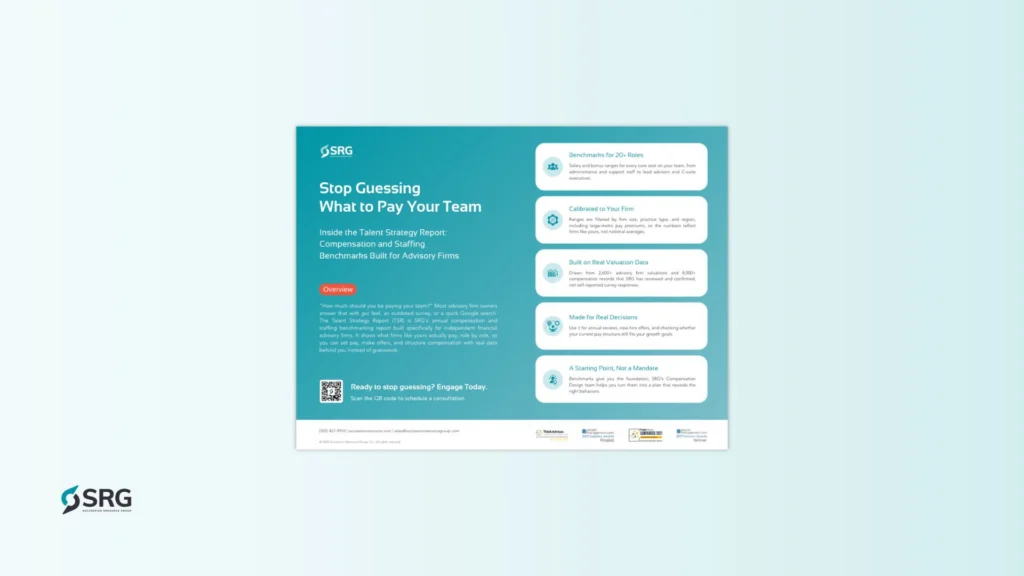
The Talent Strategy Report at a Glance The Talent Strategy Report (TSR) is SRG’s annual compensation and staffing benchmarking report built for independent financial advisory firms. This infographic breaks down what’s inside, how the data is sourced, and what makes it different from the generic salary surveys most firms rely on. If you’re making compensation decisions this year, start here. Download Infographic
Building Your Team for Succession Success
Watch the Replay Does Your Team Structure Support Your Succession Plan? In this webinar, Succession Resource Group’s Julia Sexton, CVA, and David Grau Jr., MBA, explore how employment-related planning can strengthen an advisory firm’s long-term succession strategy. The session covers how employment structure, role clarity, and internal alignment all factor into a firm’s ability to execute a successful transition. Succession Resource Group walks through common organizational and planning gaps that create challenges during succession events, and what firms can do to address them before a transition is on the horizon. Advisors preparing for internal succession, evaluating their current team structure, or working to build a stronger operational foundation will find this session particularly relevant. Host David Grau Jr. MBA CEO/President Paper-plane Linkedin-in Host Julia Sexton, CVA Director of Strategic Organizational Planning Paper-plane Linkedin-in Transcript 100:00:07.270 –> 00:00:16.589David Grau: Good afternoon, everyone. David Grau here, President of Succession Resource Group, welcoming you to our session today. We’ll give you just a second. 200:00:16.870 –> 00:00:20.080David Grau: To get everyone in, Zoom always takes just a minute here. 300:00:20.310 –> 00:00:26.610David Grau: In the meantime, just a couple of quick housekeeping items, while everyone gets in. 400:00:26.710 –> 00:00:28.570David Grau: Gets access to the webinar. 500:00:28.880 –> 00:00:37.189David Grau: session today, hopefully you’re in the right spot. We are talking about building your team for succession, so this is certainly geared 600:00:37.290 –> 00:00:50.419David Grau: towards thinking about internal succession, but we’re going to talk about that as a springboard, or Plan A, and how it, frankly, can help set up Plan B, maybe even Plan C. So even if you’re listening today, and you’re sort of on the fence. 700:00:50.570 –> 00:00:57.540David Grau: About internal succession planning, the viability, ability to get value, there will… 800:00:57.610 –> 00:01:14.159David Grau: be more broad conversations than just internal succession, but we’re gonna come back to that, sort of as plan A for today. So, couple of just general housekeeping items. There’s gonna be a couple of quick poll questions. They won’t slow us down today. They’ll pop up. 900:01:14.160 –> 00:01:22.139David Grau: you can access them, complete them. We do ask if you don’t mind completing them for us. Again, A, they’re softball questions, but B, 1000:01:22.250 –> 00:01:33.490David Grau: they help us… there you go, there’s a poll question… help us bring you better, more refined content. A little bit today. Julie and I are pretty good about adjusting on the fly, but more specifically, we do try to bring 1100:01:33.610 –> 00:01:39.640David Grau: more useful educational content to you throughout the year, and it’s only early June. 1200:01:39.640 –> 00:01:58.830David Grau: So, the more feedback you can give us, the better resources we can provide you in the short term, the better content we can bring you long term. So anyway, I belabored the point. There’s poll questions, there’s one up right now, there’ll be one or two later, but like I said, we’ll continue as we present. If you don’t mind just participating, we’d greatly appreciate it. If you don’t, just stay up there and keep bothering you for the rest of the webinar. 1300:01:58.830 –> 00:02:12.060David Grau: So, second one is the slides. We’re using slides today, obviously, to guide the conversation. You will find them to be amazing slides. We’ve got a great marketing team. Julia and I put a lot of time and effort into them. 1400:02:12.080 –> 00:02:20.589David Grau: to be fair, Julia and Parker put a lot of time into them, and then I took it over for Parker, because he was tied up, we do a lot of project work this time of year. 1500:02:20.700 –> 00:02:31.930David Grau: So I get to step in and pitch it here today and talk with you about this stuff, but the slides are available. We do try to make sure that they are useful to you as standalone resources later. 1600:02:31.930 –> 00:02:46.290David Grau: So if you’d like a copy of those, just let us know. Our team will be reaching out to you, and we’re happy to get you a copy. Last but not least, the session is recorded, so if you have anything that you would like to rewatch, you want to share it with somebody after the fact. 1700:02:46.290 –> 00:02:51.800David Grau: That will also be sent to you, I believe, automatically within, like, 24 hours? 1800:02:52.950 –> 00:03:02.819David Grau: Last but not least, again, we’re gonna focus mostly on planning for internal succession as Plan A, and how that can help support, potentially, a Plan B and Plan C. 1900:03:03.150 –> 00:03:12.749David Grau: But if, as you’re listening today, you think, this is for the birds, or things change over time, it happens, half of our organization 2000:03:12.880 –> 00:03:16.129David Grau: Is dedicated to and focused around 2100:03:16.640 –> 00:03:20.029David Grau: Helping you build a more valuable business, exit that business. 2200:03:20.890 –> 00:03:32.739David Grau: The other half of the business is the listing side, where we can actually help you either confidential, you know, kind of off-market private listing, full-blown listing to bring the most potential candidates in. 2300:03:32.740 –> 00:03:42.240David Grau: So if you do need that solution, it’s different than the rest of the stuff Julie and I will be talking about here today, but we’ve got a whole dedicated team that, if you want to go that route, kick the tires on it. 2400:03:42.560 –> 00:03:54.699David Grau: If you get an unsolicited offer, private equity-backed aggregator, these folks are really good at what they do, and you don’t want to go it alone, we’ve got a whole dedicated team. So, not the topic for today, probably won’t come up again, but just planting the seed. 2500:03:55.760 –> 00:03:59.990David Grau: With that, let’s dive in. So, as we… 2600:04:00.810 –> 00:04:15.990David Grau: look at the calendar for the rest of the year. I mentioned the poll questions help inform the content we bring you. Well, the next two webinars,
Building Your Team for Succession Success
Watch the Replay Please enable JavaScript in your browser to complete this form.Please enable JavaScript in your browser to complete this form.First Name *Last Name *Phone * Work Email * Would you like to join SRG’s newsletter to receive industry updates and other webinar opportunities? Yes No Access Recording Does Your Team Structure Support Your Succession Plan? In this webinar, Succession Resource Group’s Julia Sexton, CVA, and David Grau Jr., MBA, explore how employment-related planning can strengthen an advisory firm’s long-term succession strategy. The session covers how employment structure, role clarity, and internal alignment all factor into a firm’s ability to execute a successful transition. Succession Resource Group walks through common organizational and planning gaps that create challenges during succession events, and what firms can do to address them before a transition is on the horizon. Advisors preparing for internal succession, evaluating their current team structure, or working to build a stronger operational foundation will find this session particularly relevant. Host David Grau Jr. MBA CEO/President Paper-plane Linkedin-in Host Julia Sexton, CVA Director of Strategic Organizational Planning Paper-plane Linkedin-in
Financial Advisor Compensation Guide for Advisory Firm Owners

Last Updated: August 25, 2026 Author What’s “Fair” Advisor Compensation? Compensation is both the engine that drives a service-based advisory firm and the issue that keeps firm owners up at night. Everyone wants to pay their people fairly, but what fair looks like depends on your firm’s size, structure, growth goals, and the roles people actually play on your team. The challenge is that many advisory firms are still running compensation models that were designed for a different era; one where individual production was the primary measure of value and every advisor operated as a standalone business under a shared brand. Those models worked when the industry looked that way. For many firms, the industry no longer does. In a recent episode of The Fine Print Podcast, David Grau Jr. sat down with Julia Sexton, CVA, who leads SRG’s compensation design, employment agreements, and equity sharing services, to walk through the key decisions that firm owners face when redesigning compensation. This article distills that conversation into a practical guide — organized around the decisions you need to make, in the order you need to make them. Start with the Data: Know What the Market Is Actually Paying Before you redesign anything, you need a reliable baseline. Strategy aside, if your compensation is 40% above or below the market for similar roles, you have a problem that no structure can solve. For years, the industry relied on the Investment News / Moss Adams compensation study as the go-to benchmarking resource. It had an interactive dashboard where you could filter by firm size, region, and role. That resource was eventually shuttered, and while it has returned in a free version, it now pulls from government sources rather than industry-specific survey data — making it significantly less reliable for advisory firms. SRG developed its Talent Strategy Report (TSR) to fill that gap. Rather than relying on self-reported survey data, the TSR draws from thousands of valuations performed annually — meaning the compensation data has been vetted, reviewed on calls with firm owners, and confirmed for accuracy before it enters the data set. The report covers compensation by role, firm size, and staffing benchmarks so you can see what peers at similar-sized firms are paying and how they are staffing. A few things worth noting from the data: Location matters less than it used to. With remote work now standard at many firms, geographic premiums have compressed. Compensation for the same role is more consistent across regions than it was five years ago. Firm size does not create as big a gap as you would expect. A lead advisor at a $3 million firm and a $7 million firm often earn similar total compensation — but for different reasons. Smaller firms tend to pay more per person because each person wears more hats and larger firms requiring more bodies are able to specialize more in each role. So maybe at the core, a larger firm is ‘paying more’ for the core duties of the specific role, but the reality is that smaller firms have similar if not the same tasks and responsibilities, just shared across less people – so we don’t see this changing. You should be checking this at least annually. Compensation benchmarking is not a one-time exercise. At minimum, pull updated market data every year — every other year at the outside — to make sure you are staying competitive. The bottom line: any compensation redesign should start with current, reliable data. If you are working from a study that is three years old or based on a survey with a few hundred respondents, you are building on a shaky foundation. Choose Your Model: Grid-Based vs. Ensemble Compensation This is the foundational decision, and it flows directly from a bigger question: what kind of firm are you building? Grid-based (production-based) compensation assigns each advisor a book of business and pays them a percentage of the revenue they manage — typically 30% to 45%. It is simple, familiar, and effective at incentivizing individual production. It is the model that most of the industry grew up on, originating in the wirehouses and migrating to the independent channel as advisors went out on their own. Ensemble (team-based) compensation pays advisors a base salary reflective of their role and responsibilities, with variable bonuses tied to specific goals and behaviors, and potentially a share of firm profits. It is designed to incentivize collaboration, specialization, and enterprise value. The critical insight is that your compensation model will drive behavior whether you intend it to or not. If you pay advisors on individual production, they will optimize for individual production — even if you tell them you want collaboration. You cannot put the incentives in one place and expect behavior in another. About 95% of the teams we talk to say they want to build a collaborative, team-based firm. Yet many of them are still running a production-based compensation model. If that describes your firm, the structure and the strategy are in conflict, and compensation will win that fight every time. That said, grid-based compensation is not inherently wrong. If your firm genuinely operates as a collection of individual practitioners under a shared brand — what we sometimes call a “team in name only” — then production-based pay is aligned with that reality. The problems arise when the stated goal is collaboration and scale, but the compensation model still rewards siloed behavior. Before redesigning anything, be honest with yourself about your firm’s long-term goals and strategy. Are you building an integrated enterprise, or are you running a platform for independent advisors? Either is valid. But the compensation structure needs to match. The Hidden Cost of Grid-Based Compensation Even if a grid-based model made sense when your firm was smaller, it can become a serious liability as you grow. Here is the math that tends to catch firm owners off guard. You assign an advisor 100 households representing $100 million in AUM and $1 million in annual fees. You
2026 State of Compensation: Pay, Equity & Incentives for RIAs and Advisory Teams
Watch the Replay Is Your Compensation Plan Helping You Grow or Holding You Back? Not sure what to pay your advisors and team in 2026, or whether your current compensation plan is actually competitive? In this on-demand webinar, SRG breaks down real-world compensation benchmarks for RIAs and advisory firms, including salary ranges, bonus structures, phantom equity, and staffing trends across advisor, operations, and executive roles. Using data pulled from valuation and compensation analyses, you’ll see what firms are actually paying and how to align incentives with the behaviors you want, so you can attract and retain talent without letting compensation outgrow the role. Download the Presentation Deck Here Download Speakers Host Julia Sexton, CVA Director of Strategic Organizational Planning Paper-plane Linkedin-in Host Ryan Grau, CVA, CBA Director of Valuations Paper-plane Linkedin-in Transcript 100:00:04.740 –> 00:00:10.010Ryan Grau: Hey, good afternoon. Thank everybody, everybody, for taking time out of your day to join us. 200:00:10.250 –> 00:00:16.739Ryan Grau: We still have people that are signing in and getting join… or joining the session here, so we’ll give everybody a second. 300:00:17.090 –> 00:00:18.570Ryan Grau: Before we dive in. 400:00:20.620 –> 00:00:36.559Ryan Grau: So, our primary topic today is going to be compensation trends. So, for those of you that are tuning in, this is going to be the first of an annual series of presentations that we’re going to be presenting. So, in case you missed it. 500:00:36.570 –> 00:00:44.729Ryan Grau: Last month, we gave our update on mergers and acquisitions and activities for… from 2025. 600:00:44.820 –> 00:00:52.509Ryan Grau: What we’re going to be discussing on today’s presentation is trends in compensation that we observed over 2025. 700:00:52.920 –> 00:00:53.740Ryan Grau: So… 800:00:54.130 –> 00:01:00.729Ryan Grau: Before we get started, we’re gonna launch some polling questions here for you, and while you’re doing that. 900:01:00.830 –> 00:01:15.900Ryan Grau: I do want to let you know that this presentation will be recorded, so if you’re not able to sit through the entire presentation, we will send you a link, and we ask that if you find the content that we share with you today helpful, that share the link with your colleagues. 1000:01:22.630 –> 00:01:26.580Ryan Grau: Alright, so I’ll give you guys just a few more seconds here to work through those polling questions. 1100:01:33.140 –> 00:01:40.049Ryan Grau: And following our presentation today, we do have a couple more presentations that are coming up in both March and April. 1200:01:40.390 –> 00:01:50.640Ryan Grau: David Grau, Parker Fino, and Kristen Grau are going to be talking about, how to grow your firm without limitations, 1300:01:50.890 –> 00:02:00.559Ryan Grau: in March, and then in April, Nicole Frye will be doing a presentation on mergers and teaming. 1400:02:05.220 –> 00:02:14.020Ryan Grau: All right, we should be wrapped up with the poll questions. So, for those of you that are not familiar with SRG and are just tuning in. 1500:02:14.150 –> 00:02:24.270Ryan Grau: So, SRG has been guiding advisors in the independent space, so both registered reps and RIAs, of various sizes for over 14 years now. 1600:02:24.950 –> 00:02:31.899Ryan Grau: Our team brings together professionals who specialize in everything from valuation to value building. 1700:02:32.100 –> 00:02:41.499Ryan Grau: Exit planning and exit strategies, and what we’ll be talking about today, compensation strategies, employment resources, and compensation design. 1800:02:42.060 –> 00:02:48.249Ryan Grau: So, we’ve completed several thousand valuations, as well as mergers and acquisitions, deals. 1900:02:48.510 –> 00:02:54.659Ryan Grau: We’ve done hundreds of succession plans, so internal transition of ownership to key employees. 2000:02:54.870 –> 00:03:04.510Ryan Grau: And we are here today to offer the depth and experience that we have collected over the years to help you make informed decisions around compensation. 2100:03:05.430 –> 00:03:08.950Ryan Grau: So, beyond just compensation data. 2200:03:09.070 –> 00:03:17.369Ryan Grau: SRG offers a variety of services, so our bread and butter is valuations, that’s what me and my team focus on. 2300:03:17.530 –> 00:03:35.650Ryan Grau: But beyond that, we help advisors with structuring their business from entity setup, redesign, and reorganization. We assist in creating employment contracts, the succession plans, equity sharing models, whether that be phantom or synthetic equity or other forms. 2400:03:35.720 –> 00:03:51.650Ryan Grau: We also address death and disability planning, and then, last and not least, is we offer full deal support for advisors that are in transition. So, we work with buyers and sellers to put together their purchase agreements. 2500:03:51.650 –> 00:03:59.409Ryan Grau: We work with buyers to network and find potential sellers, and vice versa. We work with sellers to help them find potential buyers. 2600:03:59.490 –> 00:04:03.729Ryan Grau: We also work on mergers of various scale 2700:04:04.280 –> 00:04:16.430Ryan Grau: So, our job is to help you understand value, what those KPIs are, what levers you can pull to continue driving value, and then how to make sure that you can put your value to work. 2800:04:16.649 –> 00:04:23.870Ryan Grau: And make sure that it’s protected for… Creating transferable and enduring value. 2900:04:25.020 –> 00:04:25.860Ryan Grau: So… 3000:04:26.580 –> 00:04:41.200Ryan Grau: Today’s presenters is going to be Julia Sexton and myself. Julia’s going to be doing a lot of the heavy lifting, so she leads our team on what we call our HR solutions, which includes compensation design. 3100:04:41.340 –> 00:04:47.140Ryan Grau: Compensation strategies, equity sharing, as well as employment resources. 3200:04:47.540 –> 00:04:52.549Ryan Grau: Julia has been consulting financial advisors now going on 8 years. 3300:04:52.810 –> 00:05:11.079Ryan Grau: Her role originally started in valuation work, and then shifted into helping advisors that were merging silos together. So, her work naturally evolved from valuation to providing ownership, equity recommendations, and merging firms together. 3400:05:11.080 –> 00:05:20.959Ryan Grau: As well as deal support, and then from there, one of the big issues that most advisors run into when bringing their practices together is compensation. 3500:05:20.970 –> 00:05:33.430Ryan Grau: So, and specifically in those type of deals, it’s owner compensation, and how do we set level and fair compensation, which tends to
Equity Compensation: A Technical Comparison between Restricted Equity Grants

Please enable JavaScript in your browser to complete this form.Please enable JavaScript in your browser to complete this form. Name * FirstLast Phone Work Email *How Did You Hear About SRG? *— Select Choice —ConferenceDirect MailExisting/Past ClientGoogle AdWordsOtherReferralSocial MediaSeminar/WorkshopWebinarWebsite Download Empower your team and strengthen the long-term health of your business with SRG’s “Equity Compensation: A Technical Comparison Between Restricted Equity Grants” white paper. This practical, easy-to-understand resource breaks down the key differences between Restricted Stock Awards (RSAs) and Restricted Stock Units (RSUs) — two of the most common tools for sharing ownership value and aligning employees with your company’s future. Whether you’re designing a new equity plan, preparing for growth, or looking to retain top talent, this guide clarifies the structural, tax, and ownership considerations every business owner should understand. From grant mechanics and vesting to 83(b) elections and S-Corp compatibility, you’ll learn how each approach impacts control, complexity, and long-term planning. Explore how the right equity strategy can motivate your team, support succession goals, and protect the value you’ve built. Download the white paper today and make confident, informed decisions about equity compensation.
Breaking the Cycle | Compensation Strategies That Protect Value & Drive Growth
Valuation expert Ryan Grau, CVA, CBA, and compensation strategist Julia Sexton, CVA, reveal the most common comp mistakes—and how to fix them. Learn how to build pay models that drive growth, retain talent, and preserve business value. Watch the Replay Host Julia Sexton, CVA Director of Strategic Organizational Planning Paper-plane Linkedin-in Host Ryan Grau, CVA, CBA Director of Valuations Paper-plane Linkedin-in