Authors

Kristen Grau, CPA, CVA, CEPA, Executive Vice President
Kristen Grau is the Executive Vice President of Succession Resource Group, where she leads the firm's Seller Advocacy program. A CPA, CVA, and CEPA with over a decade of experience as a business appraiser and sell-side adviser in financial services, Kristen has helped sell and transition more than 100 advisory businesses ranging from $40 million to $1 billion in AUM.

Nicole Frey, CFP®, Director of Team Solutions
Nicole Frey, CFP®, is Director of Team Solutions at Succession Resource Group, where she specializes in entity formation, organizational restructuring, and merger transactions for independent financial advisors, registered investment advisors (RIAs), and insurance professionals. With more than a decade at SRG, Nicole has guided approximately 200 entity and merger engagements each year, helping advisors structure entities to facilitate equity sharing, expense management, shared service arrangements, and ensemble practice formation.
"It depends on your objectives."
The right exit path for your advisory firm depends on your objectives, not your firm’s size. A merger and a sale serve fundamentally different goals, and choosing the wrong one can cost you years, money, and the legacy you spent decades building. This article walks through both paths and provides a framework to help you decide which one fits your situation.
"Should I merge or sell my firm?"
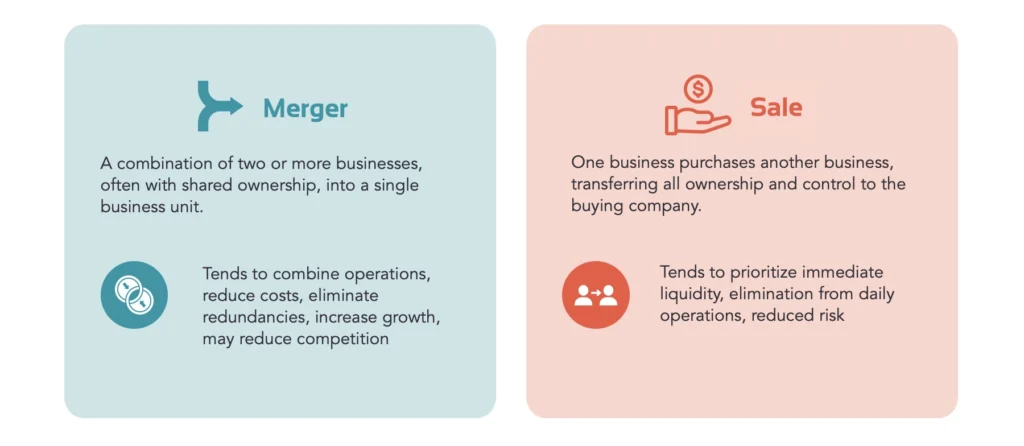
These two terms get used loosely in financial services, and the confusion creates real problems when it comes time to plan an exit. Before evaluating either path, it helps to start with clear definitions.
A merger is a combination of two or more businesses into a single entity with shared ownership and shared control. Two firms become one new operating unit. Revenue, expenses, and profits are pooled. Both parties typically stay involved in the business going forward, often for years. Mergers tend to combine operations, reduce duplicative costs, and create growth opportunities that neither firm could achieve alone.
A sale is a transfer of ownership from one party to another. The buyer acquires the business, and the seller exits daily operations. A sale prioritizes immediate liquidity and a clean reduction in risk. Once the deal closes, the seller’s ongoing involvement is typically limited to a defined transition period.
"A merger isn't just a smaller sale, and a sale isn't automatically the better move. The right path depends on what you want your role, your clients, your team, and your legacy to look like once the transaction is done."
Kristen Grau, CPA, CVA, CEPA
Why Your Exit Path Shapes Everything That Follows
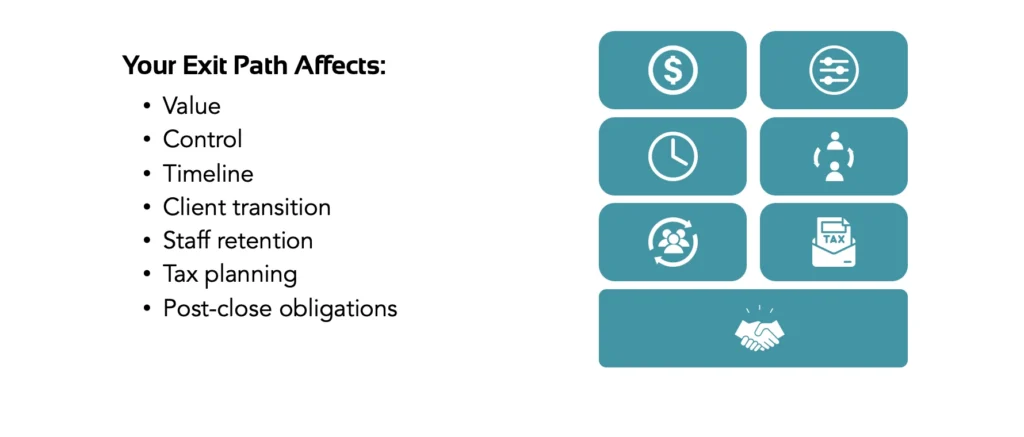
This is not a decision that affects one part of your business. It touches seven areas at once, and each one plays out differently depending on which path you choose.
Value. A merger and a sale get valued differently and, more importantly, get paid out differently. In a sale, the purchase price is typically a defined sum paid through some combination of cash at close, a promissory note, and earn-out payments. In a merger, the “price” is usually expressed as an equity stake in the combined entity, which appreciates over time rather than arriving as a lump sum.
Control. In a sale, control transfers entirely to the buyer. In a merger, control is shared, which means you keep influence over decisions but also share that influence with your partner.
Timeline. Some exits wrap up in months with a defined end date. Others keep you involved for 5 to 15 years. The path you choose determines which end of that spectrum you land on.
Client transition. How your clients experience the change depends heavily on the structure. A merger can position the transition as a growth story. A sale requires a more deliberate communication strategy to ensure clients feel secure with a new owner.
Staff retention. Your team watches closely during a transition. In a sale, staff may face uncertainty about their roles under new ownership. In a merger, the combined entity may create new opportunities, but it can also create redundancies that need to be resolved.
Tax planning. The two paths create different tax outcomes. In a sale, the deal structure determines how proceeds are taxed. In a merger, equity contributions can often be structured as tax-deferred events, though the specifics require careful planning.
Post-close obligations. A sale typically involves a defined transition period with clear boundaries. A merger means ongoing obligations as a co-owner, including governance, decision-making, and shared accountability for results.
"Your exit path isn't a decision you make once and forget. It shapes years of your life afterwards."
Kristen Grau, CPA, CVA, CEPA
The Sale Path: What to Expect
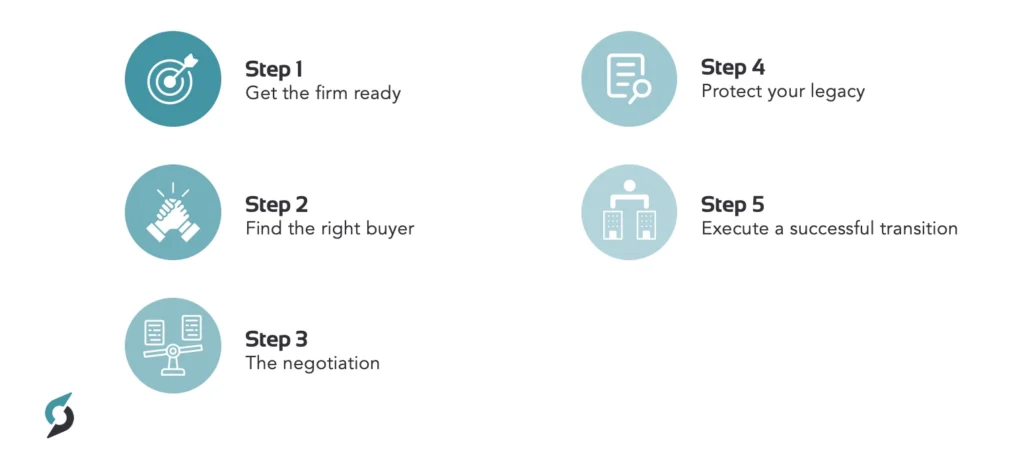
Most advisors think they understand what selling looks like. But the firms that get the best outcomes follow a structured process that starts well before any buyer enters the picture.
Step 1: Get the Firm Ready
This is the step most advisors underinvest in because it does not feel like progress. There is no buyer yet, no offer, nothing exciting happening. But this is where deals are won or lost.
Start by clarifying your objectives. What do you want your life to look like in three years? What does a successful outcome look like for your clients and your team? Without clear answers to these questions, you cannot evaluate any offer against your actual goals.
Then get your financials in order. Organize historical and current financial data from sources a buyer can verify.
"Sloppy books don't just slow due diligence, they cost you money. Uncertainty and a lack of organization gets priced as risk."
Kristen Grau, CPA, CVA, CEPA
Third, get a formal valuation. A certified valuation report helps you understand your value, what is driving it, and what is putting it at risk. Do this well before sitting across from a buyer who already knows your numbers.
Finally, streamline your processes. Reduce how much of the business runs through you personally. Document your workflows.
"Every process that is tied directly to you, or goes undocumented, is a discount that the buyer will find."
Kristen Grau, CPA, CVA, CEPA
Step 2: Find and Screen the Right Buyer
Finding a buyer is not a sourcing problem. It is a screening problem. Advisors receive unsolicited acquisition letters regularly. The work is figuring out which buyers are actually right for you.
Screen every buyer against consistent criteria: financial strength, how they are funding the transaction, their plan for your clients and team, their track record of closing deals, and whether their timeline aligns with yours. Applying the same evaluation framework across all candidates lets you compare offers meaningfully rather than reacting to whichever one arrives first.
SRG’s Seller Advocacy program handles this screening and negotiation process on behalf of sellers. For those who have already identified a buyer, SRG’s Deal Support service provides valuation, structuring, and contract support on a flat-fee basis.
Step 3: Negotiate the Structure
The central question in any sale negotiation is whether you are selling the assets of your business or the equity in your entity. This single choice drives your tax outcome, negotiating leverage, and optionality.
In an asset sale, the buyer purchases your book of business, client relationships, and select assets. This is the most common structure in advisory practice sales. In an equity or stock sale, the buyer purchases your ownership interest in the entity directly, and contracts and liabilities generally transfer with it. Equity sales can result in higher client retention rates, but buyers are often hesitant because they inherit liabilities.
Beyond the deal structure, four specific deal points deserve close attention: (1) how the purchase price is paid, including the mix of cash, notes, and earn-out payments; (2) your role, transition period, and compensation during it; (3) continuity provisions covering employees, locations, platforms, and billing; and (4) risk allocation, including any performance targets, non-competes, and clawback provisions.
"A dollar of cash and a dollar of earnout are not worth the same to you, and often adjust the risk profile substantially."
Kristen Grau, CPA, CVA, CEPA
Steps 4-5: Transition and Execution
Legacy protection is not a final step. It is something you should think about from the beginning. Ensure client communication reflects your historical style. Get genuine buy-in from your staff by helping them understand how the deal protects their interests.
"Uncertainty is what drives client attrition, not the change itself."
Kristen Grau, CPA, CVA, CEPA
During execution, track five markers: agreed milestones and responsibilities, client communication, client consent and repapering completion, smooth account transfers, and retention measured by revenue or AUM. On that last point, retention numbers can be misleading.
"You can retain 95% of your clients and still lose real value if two households left happen to be your largest."
Kristen Grau, CPA, CVA, CEPA
Prioritize outreach to your largest and most at-risk clients first.
For a more detailed walkthrough of the selling process, see our full guide: How to Sell Your Financial Advisory Book of Business.
The Merger Path: What to Expect
A merger is not just a slower sale. It is a fundamentally different transaction with different goals, different economics, and different risks.
"In a merger, you are not just transferring clients or revenue. You are actually redefining ownership, roles, economics, and how decisions will be made going forward."
Nicole Frey, CFP®
Why Firms Merge
Advisors pursue mergers for four primary reasons. First, growth: a merger lets you serve more clients, enter new geographic markets, and expand your service model without doubling operating costs. Second, risk reduction: adding a partner creates a definitive succession plan and protects against key-person risk from death or disability. Third, operational efficiency: the combined entity can support specialized roles, reduce per-person costs, and negotiate better terms with vendors and custodians. Fourth, improved business outcomes: larger firms have more leverage on payout grids, benefits plans, and recruiting.
Finding the Right Partner
The right merger partner should be similar or complementary to your business across service model, client demographics, technology, compliance culture, and growth goals. Start with your network. Attend broker-dealer conferences, connect with business coaches, reach out to industry contacts. Build trust through high-level conversations before sharing detailed information under an NDA.
One critical screening item: growth goals. If one party wants to grow aggressively while the other is slowing down, the imbalance creates friction around compensation and workload distribution. Different growth ambitions can be managed, but they need to be addressed before the merger, not after.
Valuation and Ownership Division
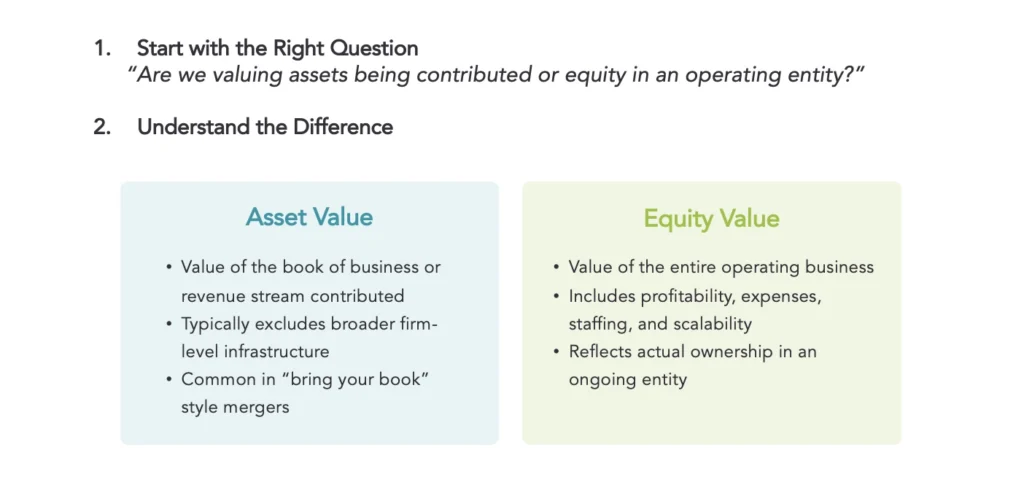
In a merger context, valuation serves a different purpose than in a sale. Rather than setting a purchase price, the valuation determines how ownership is divided. If Party A is valued at $1 million and Party B at $500,000, Party A typically receives two-thirds ownership and Party B one-third.
The valuation approach matters. For two solo advisors combining books of business, asset value is usually sufficient. For more complex firms with substantial balance sheets, acquisitions, and existing liabilities, equity value is more appropriate. The parties do not have to use the same approach, but valuations should share the same effective date.
Structuring the Deal
Nicole warns that some mergers look great on paper but fall apart in the cash flow analysis.
"Sometimes these mergers look really great theoretically. However, when you actually start plugging in each party's numbers in a spreadsheet, you might find that one of the owners will end up with less cash flow than what they had before the merger."
Nicole Frey, CFP®
This happens when two parties with different profit margins combine and profits are allocated by ownership percentage. Remedies include adjusting the grid rate, reducing P&L redundancies, or structuring short-term compensation adjustments.
Owner roles and commitments must be defined before the merger closes.
"The merger is basically a marriage on the business level. That merger date marks your wedding date, and then all of a sudden you enter into this honeymoon period, and you don't know who's doing what."
Nicole Frey, CFP®
Governance documents should clearly address ownership classes, voting thresholds, management responsibilities, and exit provisions in case the partnership does not work out.
For a deeper look at the merger process, read our full guide: How to Make a Merger a Growth Move: A 5-Step Roadmap.
How Mergers and Sales Compare
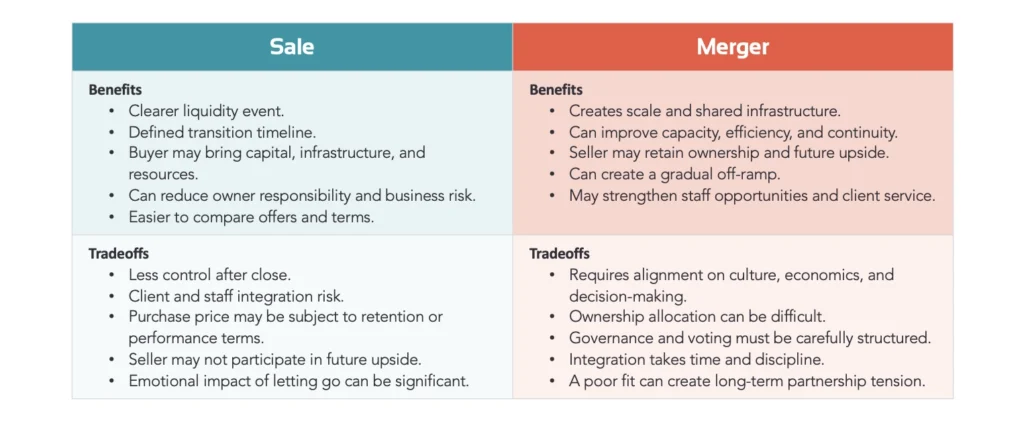
When you line up the two paths across the dimensions that matter most, the differences become clear.
Ownership outcome. In a sale, ownership transfers fully to the buyer. In a merger, ownership is shared in the combined entity based on relative valuations.
Cash at close. A sale typically provides a defined purchase price with some portion paid in cash at closing. A merger typically provides equity in the new entity, with minimal or no cash at close. If cash is a component of a merger, the amount must be carefully structured to avoid the IRS treating the entire transaction as a disguised sale.
Ongoing involvement. After a sale, involvement is limited to a defined transition period, often 12 to 24 months. After a merger, ongoing involvement as a co-owner is the expectation, often lasting 5 to 15 years.
Risk profile. A sale reduces risk by transferring it to the buyer. A merger redistributes risk across partners. In a merger, your financial outcome is tied to the performance of the combined entity over time.
Client impact. In a sale, clients transition to a new firm and a new advisor relationship. Communication must be carefully managed. In a merger, clients remain within the combined entity, and the change can be positioned as enhanced service capacity.
Team impact. In a sale, staff may face uncertainty about their roles. In a merger, the combined entity creates opportunities for career growth, but also introduces potential redundancies that need to be addressed transparently.
Timeline. A sale can be completed in 6 to 12 months from engagement to close. A merger engagement typically spans 9 to 12 months for the formation phase alone, with integration continuing well beyond close.
Tax structure. Sale proceeds are typically taxed as capital gains or ordinary income depending on deal structure. Merger equity contributions can often be tax-deferred, though the specifics depend on entity type and structure.
How Do You Know Which Path Fits?
The decision comes down to your personal and professional objectives, not your firm’s revenue or AUM.
You are likely a strong sale candidate if you want a clear transition with a defined end date, you are ready to meaningfully reduce or eliminate your ongoing workload, and you prefer a clean transfer of ownership rather than an ongoing shared decision-making relationship. A sale is also the right path when you do not have an internal successor, or when the business has outgrown what an internal successor can realistically handle.
You are likely a strong merger candidate if you genuinely want to keep working and building for another 5 to 15 years, you are comfortable sharing leadership and decision-making, and your firm can adapt its processes and technology to integrate with another operation.
Hybrid approaches exist. A “sell-and-stay” arrangement lets you sell your practice but remain in an employment or contractor capacity, giving you liquidity while maintaining client relationships. An internal succession plan can also serve as a precursor to either path, positioning the firm for a future sale or merger from a position of strength.
The most important thing is to make the decision deliberately. Talk to your clients about succession planning. Get a valuation so you understand your starting position. And work with advisors who have been through both paths and can help you evaluate the trade-offs objectively.
SRG’s Seller Advocacy program represents sellers through the full sale process. For mergers, SRG’s Advisor Merger Support team handles entity formation, valuation, deal structuring, and integration. For buyers exploring acquisitions, SRG’s AcquireEdge program provides buy-side representation.
Frequently Asked Questions
Does firm size determine whether I should sell or merge?
No. This is one of the most common misconceptions. Advisors often assume larger firms merge and smaller firms sell, but that is not how it works in practice. Firms of all sizes pursue both paths. The deciding factor is your objectives: what you want your involvement, timeline, and financial outcome to look like.
Can I sell my practice and still keep working?
Yes. A “sell-and-stay” arrangement lets you sell your book of business and then continue working as an employee or contractor at the acquiring firm. You receive liquidity from the sale while maintaining your client relationships and daily routine. This structure is more common than many advisors realize.
How long does each process take?
A sale typically takes 6 to 12 months from initial engagement to closing, depending on the complexity of the deal and the speed of due diligence. A merger formation process typically spans 9 to 12 months through entity formation and legal documentation. Post-merger integration continues beyond that, with most firms conducting monthly reviews for the first year and quarterly reviews thereafter.
Do I need a valuation before deciding which path to pursue?
Yes. A formal valuation helps you understand your starting position regardless of which path you choose. In a sale, it tells you what your firm is worth and what is driving that value. In a merger, it determines how ownership will be divided. In both cases, getting valued before entering negotiations ensures you are driving the conversation rather than reacting to numbers presented by the other party.
What types of buyers are active in the market right now?
The buyer market includes both private equity-backed consolidators and independent firms such as RIAs and broker-dealer-affiliated practices. PE firms tend to generate more headlines, but independent buyers remain active across all deal sizes. Whether a PE buyer or an independent firm is the right fit depends on your objectives: PE buyers may offer higher headline multiples, while independent buyers may offer more flexibility on timeline, transition role, and cultural continuity.
This article is based on the SRG webinar “Merger or Sale: Finding the Right Path to Your Exit,” presented by Nicole Frey and Kristen Grau on August 5, 2026.