


There are dozens of factors that influence the value of a business, but in reality, there are only a few key performance indicators that materially drive the value, and that's where most advisors should focus first. Recurring revenue, organic growth, profitability, client age, AUM concentration and key-person dependency are the factors to focus on first. Metrics like return on assets mostly describe the practice and may highlight future opportunity, but by themselves have only a minimal impact. Most of the drivers take two to three years to change, so the time to measure them is well before an offer arrives.
That was the core message of SRG's webinar, Valuation Best Practices: Stop Leaving Money on the Table, hosted by Ryan Grau, CVA, CBA, and David Grau Jr., MBA. This article walks through what they covered: why your practice has more than one value, which KPIs set your multiple, the mistakes that cost advisors money, and when to get a formal valuation.
Why does your advisory practice have more than one value?
Value follows cash flow, and cash flow depends on why you need the number and who you assume is buying. The same practice can be worth $846K to an internal successor and $2.5M to an outside buyer. Neither number is wrong. They answer different questions.
Purpose comes first. Some valuations are binding: they have to hold up to a lender, a court or the IRS. That includes SBA and bank acquisition loans, divorce, partner disputes, estate and gift tax, and buy-sell agreements that set a price by appraisal. Others are decision-making valuations that inform your next move, such as exit planning, merger pricing, succession planning and year-over-year benchmarking.
The buyer comes second. Each buyer type has different cash flow on the same business being valued:
An internal sale often prices lower because a key employee buying in brings no synergies. A peer in the area can drop the second office location, a second receptionist and a second investment manager, so the same revenue produces more cash flow for them. For a deeper look, read why your practice's value depends on the buyer.
How do valuations actually work?
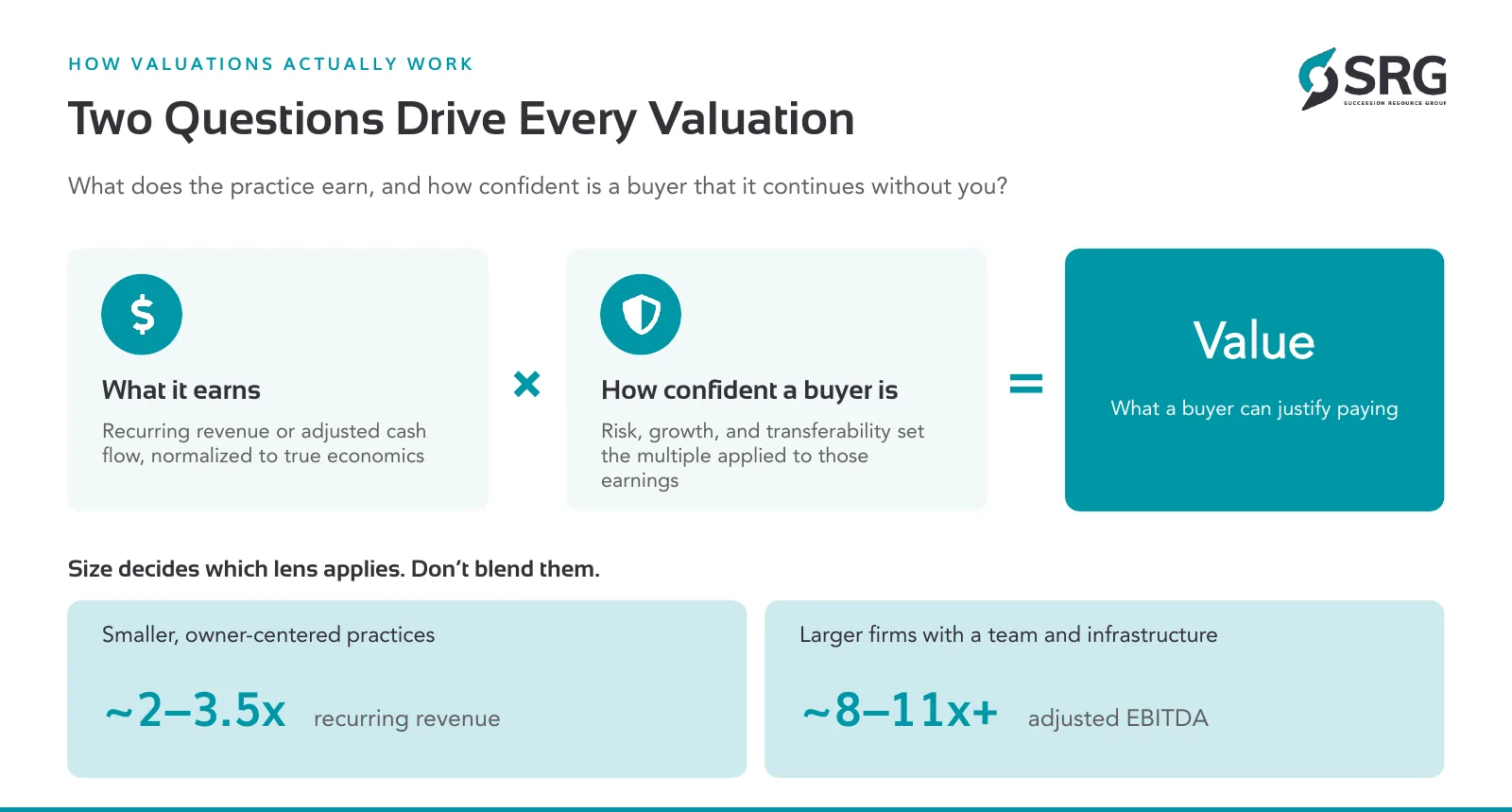
Every valuation answers two questions: what does the practice earn, and how confident is a buyer that those earnings continue without you? Earnings are measured as recurring revenue or normalized cash flow. Risk, growth and transferability set the multiple applied to them.
Size decides which lens applies. Smaller, owner-centric practices (often called "lifestyle practices") are usually valued on recurring revenue, at roughly 2x to 3.5x. Larger firms with a team and infrastructure are valued on adjusted EBITDA, at roughly 8x to 11x or more. Industry-wide, the average recurring revenue multiple for an RIA sits around 3.27x, inside a range of about 2x to 4.5x.
Averages are useful for benchmarking and useless for pricing. As pointed out during the webinar, they work like price-per-square-foot in real estate: worth knowing, but you would never buy or sell a home on that number alone. Our guide to how RIA valuations work covers the methods in more detail.
Which KPIs actually move your valuation multiple?
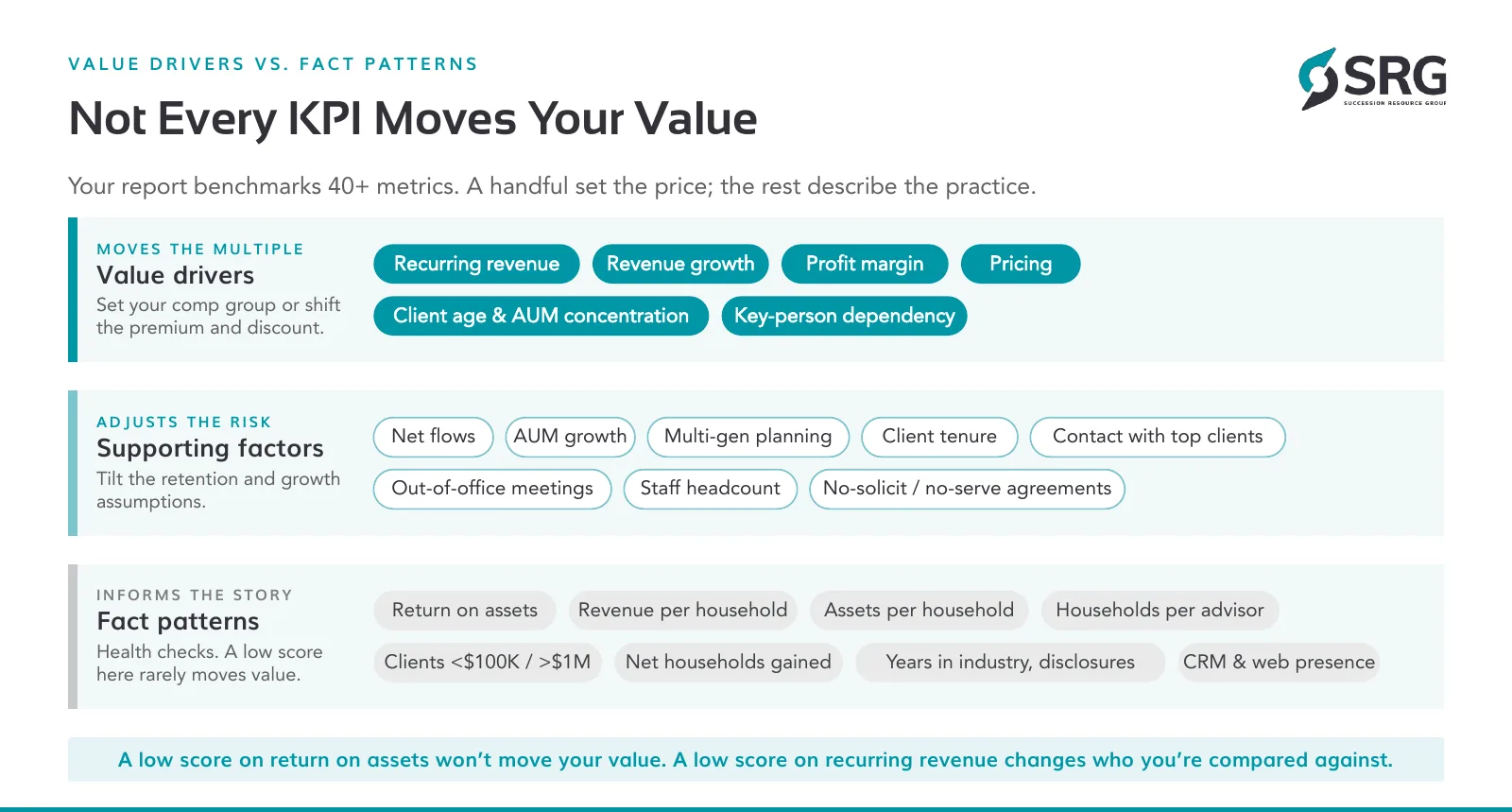
A small group of value drivers sets your multiple, a second group adjusts the risk, and the rest are fact patterns that tell the story. A typical SRG valuation report benchmarks more than 40 metrics.
Here is how we sort them:
Value drivers (move the multiple)
- Recurring revenue
- Revenue growth
- Profit margin
- Average fees
- Client age and AUM concentration
- Key-person dependency
Supporting factors (adjust the risk)
- Net flows and AUM growth
- Multi-generational planning
- Client tenure and contact with top clients
- Out-of-office meetings
- Staff headcount
- No-solicit and no-serve agreements
Fact patterns (inform the story)
- Return on assets
- Revenue and assets per household
- Households per advisor
- Clients under $100K or over $1M
- Years in the industry, disclosures, CRM and web presence
Recurring revenue sets your comparison group
Recurring revenue is the biggest risk lever in any advisory practice. When we pull market comparables, we filter by transaction date, size and revenue mix, so your recurring percentage decides which practices you're measured against. On the high end of the market, revenue multiples reach almost 4.5x for well-run practices. On the low end, commission revenue tied up in surrender periods can trade at 0.1x to 0.2x, and in some cases has no value to a buyer.
Non-recurring revenue is harder to value. The average multiple works out to roughly 0.63x, but in practice, buyers pay either 1x (when you can show a consistent track record) or zero (for a one-time sale with no historical track record).
Organic growth measures what you and your team produce
For most advisors, more than half of their annual growth comes from the market. Buyers want to see what you and your team are producing, not how the market has performed. Thus, we look at two things:
- Net new assets. New households from referrals and converted leads, minus households lost and the AUM that left with them.
- Net flows from existing clients. Younger clients add assets. Retired clients draw them down.
It's common to see a practice bring in $8 million in net new assets while net flows land at only $2 million, because an older client base is drawing down faster than new business replaces it.
Client age and AUM concentration
Many advisors underestimate how old their book is. In our debrief calls with valuation clients, it's common to find 75% to 84% of AUM held by clients aged 61 and older, against a benchmark closer to 60%. The age of your assets matters more than the average age of your households, because older clients' portfolios tend to be more conservative and participate less in market growth.
While you can't make clients younger, you can make the book younger. Bring your best clients' children and grandchildren into the planning process, and consider adding a next-generation advisor who connects naturally with younger households.
Profitability depends on compensation design
The biggest expense in a professional service business, and driver of profitability, is how you pay people. Revenue splits, revenue sharing and equity granted outside the ownership group also pull value down quickly, and they get harder to unwind the longer they stay in place. A right-sized team using the salaried advisor model (base salary, bonus, profit share and a pathway to equity) pushes value up. SRG's compensation design work focuses on exactly this, and it's one of the biggest changes in the last few years impacting advisor valuations.
Key-person dependency and personal branding
Buyers price in how the practice performs without you. Bringing partners into the ownership circle and building a team that owns client relationships spreads goodwill beyond one person. A practice with your name on the front door concentrates it. All personal branding does is amplify key-person risk, and at retirement, it results in a loss of continuity from one generation to the next, increasing risk and lowering value.
What does the difference look like in dollars?
Here is an illustrative example we shared during the webinar. Both practices produce $1M in annual revenue.
Same revenue, a $1.2M difference. This is an illustration for discussion, not an indication of value for any specific practice.
What mistakes undermine a valuation?
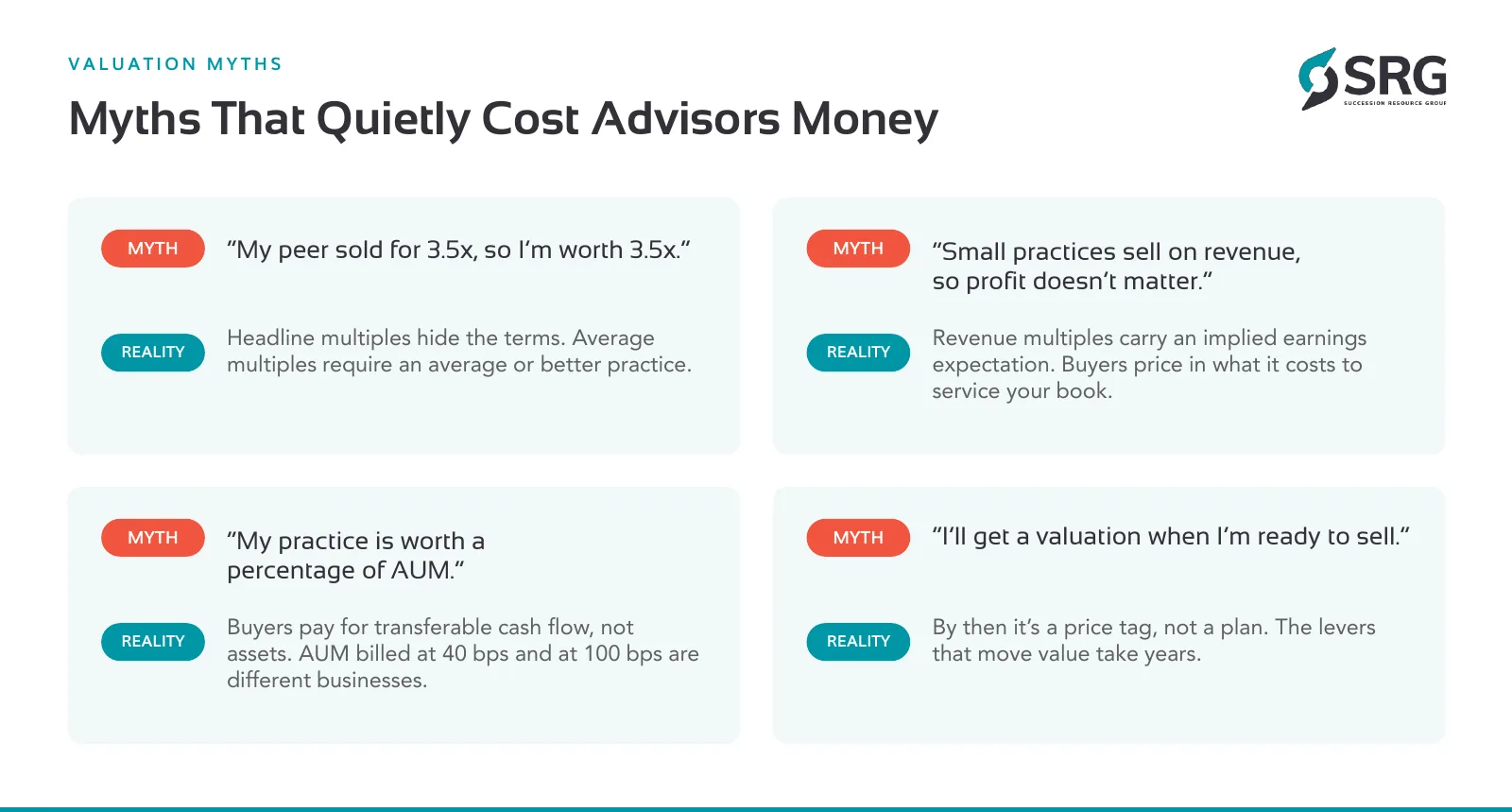
Most bad valuation numbers trace back to one of four mistakes: the wrong question, the wrong inputs, the wrong benchmark or the wrong timing.
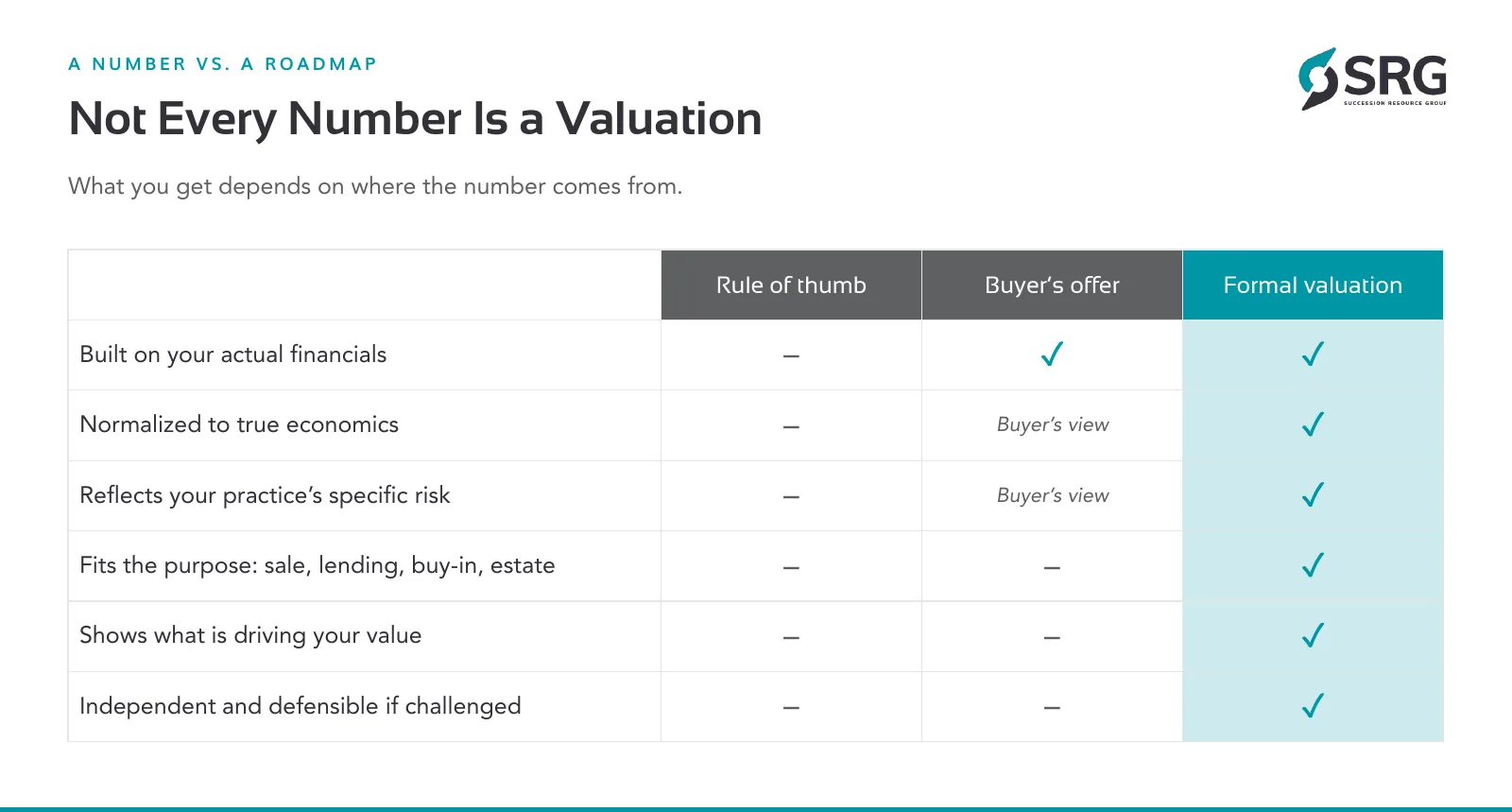
- Wrong question. Asking "what's it worth?" without defining the purpose or the buyer. A sale, a bank loan, a partner buy-in and an estate are different questions with different answers. Lack of alignment here can make a valuation utterly useless.
- Wrong inputs. Financials that aren't reviewed or normalized, personal expenses left in the P&L, and revenue lumped together instead of separated by source.
- Wrong benchmark. Using a rule of thumb or a peer's headline multiple. One hybrid firm produced $10 million in revenue, mostly fees, and was valued at about $10 million. The owner had expected far more based on his simple math using commonly cited revenue multiples. But heavy reinvestment left earnings under $1 million, and earnings are what a buyer pays for at that size.
- Wrong timing. Waiting for an offer, when the number can still be negotiated but no longer improved.
What should you fix now to raise your multiple?
Start with what moves fastest and begin the long-runway work at the same time. Some of the biggest improvements cost almost nothing.
This year
- Clean up and normalize your financials
- Separate personal expenses from the business
- Track revenue by type: recurring, transactional and one-time
- Clean up client data, including ages and households
- Sign employment agreements with appropriate client protections for advisors and key staff
- Track organic growth apart from market growth: net new assets and net flows from existing clients
In one to three years
- Shift toward recurring, fee-based revenue at market rates
- Segment and right-size the client base, and consider a partial book sale to transition non-core clients to a different advisor
- Reduce dependence on your largest clients
- Get your team in regular contact with your top clients to reduce dependence on you
- Benchmark your fees against peers and make adjustments as appropriate
- Align staff compensation with the work and the results, and phase out revenue splits and revenue sharing in favor of a salaried advisor model
In three to five years or more
- Develop next-generation advisors who take client service work off your plate
- Introduce your team to the next generation of client families
- Step out of the center of daily operations
- Move from a personal brand to a firm brand
- Put a succession structure in writing
For more ideas, see six ways to increase the value of your RIA firm.
When should you get a formal valuation?
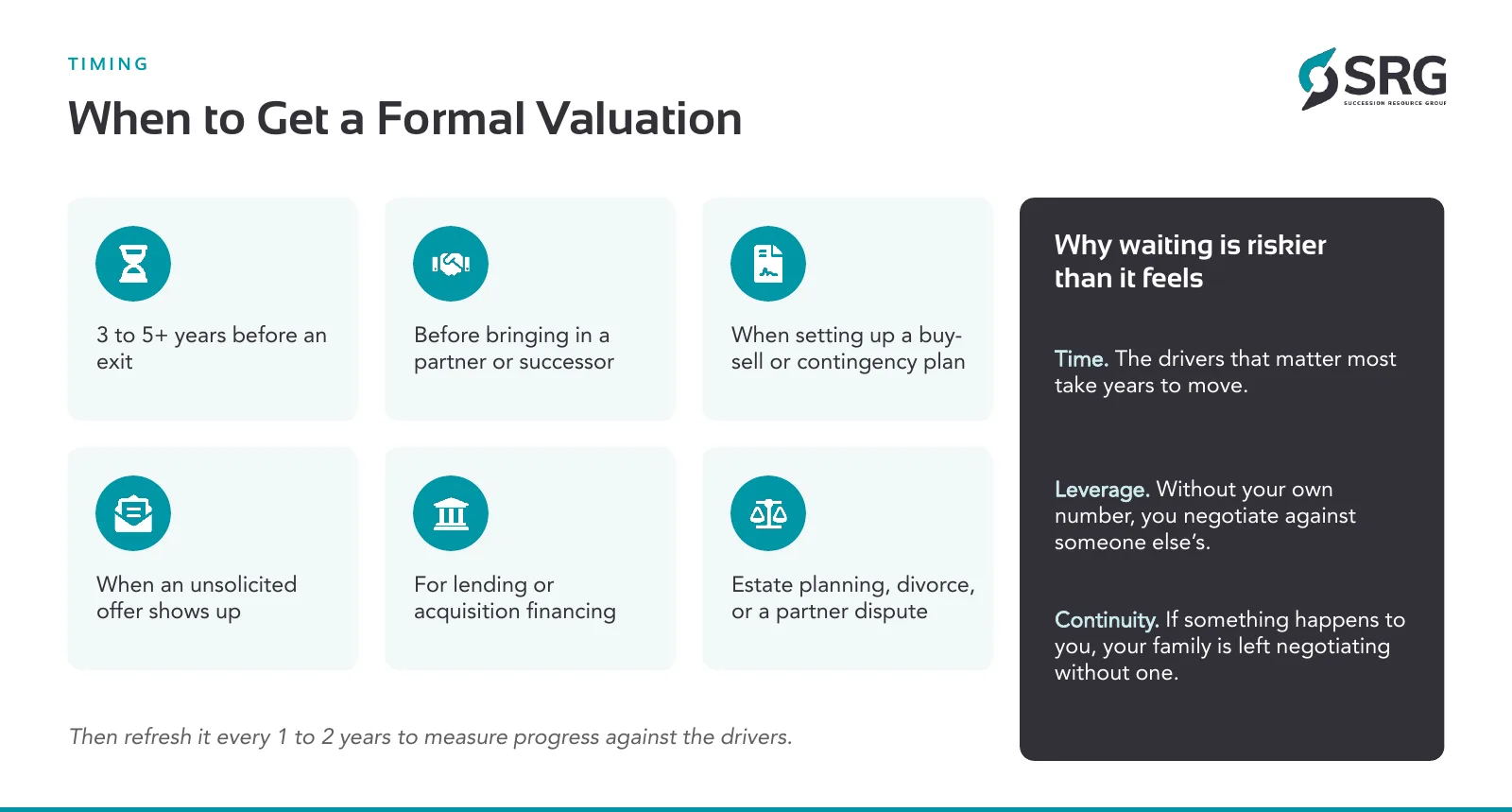
Get a formal valuation at least three to five years before an exit. The drivers that matter most take years to move, but it's worth the investment. It takes 24 to 36 months for many of these fact patterns to improve enough to show up in a valuation.
Other times you need one:
- Before bringing in a partner or successor
- When granting equity to a team member or family member
- When setting up a buy-sell or contingency plan
- When an unsolicited offer shows up
- For lending or acquisition financing
- For estate planning, divorce or a partner dispute
After that, refresh it annually to measure progress. Waiting is riskier than it feels. Without your own number, you negotiate against someone else's, or you're making adjustments without understanding the true impact. And if something happens to you, your family is left negotiating without a current valuation, making their job infinitely harder and more stressful. We cover more triggers in six events that require a valuation of your financial practice.
The first valuation is the hardest, because you're gathering data for the first time. The second is much easier. Ultimately, what's measured improves. That's why SRG offers an Annual Valuation Program, and why every SRG valuation includes a debrief meeting on what to focus on next. If you're also weighing a sale, our selling and succession services pick up where the valuation leaves off.
Want the full discussion, including the live Q&A? Watch the Valuation Best Practices webinar replay.
Frequently Asked Questions
What is a good valuation multiple for a financial advisory practice?
The industry-wide average recurring revenue multiple for an RIA is about 3.27x, within a range of roughly 2x to 4.5x. Larger firms valued on earnings average close to 10x adjusted EBITDA, within a range of about 6x to 14x. Where you land depends on recurring revenue, growth, client age and key-person risk.
Does return on assets affect my practice's value?
Rarely on its own, but it does affect other measurable factors that impact value. Return on assets is a fact pattern that describes how the practice operates. It can point to pricing or service issues, but a low ROA score by itself does not change your multiple the way recurring revenue or client age does.
How long does it take to improve the KPIs that drive value?
Usually 24 to 36 months for the improvement to show up in a valuation, though some changes have a more immediate impact, such as converting commissionable activities to recurring income or raising your fees. Other fixes may not be as immediate, but even cleaning up financials or signing no-solicit and no-serve agreements can happen within a year. Others, like developing a next-generation advisor, shifting away from personal branding or optimizing your EBITDA, can take three to five years.
Why is an internal sale valued lower than a sale to a peer?
An internal successor buys the practice as it is, with no cost savings or added revenue. A peer buyer can remove duplicate overhead and may earn a higher payout on combined revenue, so the same practice produces more cash flow for them. A peer sale is also usually a competitive bidding process.
Examples and figures in this article come from SRG's October 2026 webinar and are shared for discussion. They are not an indication of value for any specific practice.