
To PE or Not to PE: What Every Advisor Should Know About Private Equity Offers (Ep. 35)

When Private Equity Calls: A Guide for Advisors Private equity has officially moved downstream. PE-backed aggregators that once targeted billion-dollar firms are now writing offers for practices with $150 million to $500 million in AUM, and many advisors are receiving these offers without having gone looking for them. In this episode, David Grau Jr, MBA. and Kristen Grau, CPA, CVA, CEPA cut through the headlines to explain what a PE-backed deal actually looks like from the inside. The conversation covers who these buyers are, how they structure offers, and why the classic idea of “selling and retiring” often does not fit the PE model. David and Kristen walk through financial normalization, recurring revenue debates, P&L preparation, and the often-overlooked reality that time kills deals. If you have ever been approached by a PE-backed firm, or think you might be, this episode gives you the framework to evaluate the offer clearly. SRG works exclusively alongside sellers in the M&A process, helping advisors get the right offers in front of the right buyers. Whether you received an unsolicited offer last week or you are thinking three to five years ahead, now is the time to understand the landscape. Show Notes PE-backed aggregators vs. direct PE: Direct PE investment goes to large enterprises (typically multiple billions in AUM). PE-backed aggregators have already taken that investment and are deploying it through acquisitions of firms as small as $150M to $250M in AUM. The seller profile is shifting: PE buyers want firms they can grow. The new seller profile is 50 to 70 years old — someone still willing to work and grow, not ready to retire in 12 months. Big multiples come with conditions: PE buyers may quote 10x to 12x earnings, but achieving that figure typically requires staying on for three to five years and hitting specific growth targets above current trajectory. Normalization can shrink your effective multiple: If you plan to leave post-sale, PE buyers add replacement comp back into expenses — often 25% to 35% of revenue — reducing normalized earnings and the effective payout. Know your numbers: Experienced buyers will cross-reference reports and look at client-level data. Sellers who do not know their numbers give buyers leverage to negotiate down. Clean your P&L before going to market: Remove owner-discretionary expenses, get onto a consistent tech stack, and track your financials quarterly for three to five years before selling. Best price or best terms — rarely both: A high purchase price often means more back-end risk and longer commitments. A lower cash deal with clean terms and a shorter transition may serve some sellers better. When you get an offer, pause: PE buyers are disciplined and experienced. They will create urgency. Pause, shop the offer, and call SRG before signing anything. Hosted By David Grau Jr., MBA (Founder / CEO) Kristen Grau, CPA, CVA, CEPA
How to Get “PE Value” With or Without PE

Watch the Replay Please enable JavaScript in your browser to complete this form.Please enable JavaScript in your browser to complete this form.First Name *Last Name *Phone * Work Email * Would you like to join SRG's newsletter to receive industry updates and other webinar opportunities? Yes No Access Recording Can You Get Private Equity Value Without Selling to Private Equity? In this session, Succession Resource Group’s David Grau, Jr., MBA, unpacks how advisory firm owners can pursue private equity-level value whether or not they sell to private equity. The webinar breaks down the difference between direct PE investment and PE-backed aggregators, how headline multiples of up to 15x EBITDA translate into the 9x to 11x most sellers actually realize once deal terms are accounted for, and why the definition of a seller has shifted toward owners who sell and continue to run their firm. David also reviews the four variables that shape the right path, including practice size, timeline, buyer universe, and long-term priorities, along with the deal structures that decide what an owner takes home, from the traditional 80/20 down payment to today’s 40/30/30 split of cash, rolled equity, and earnouts. He then shows how internal succession and peer-to-peer sales can close the value gap and approach PE-level outcomes when firms start early, keep growth in focus, and sell in tranches. Advisors weighing an exit in the next three to ten years, evaluating an unsolicited offer, or planning an internal succession will find this a practical, data-backed guide to their options. Host David Grau Jr. MBA CEO/President Paper-plane Linkedin-in
The Exchange: Selling Your Advisory Business and What Every Owner Needs to Know (Ep. 33)
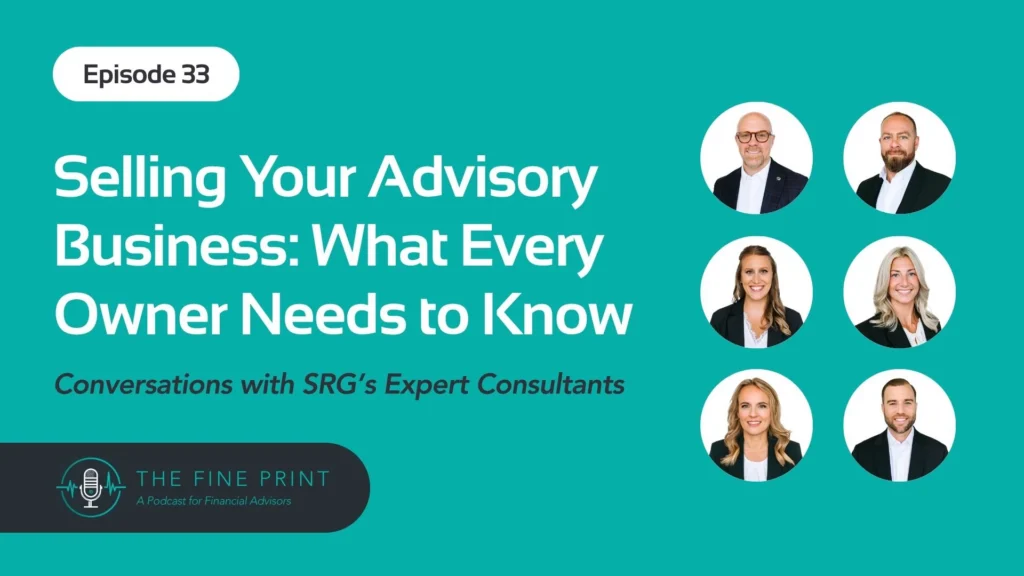
Navigating the Noise When It’s Time to Sell When you decide to sell your advisory business, you will be approached from every direction; aggregators, PE firms, broker dealers, and peers all ready to make an offer. The question isn’t whether demand exists. It’s whether you have the right team to make sure you’re getting the most out of it. In this episode of The Fine Print, David Grau Jr., MBA is joined by Kristen Grau CPA, CVA, CEPA, Parker Finot, and Ryan Grau CVA, CBA to break down what seller advocacy really means, where self-negotiated deals tend to fall short, and what advisors should look for when choosing an intermediary. You will hear why great offers never show up in the first draft, what the “auction” label gets wrong about the listing process, how some intermediaries secretly work both sides of the deal, and why getting a valuation three years before you’re ready to sell can change everything. Show Notes The noise every seller has to cut through. Aggregators, PE firms, broker dealers, peer buyers, and DIY platforms are all competing for your attention. The real question isn’t which offer to take — it’s whether you have the right expertise on your side to evaluate them properly. The risks of going it alone. Self-negotiated deals often skip NDAs, skip proper due diligence, and rely on one-page agreements that banks won’t underwrite. Sellers narrow their options to one or two familiar names and leave significant value on the table before negotiations even begin. Fit vs. price: the conversation has shifted. The industry long put fit above everything else. That’s changing. Price, terms, and taxes are increasingly driving decisions — and advisors who sell to the first familiar face often sacrifice all three without realizing it. Great offers never show up in the first draft. Eye-catching multiples often mask back-end payments tied to growth targets the seller has never come close to hitting. Knowing what to look for — and what questions to ask — is the difference between a good deal and a great one. The “auction” label is a buyer’s talking point. What sellers call a listing process, buyers call an auction to make it sound unappealing. In reality it is a confidential, structured process that lets sellers compare qualified buyers, protect their identity, and make a decision based on actual fit rather than whoever showed up first. Not all intermediaries are working for you. Some firms charge sellers a retainer while simultaneously collecting fees from buyers — limiting the pool presented and skewing the outcome. Ask who your intermediary is getting paid by and how many times they have transacted with the same buyers. Get your valuation done three years out. Waiting until you are ready to sell leaves no runway to improve your numbers, clean up your financials, or understand your KPIs. A valuation three years prior gives you time to act on what it tells you. Your business is your most valuable asset. Whether you plan to sell in two years or ten, giving the process the time and attention it deserves — with the right team in your corner — is one of the most consequential decisions you will make for yourself, your clients, and your family. Hosted By David Grau Jr., MBA (Founder / CEO) Kristen Grau, CPA, CVA, CEPA (Executive Vice President) Ryan Grau, CVA (Director of Valuations) Parker Finot (Director of Transaction Advisory Services)
Grow Your Advisory Firm Without Limiting Your Exit Options

Last Updated: August 25, 2026 Authors Growth builds momentum. It creates new opportunities, expands your client base, and can increase enterprise value. But growth also forces us to build structure. Over time, that structure shapes your future transition options. Decisions around equity, compensation, leadership, client relationships, and governance can either expand your optionality, or quietly limit it. Advisors make decisions about their firm, often without thinking about the downline impact. Without intentional planning, it is easy to paint yourself into a corner through years of choices, and end up with only one viable exit option. Think of it this way: if a client walked into your office with $5 million to invest, but told you they were retiring in six days, you could still help them. But, imagine how much more you could have done if they had come to you five or ten years earlier. The same principle applies to your business and planning for your eventual exit. The firms that get the highest valuations are not simply the fastest growing. They are the ones built to be scalable, transferable, and adaptable, giving them multiple transition options. The Earlier You Start, The More You Control Every business owner will exit at some point. The question is not “if,” but “how,” and how well. The earlier you begin planning, the more control you retain over that outcome: Earlier planning leads to more transition options More options create a stronger negotiating position Better preparation leads to maximum value for the founder This is why the best-prepared firms often begin planning 10 or more years in advance. Without that runway, decisions become reactive. With it, you can build intentionally while preserving flexibility. And regardless of which path you eventually choose, internal succession, merger, private equity partnership, or external sale, the foundation you build today will determine the options available to you tomorrow. Universal Do’s and Don’ts to Preserve Optionality For advisors who are still evaluating their long-term direction, the goal is to have options and remain flexible. That means avoiding decisions that unintentionally lock the business into a single outcome, or making decisions that will provide you options. Across firms, a consistent set of patterns either supports or limits future flexibility. Ownership Structure Do: Understand how your entity structure and equity design impact future transition options. Many firms are operating with the same entity they set up when they first launched, which was adequate at the time. But, what worked then may not serve you now or in the future. As your firm grows, revisit your entity structure to ensure it is still optimal for your short and long-term succession and growth goals. Most of the time, what you had twenty years ago isn’t ideal for where you are today. Don’t: Distribute equity without buyback or bring-along provisions. If you share equity, make sure your agreements preserve the flexibility to steer the business in the direction you choose. Client Relationships Do: Delegate client service work to your team, freeing you up to mentor, train, manage, and grow the business. Also – as you hand off client relationships, ensure you have appropriate protections in place so team members can leave and take your clients. Non-competes are difficult to use and hard to enforce – there are other better ways to protect your practice. Don’t: Overcommit ownership or transition expectations without formal agreements in place. Informal arrangements may feel sufficient today, but they create significant complications during a disagreement or transition event. Financials Do: Maintain clean and clear financials over multiple years and invest in scalable growth. Predictable financials, where the chart of accounts doesn’t shift dramatically year to year, are essential for any planning or transaction process. Know your P&L. Don’t: Compensate employees at levels that undermine owner economics. A common pitfall: team members receiving variable, revenue-based compensation without bearing the risk or downside of ownership. When it comes time for those team members to buy in, the math (especially when risk-adjusted) simply doesn’t work. There is no faster way to decimate your value than to pay your advisors using a percentage of revenue on clients you assigned to them. Organizational Resilience Do: Build a team that allows the business to grow beyond the founder. Gen1 mentors and trains Gen2. Gen1 and Gen2 work to mentor and train Gen3, and so on. Whether you plan to sell internally to your team, or to a competitor, a well-staffed firm that can operate independent of the founder will unlock the best outcomes. Don’t: Assume the right transition option will materialize without preparation or that qualified team members automatically want to be successors. Desire and capability are two different things, and you need both. Legal and Compliance Do: Keep entity documents, employment agreements, and compliance records current. Every team member, especially client-facing advisors, should have a formal agreement in place. Don’t: Wait until due diligence to address gaps. Problems discovered at the ninth inning are far more expensive and stressful to resolve than those addressed years in advance. Understanding the Four Primary Transition Options Most financial service firm transitions pursue one of four paths. Each requires different preparation, timelines, and trade-offs. Internal Succession Typical timeline: 5 to 10 years (from the first sale to the last) Internal succession focuses on transitioning ownership and leadership to the next generation within the firm. To do this effectively, firms must: Recruit and retain quality advisors and leaders Mentor and train employees to become viable successors Develop leadership capabilities over time Implement equity sharing plans as part of the career track Gradually transition client relationships before the founder’s exit One of the most important things to clarify early is your “why.” Internal succession typically prioritizes legacy, continuity, control, and minimizing disruption for clients. It is unlikely to produce the highest value for the founder, compared to an external transaction, but for many founders, value is not the primary goal. “When it comes to internal succession, you should be convicted in the outcome — transferring the business to your successors
How to Make a Merger a Growth Move
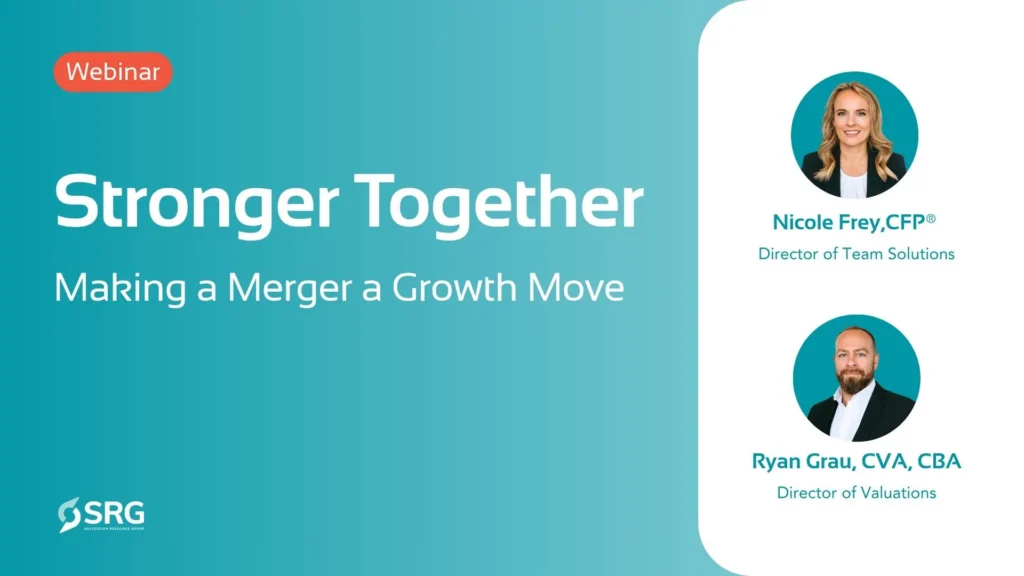
Watch the Replay Is a Merger the Right Growth Move for Your Advisory Firm? In this webinar, Succession Resource Group’s Nicole Frey, CFP®, and Ryan Grau, CVA, CBA, walk advisory firm owners through the full merger process, from initial preparation to post-merger integration. The session covers why firms pursue mergers, how to evaluate whether a potential partner is the right fit, and what structural and legal considerations need to be addressed before any deal moves forward. Download the Presentation Deck Here Download Speakers Host Nicole Frey, CFP® Director of Team Solutions Paper-plane Linkedin-in Host Ryan Grau, CVA, CBA Director of Valuations Paper-plane Linkedin-in Transcript 100:00:05.100 –> 00:00:17.260Nicole Frey: Hello, and welcome to Succession Resource Group’s monthly webinar series. Today, we will share with you how you can become stronger together by making a merger a growth move. 200:00:17.360 –> 00:00:29.270Nicole Frey: For those of you who are interested in more content from us, we have a webinar coming up every month. You see the next two up here on the screen, and in the chat, you will find the link to sign up for those webinars. 300:00:29.270 –> 00:00:42.069Nicole Frey: If you forget, or if you want to postpone that to a later time, please feel free to follow us on LinkedIn. You will find the announcements there as well, along with other great content that we publish on a regular basis. 400:00:43.780 –> 00:00:56.829Nicole Frey: For those of you who are not familiar with us, just a quick introduction. Here at SRG, we help advisors turn business goals into reality. Our mission is to help you understand your options. 500:00:56.950 –> 00:01:01.779Nicole Frey: Develop a great strategy, and ultimately put your plan into action. 600:01:02.150 –> 00:01:12.580Nicole Frey: Our team’s experience covers areas such as valuations, M&A, equity planning, HR resources, and organizational strategies. 700:01:13.340 –> 00:01:18.989Nicole Frey: At the end of the day, our goal is simple. We want to help you build a strong and lasting business. 800:01:20.310 –> 00:01:36.499Nicole Frey: Your presenters today include Ryan Grau, our Director of Valuations. Ryan is a Certified Valuation Analyst and Certified Business Appraiser. I would say he’s the industry-leading expert on valuing advisory and wealth management firms. 900:01:36.550 –> 00:01:43.930Nicole Frey: He has been admitted in multiple states, as an expert witness, and testified in FINRA arbitrations. 1000:01:44.010 –> 00:01:50.680Nicole Frey: NT has completed thousands of valuations for M&A, succession, litigation, and tax purposes. 1100:01:51.480 –> 00:02:03.759Nicole Frey: My name is Nicole Frye. I am the Director of Team Solutions here at Succession Resource Group. I help advisors with entity formations, entity restructurings, and mergers. 1200:02:03.760 –> 00:02:16.519Nicole Frey: My background is mainly legal. I study law in Germany, where I’m originally from, and I’ve worked for law firms for quite a few years. And now here at SRG, I help advisors, 1300:02:16.950 –> 00:02:21.209Nicole Frey: Integrate their firm successfully, and also build sustainable partnerships. 1400:02:23.410 –> 00:02:40.000Nicole Frey: Before we start with today’s agenda and content, I just want to get some housekeeping items out of the way to make sure you’re set up well for this presentation. Our team will also pull up a short poll survey here to answer some questions, so please feel free to submit your responses. 1500:02:40.340 –> 00:02:56.450Nicole Frey: For any questions you might have, we encourage you to submit those in the Q&A section of this webinar. We love to hear from you. We also like to know if something is not clear, so we can help clarify that and customize the content to your particular needs. 1600:02:56.770 –> 00:03:05.950Nicole Frey: The webinar recording will also be available in the next 24 hours, so please look out for an email from our team with a link so you can access that. 1700:03:06.130 –> 00:03:23.479Nicole Frey: And if you like today’s presentation deck, you can also request that from us. So please feel free to reach out to our team, or you can just wait until our team reaches out to you. They want to make sure that your questions are answered, and that might be a good time to also request the slide deck. 1800:03:24.530 –> 00:03:34.979Nicole Frey: All right, so your poll questions and responses are in. We appreciate that feedback, so that we can tailor our communication to you based on your particular needs. 1900:03:37.790 –> 00:03:40.500Nicole Frey: For today’s agenda. 2000:03:41.480 –> 00:03:59.129Nicole Frey: I want to start off by talking about why advisory firms seek out mergers, before we dive into the different phases of a merger. And those phases will cover the pre-merger preparation that you can take in order to get ready for that merger. 2100:03:59.130 –> 00:04:08.640Nicole Frey: We will then talk about the actual merger process, and here Ryan will help you understand some of the valuation considerations that are necessary. 2200:04:08.640 –> 00:04:28.990Nicole Frey: And then we’ll talk about the post-merger implementation, which is often forgotten, unfortunately, and then the merger is not going to be as successful as it can be. So definitely something we want to take some time today to help you understand what is needed in order to make that merger as successful as possible. 2300:04:31.790 –> 00:04:55.359Nicole Frey: When it comes to reasons why advisory firms seek out mergers, they can be very different, so it depends on where your business is in its current life cycle. Obviously, for some advisors, they’re seeking faster growth, so rather than just growing their business organically, they’re looking into merging other partners in who also have a book of business. 2400:04:55.450 –> 00:04:59.470Nicole Frey: So the merger is one good strategy to get that accomplished. 2500:04:59.820 –> 00:05:14.580Nicole Frey: Mergers can also result, or should result, in more scale. We see that all the time, that mergers result in more revenue being combined, so you see a lot more growth there on that end. 2600:05:14.580 –> 00:05:25.349Nicole Frey: While the expenses grow at a slower rate. So that’s the
The Silent Risk Healthy Advisors Never See Coming

Why waiting until you feel ready puts your practice value, clients, family, and successor options at risk—and why the strongest advisory exits happen long before you feel ready. Many advisors believe that as long as they are healthy, active, and fully capable of running their business, there’s no need to think about preparing their practice for sale or building a succession plan. The logic seems straightforward: “I feel great. I’m in control. I have time.” But this belief focuses entirely on the advisor’s current physical state and overlooks a fundamental truth of this industry: practice value, transition readiness, and successor options have nothing to do with how healthy you feel today. The most successful transitions happen years before advisors intend to slow down—not after decline, fatigue, or urgency begin to set in. Feeling healthy may make you feel secure, but it does not eliminate the long-term risks of waiting too long, losing leverage, or being forced into a rushed exit. Seller Advocacy. Your Sell-Side Partner. Sell Your Book of Business or Financial Advisory Practice with SRG See Service Separate from your own well-being, advisors often forget another uncomfortable reality: unexpected health issues frequently arise not for the advisor, but for the people around them—a spouse, aging parents, children, or even a key employee who carries critical operational knowledge. These events can demand time, attention, and emotional energy, forcing advisors to step back abruptly or reprioritize their life without warning. Even if you are perfectly healthy, life can change your timeline overnight. Feeling healthy today isn’t a reason to delay your succession plan—it’s proof that now is the ideal time to create one while you still have full control, full energy, and full optionality. In the advisory industry, where client relationships, revenue continuity, and risk exposure define the value of the business, waiting until you “need to” is rarely strategic. The truth is clear: Healthy advisors with no urgency are the ones who get the best deals and those who wait unit circumstances force their hand almost always get the worst. The Reality: Health Is Not an Exit StrategyBelow are the core reasons why health—your own or your loved ones’—is not a reliable foundation for your succession timing Being Healthy Today Does Not Protect Future Practice ValueMany advisors assume that as long as they feel physically strong and engaged, their business will remain equally strong. But practice value is tied to stability, not personal wellness. Buyers look for consistent revenue, low transition risk, and a clear, well-orchestrated succession path—not the advisor’s current level of energy. In fact, the healthiest advisors often receive the highest valuations precisely because they have the time and capacity to participate in a thoughtful, well-paced transition. Waiting until health changes or energy declines reduces leverage, constrains options, and introduces uncertainty that buyers notice immediately. Buyer Optionality Shrinks When You WaitWhen you plan early, you have the broadest universe of potential successors—individual buyers, teams, consolidators, RIAs, and strategic partners. This allows you to compare philosophies, personalities, cultures, financial profiles, and deal structures. But as time pressure builds, the buyer pool narrows significantly. Urgency forces advisors to choose the buyer who is available—not the one who is truly aligned. This is why advisors who wait often end up settling for deals that don’t reflect the scale, value, or legacy of the practice they built. Health Issues Among Loved Ones Can Disrupt Your Timeline InstantlyEven if you personally remain healthy, your timeline can be upended by the needs of those closest to you. The most common reasons advisors suddenly accelerate their exit have nothing to do with their own health. They include: a spouse’s unexpected medical diagnosis the need to care for aging parents emergencies involving children the loss of a key employee who carries operational knowledge These situations force advisors to shift priorities quickly. When this happens without a succession plan in place, the result is often panic-driven decision-making, lower valuations, and minimal buyer optionality. Emergency Sales Are the Most Expensive SalesAdvisors who delay planning often find themselves in reactive mode: scrambling to gather documents, explain financial trends, prepare staff, and communicate with clients—all under the pressure of a shortened timeline. Buyers recognize this pressure and adjust terms accordingly. Distressed sales typically produce smaller upfront payments, more contingent structures, reduced negotiating power, and fewer protections for client and staff continuity. The unfortunate reality is that urgency signals vulnerability—and the market responds to vulnerability by lowering value. Preparing Early Doesn’t Mean You’re Leaving EarlyThis point is widely misunderstood. Planning is not retiring. When advisors begin planning early, they gain clarity on valuation, understand their deal options, and learn what steps will actually strengthen their business over the next several years. Early planning also puts structure around the advisor’s role after closing—whether that’s two years of client introductions, part-time involvement, consulting, or an eventual clean break. Planning empowers advisors to shape their legacy while continuing to work at full capacity. Delaying, on the other hand, strips away flexibility and forces decisions to be made from a place of constraint. Early Planning Gives You Control. Late Planning Takes It Away.An advisor who plans early controls the narrative, the timing, the successor selection, the client messaging, and the economics of the transaction. They set the pace. They negotiate harder. They attract better-aligned buyers. And they protect the people who depend on the business—including clients, staff, and family. But when planning begins only after health changes or life intervenes, the advisor’s control diminishes quickly. Urgency becomes the driver. Buyers dictate terms. The timeline compresses. And optionality disappears. Early planning isn’t just advantageous—it’s protective. Are You Ready to Exit? Download SRG’s Seller Readiness eBook Conclusion: Health Is Not a Reason to Wait—It’s the Best Reason to Start Now Feeling healthy and capable does not mean you should delay your exit planning—it means you are at the perfect stage to protect your future. Early planning gives you: maximum value maximum leverage maximum buyer fit maximum time to transition clients maximum options for your role maximum
Grow Your Firm Without Limiting Your Future Exit Options

Watch the Replay Are Your Growth Decisions Expanding or Limiting Your Future Exit Options? Many advisors focus on growth without realizing the structural decisions they make today can shape their future exit options. In this on-demand webinar, Succession Resource Group explores how growth-stage RIAs and independent advisory firms can increase enterprise value while preserving strategic flexibility. Learn how firms position themselves to remain scalable, transferable, and attractive in today’s M&A market, while keeping the door open for internal succession, a future sale or merger, capital investment, or long-term independence by choice rather than default. Download the Presentation Deck Here Download Speakers Host David Grau Jr. MBA CEO/President Paper-plane Linkedin-in Host Kristen Grau, CPA, CVA, CEPA Executive Vice President Paper-plane Linkedin-in Host Parker Finot Director of Transaction Advisory Services Paper-plane Linkedin-in Transcript 100:00:06.820 –> 00:00:21.600David Grau: All right. Good afternoon, everybody. We’re going to go ahead and give everyone just a second here. It always takes a minute to get everybody in and admitted, but in the meantime, I will put up our deck for you to stare at instead of Parker, Kristen, and I. So… 200:00:22.020 –> 00:00:33.030David Grau: session here today. You know the title, presumably. You were kind enough to reserve time on your calendars to join us here, but it is growing your firm without limiting your future exit options. 300:00:33.080 –> 00:00:42.730David Grau: This is a topic we talk about a lot internally, right? Because we see this happen where folks, they do internal succession work, right? They’re sharing equity, they’re doing stuff with their team, which is great. 400:00:43.440 –> 00:00:54.940David Grau: And unfortunately, it just doesn’t end up panning out as well as they had hoped, right? They grow too fast, the team doesn’t grow fast enough, they don’t have the desire, but unfortunately, the documents that they use, the path that they chose. 500:00:55.110 –> 00:01:09.410David Grau: ends up cutting off different options for them that they would have otherwise liked to have left open. And so that’s thematically what we’re going to focus on here today, that you continue to build and take action, that we can be as intentional about having our eye towards the future. 600:01:10.030 –> 00:01:15.810David Grau: And not doing things that could close doors too early, that we’re not comfortable with. 700:01:15.810 –> 00:01:30.620David Grau: Especially having that happen inadvertently, or that we can at least proactively be building our business in a way that we could pursue a private equity sale, or an internal sale, or maybe a merger, or who knows, maybe safety net. We could also just sell this thing to a peer and walk away in a couple years. 800:01:30.880 –> 00:01:32.439David Grau: If you do it right. 900:01:33.180 –> 00:01:45.679David Grau: most, if not all of those, can be options for you. Now, I’ll also acknowledge it’s going to be somewhat size-dependent, right? If you’re sitting here listening today, and you are an empire builder, you’ve got a billion in AUM, and you’re heading towards your next two or three. 1000:01:46.620 –> 00:01:54.619David Grau: you legitimately could pursue all of these options, right, if you’re careful. If you’re sitting here listening, you do a million a year in annual revenue. 1100:01:55.320 –> 00:02:06.689David Grau: you may or may not want to grow your business to the size where you do an internal succession plan, right? That may just not be in the cards as something you’re even desirous of. Maybe you don’t like managing people, maybe you don’t like people at all. I get it. 1200:02:07.040 –> 00:02:25.110David Grau: But there are still things, even if you cross that one off the list, that you could be considering in other options, other avenues, depending on the timeframe, what you’re trying to get out of it. So, that’s our focus here today. It’s gonna be a little different for each of you, but we are going to make sure that we hit all of the potential exit strategies and some of the do’s and don’ts. 1300:02:25.190 –> 00:02:30.290David Grau: Quick housekeeping items, real easy ones here. The deck that we’re going to be using here today 1400:02:30.560 –> 00:02:35.710David Grau: If you find it useful, interesting to reference back to, it will be available to you. 1500:02:35.900 –> 00:02:42.650David Grau: Our team will be following up with you after today’s session, so just let Sabrina, Craig, Nikki know when they reach out. 1600:02:42.760 –> 00:02:51.989David Grau: That you’d like a copy of it, and I’ll be happy to get it to you. The session is also being recorded, or at least I hope it is. You’ll get a copy of that in your inbox automatically tomorrow. 1700:02:52.550 –> 00:02:59.160David Grau: And last one is, we’re gonna have a quick poll question, or a couple questions, one poll here at the very beginning. 1800:02:59.360 –> 00:03:08.690David Grau: Case in point. This won’t slow us down or distract, it just… this simply helps us focus the content that we bring you in the coming months. 1900:03:08.900 –> 00:03:25.330David Grau: that it’s as relevant and topical, and that the content of those presentations is as useful and on point as possible. But to do that, we need your feedback. So, if you don’t mind just taking a second, there’s 7 quick kid or questions here. If we don’t see enough responses, I’ll just sit here and stare at you till the other 46 of you answer. 2000:03:25.730 –> 00:03:37.749David Grau: But looks like we’ve got answers rolling in. We certainly do appreciate it. It, believe it or not, is actually useful. In the meantime, I say it’s helpful for informing the content. It’s not helpful for informing the next three presentations, because those are already lined up. 2100:03:37.860 –> 00:03:56.990David Grau: But it answers here can actually help inform the content that we cover in each of these. The one next month is going to touch on mergers. We’re going to talk about that a
Why Relying on Your Broker-Dealer to Sell Your Practice Is a Costly Mistake

Why your broker-dealer is not a neutral partner in your exit, and why home office referrals often fail. Many advisors believe that when it’s time to transition their practice, their broker-dealer’s home office team will actively help them sell their business. After years of interacting with relationship managers, home office consultants, practice management specialists, and OSJ leadership, it’s natural to assume that: They know your business. They know your goals. They care about your success. They’ll help you find the right buyer when you’re ready. Seller Advocacy. Your Sell-Side Partner. Sell Your Book of Business or Financial Advisory Practice with SRG See Service Home office representatives often feel like an extension of your practice. They attend your conferences. They support your growth initiatives. They review your business metrics. Some even position themselves as strategic consultants or sounding boards. When they offer to “connect you with a few people,” it can feel like genuine advocacy. This leads advisors to believe: “My home office wants to help me transition successfully, and they will connect me with the right successor when the time comes.” But this belief is built on a misunderstanding of what the home office is designed to do. Their job is not to manage your exit. Their job is not to evaluate buyer fit. Their job is not to find you the best deal. And most importantly: Their job is not to represent your interests. Their job is to retain assets, not to help you leave. This creates a dangerous misconception for sellers, because trusting your home office to guide your exit often leads to the exact opposite outcome you want: poor successor fit mismatched introductions delays and false starts underinformed buyers reduced valuation wasted time stalled transitions and structural misalignment In other words: good intentions, bad incentives. The Reality: Home Office Teams are Not Your M&A Parter While home office professionals may genuinely like you and want to be helpful, their fiduciary duty is to their employer. Not to your sale, not to your clients, not to your employees, and not to your retirement plan. Below are the key reasons why relying on your broker-dealer to help with your exit strategy is almost always the wrong move. 1. Home Office Professionals Are Incentivized to Retain Assets This is the most important point. Broker-dealers make money from assets, production, product placement, and technology usage. When you exit your business, the firm risks losing those assets, that revenue, and all associated advisor economics. So while the home office may want to “support” you, their version of support is very specific: Keep the assets where they are. This is not the same as: finding you the best buyer maximizing your valuation protecting your timeline aligning culture and client philosophy ensuring your staff is supported giving you a clean or flexible exit Their job is to protect the firm, not enhance your exit strategy. 2. Home Office Referrals Are Strategically Motivated, Not Seller-Centric When a home office representative says: “I know some advisors I can introduce you to,” What they usually mean is: “I know some advisors we want to keep or recruit.” Home office referrals are based on: which advisors they want to retain which advisors are loyal to the BD which practices are growing which advisors they want to “strengthen” which advisors they’re recruiting which offices they want to protect from leaving who they believe will keep the most AUM on-platform These referrals are not based on cultural alignment, client compatibility, operational fit, deal structure preferences, buyer financial readiness, successor experience, or long-term service philosophy. The home office’s job is to recommend buyers who will stay— not buyers who are the right match. This is a conflict of interest hidden behind friendly support. 3. Home Office Introductions Lack Process, Screening, or Qualification The typical home office introduction is typically blind. No valuation review. No practice analysis. No buyer readiness assessment. No disclosure of buyer’s capabilities. No examination of client demographics. No buyer/seller compatibility analysis. No assessment of culture or service model. No review of deal structure preferences. No financial vetting. This creates serious problems from awkward mismatches to wasted time to repeated dead ends. Succession Resource Group has supported sellers who received zero meaningful referrals from the home office for months. Others received only one referral, and it was not even close to a fit. Some received referrals that were actually recruiting targets, not actual buyers. This is not a process, it’s a hope. Are You Ready to Exit? Download SRG’s Seller Readiness eBook 4. Home Office Support Delays Your Timeline Because home office referrals are sporadic, informal, and unstructured, sellers experience: long gaps between introductions buyers who show up unprepared deals that start but never progress repeated back-channel conversations long delays with no traction stalled negotiations transitions that fall apart after months of waiting What feels like “support” often becomes paralysis, not progress. Most advisors lose months, sometimes years, waiting for the home office introduction that will “change everything.” It rarely does. 5. Home Office is a Solid Resource. Just Not One for Finding Your Buyer Home office employees can be extremely useful for: Data gathering Pulling client segment reports Practice diagnostics Compliance guidance Technology updates Preparing transition paperwork Historical production review Team structure analysis But they shouldn’t (and often cannot) conduct a successor search, evaluate buyer financial readiness, maximize your asking price, provide neutral guidance, prepare your business for sale, protect your confidentiality, manage buyer negotiations, structure a deal, or manage your legal risk. They are support partners—not M&A specialists. And they represent the broker dealer— not the seller. 6. Advisor Loyalty to Home Office Creates Delays, Lost Value, and Damages One of the most harmful, yet least discussed, drivers of this myth is advisor loyalty. After years or even decades with a broker-dealer, many advisors feel a moral responsibility to “give the home office the first shot” before involving a professional succession partner like SRG. It sounds reasonable. “They’ve always supported me. I’ll let them try first, and if that doesn’t work, I’ll bring in a consultant later.” But this instinct, while emotionally understandable, is structurally dangerous. Here’s why: 1. By the time you realize it’s a bad plan, you’re already in too deep. Home office introductions feel promising at first. A warm conversation here. A possible peer match there. Maybe a potential buyer raises their hand. But because there is no process, no structure, and no vetting, the advisor has already invested months, sometimes a year, has shared superficial practice information, has engaged in
How to Maintain Client Experience and Retain Staff When Selling to an Outside Buyer

Last Updated: August 25, 2026 Author A practical roadmap for readiness, people, and a smooth client transition Selling a financial planning practice is not just a transaction. It is a change event that touches clients, staff, regulators, technology, and your own identity as the founder. The advisors who feel best about their outcome tend to do two things well: Prepare the business like an acquirer will run it tomorrow. Communicate the transition in a way that protects trust and continuity. Why “seller readiness” is the real deal leverage Many owners think “getting ready to sell” starts when a buyer is identified. In practice, it starts much earlier, because early preparation gives you options: tax planning, negotiation leverage, cleaner due diligence, and a calmer client transition. SRG’s dissolution guidance recommends beginning 12 to 24 months before close to allow time for tax optimization, buyer negotiation, and client transition planning without rushing. A simple readiness checklist that buyers actually care about Before you name a price or talk terms, start by getting your house in order. SRG’s Seller Readiness eBook highlights several practical pre-sale actions: Verify and document internal processes. Shift as much revenue as possible toward recurring sources. Reduce overhead and eliminate long-term obligations where possible. Create documentation and manuals for core workflows. Assemble your M&A team early. One more important point: avoid casually floating the idea of selling around your network. When you are ready, leverage a structured process and an advocate who can screen candidates thoroughly. That matters because you only sell this business once. Your timeline and process should be built to protect clients and reduce the risk of a rushed decision. The transition plan is not optional Even in a strong market, sellers can underestimate the work required after the deal terms are signed. A transition plan is how you protect enterprise value after closing, because retention is where the economics are either earned or given back. A typical relationship transition often spans 6 to 18 months and can require hundreds of hours of transition-related support time. That benchmark is a useful anchor because it signals realism. Selling is not an event. It is a structured handoff. Your staff can make the deal easier or harder If clients are the revenue engine, staff are the continuity engine. They hold systems, workflows, relationships, and culture. That is why employee communication is one of the most sensitive parts of the process, with real implications for morale, reputation, and legal risk. When to tell the team In many deals, you need staff involved before a transaction is complete because due diligence requires data gathering, reporting, and operational support. At the same time, timing matters. Tell staff too early and you can create uncertainty. Tell them too late and you can fuel rumors. Clear, definitive messaging reassures employees and helps retain top talent. How to tell the team A strong best practice is to communicate face-to-face first. Avoid using email, phone calls, instant messaging, or text for the first conversation. A helpful structure is: Individual conversations first, so people can react privately Then a group discussion to reinforce consistent messaging and create a forum for questions What to say so you keep people You do not need a perfect script, but you do need clarity. Cover: why you are selling what the sale means for them what is likely to stay the same (location, roles, compensation and benefits, service model, workflows) the expected timeline (due diligence, close, what happens after) Also consider retention bonuses for key employees and incentives for the added workload your team takes on during due diligence. Lack of buy-in can create friction for buyers and the deal. Client communication: protect trust with sequencing and clarity Clients do not need every detail. They need confidence, continuity, and a clear plan. Effective communication maintains trust and continuity, reinforces what will remain the same (services, relationships, points of contact), and outlines next steps and timeline. Plan first, then execute Communication planning is a phase, not an afterthought. Key pre-work often includes: identifying stakeholders developing a notification timeline drafting the client letter with buyer collaboration preparing transition paperwork building call scripts and meeting plans Be mindful when sharing client-specific information. Only disclose what is necessary for service delivery or compliance purposes, and protect sensitive data throughout the process. Sequence communication to reduce confusion A practical sequence is: regulators custodians clients This sequencing helps ensure you are prepared to support the transition when clients hear the news. Timing expectations that reduce surprises Written notice typically goes out immediately after close, and should not be delayed. For key relationships, plan to call priority clients, schedule introductory meetings with the seller and buyer, and then provide transition paperwork. Operational continuity: the unglamorous details that keep clients calm A transition can fail because of small operational mistakes that create friction for clients. Office and system updates matter, such as: redirecting phones and emails forwarding websites and ensuring portals work updating access controls and permissions keeping workflows stable during the handoff One important caution: implementing changes too early can create privacy issues, confuse clients, and create costly reversals if the sale does not close. Compliance and wind-down: avoid avoidable risk after a sale A sale does not eliminate your obligations overnight. Recordkeeping, data security, and regulatory procedures still matter after close. Maintain records for the required statutory period and secure client data appropriately. Also remember that regulatory filings do not automatically dissolve the underlying business entity, and filing too early can create problems during the account transition. Your stakeholders matter, but they need to be used at the right time Sellers should not do this alone. The right stakeholders improve outcomes and reduce risk, including: staff legal counsel tax and accounting professionals trusted partners who can provide perspective an experienced advocate to manage the process and screen buyers When used correctly, the people around you do not create noise. They create clarity. Conclusion: sell with clarity, not urgency Selling your practice is not just about
Should Financial Advisors List Their Practice? The Truth Behind RIA Practice Listings

The Truth About Listing a Financial Advisory or RIA Practice — And Why It’s a Strategic Advantage, Not a Weakness. For many financial advisors and RIA owners, the idea of “listing” their practice triggers an immediate sense of resistance. It can feel public, vulnerable, and even risky. Some envision a Craigslist-style listing that signals desperation. Others fear clients or staff discovering the news prematurely. And nearly every advisor has heard some version of the belief that good practices don’t need listings — the right buyer will just appear. These assumptions have created one of the most pervasive misconceptions in the financial advisory industry. Yet, as SRG’s extensive experience shows, listing your practice is not a last resort — it’s a leadership decision. A strategic accelerator. A valuation maximizer. A risk-reducing mechanism. In today’s competitive advisory marketplace, listing a practice confidentially and professionally is one of the most effective ways to uncover qualified buyers, increase value, and protect clients. Let’s break down the real truth behind the myth. Why the Myth Exists in the Financial Advisor & RIA Space 1. Misunderstanding What “Listing” Actually Means Many advisors imagine a public posting revealing: their name their AUM their client list their revenue their intent to exit In reality, professional listings (like those SRG facilitates) are private, controlled, gated, and fully confidential. Are You Ready to Exit? Download SRG’s Seller Readiness eBook Selling your business can seem like a daunting task. Our Seller Readiness E-Book identifies crucial elements for you to think about as you begin the process of finding your successor. 2. Fear of Optics Financial advisors and RIA owners often pride themselves on stability, trust, and continuity. They fear that listing creates the perception of instability. 3. Desire for Simplicity Selling to a colleague or local advisor feels easier — even if it lowers valuation or increases risk. 4. Believing “Good Practices Sell Themselves” This mentality reinforces the idea that a listing is only for advisors struggling to find a buyer. Each of these fears is rooted in emotional instinct — not reality. The Reality: Listing Is One of the Strongest Strategic Moves an Advisor Can Make 1. A listing is confidential, controlled, and entirely seller-driven. A proper advisory practice listing is not public. SRG’s listing process is intentionally designed for discreet, confidential outreach. Nothing is posted publicly. Nothing is shared without a signed NDA. Your name, your client list, your financials, and your intentions are all protected until you decide otherwise. A listing is not a “for sale” sign — it’s a structured, professionally managed expression of interest designed to attract qualified buyers, not curiosity seekers. 2. Listing expands your buyer pool — and competition directly increases value. One of the biggest risks in a sale is limiting yourself to too few candidates. When sellers only talk to their friend, their junior advisor, or a single referral, they drastically reduce competitive tension — which often translates to: lower upfront value less favorable terms weaker client transition support longer seller obligations A listing introduces strategic choice. It brings in candidates you would never meet otherwise — candidates you can compare, interview, and evaluate. It gives you leverage and a clearer understanding of what the market is willing to pay. 3. Listing doesn’t lock you into anything – it gives you optionality Many sellers think that once they list, they’ve “started the clock” or agreed to sell. Not true. Listing simply opens the door. You can: proceed delay pause or walk away entirely You control the pace. You control the communication. You choose when — or if — you accept any offer. A listing is optionality, not commitment. 4. Listing allows SRG to screen out 90% of unqualified, unprepared, and unaligned buyers. Without a structured process, sellers are forced to field calls from anyone with a passing interest — tire-kickers, undercapitalized advisors, mismatched cultures, and buyers who lack financing. With SRG managing the listing, you never deal with: buyers who don’t meet financial requirements advisors who only want the “top 20% of your book” competitors fishing for information firms with no capacity for transition management This prevents wasted time, misalignment, and unnecessary exposure. 5. Listing allows you to shape the narrative, not react to it. When you proactively list with a structured process, you become the pilot — not the passenger. You determine: How buyers perceive your practice How clients are introduced How staff is prepared How your brand and legacy are represented What strengths are highlighted What risks are managed Without a listing, buyers create their own narrative — usually based on incomplete or inaccurate assumptions. Listing is how you take control of your story. 6. A listing is a sign of good business ownership – not desperation Strategic buyers respond best to strategic sellers. Listings demonstrate that you are intentional, organized, committed to continuity, financially informed, and proactive. This increases confidence – which increases deal quality. 7. A Well-Crafted Listing Attracts Sophisticated Buyers A high-quality listing is not a generic advertisement. SRG creates a professionally structured profile backed by: Certified valuation Financial review Client demographic analysis Transition planning strategy Risk-adjusted value modeling Deal structure guidance This positions your practice as a premium opportunity, not an anonymous listing. In fact, many of the highest-value sales SRG has executed in the past decade started with a listing — because listings generate healthy competition that private conversations cannot. Conclusion: Listing Is Not a Sign of Weakness — It’s a Sign of Intentional Leadership Advisors don’t list because they’re weak. They list because they are: Strategic Responsible business owners who plan rather than react protective of their clients committed to a good transition honoring their family’s financial future protecting the legacy of their firm – including the employees who helped build it maximizing value reducing risk taking control of their exit A listing is not an exit — it’s the beginning of a well-managed, thoughtful, confidential exploration of your options. Used correctly, it positions sellers for the strongest valuation, best buyer, and smoothest