
How to Get “PE Value” With or Without PE
Watch the Replay https://vimeo.com/1208241907?share=copy&fl=sv&fe=ci Can You Get Private Equity Value Without Selling to Private Equity? In this session, Succession Resource Group’s David Grau, Jr., MBA, unpacks how advisory firm owners can pursue private equity-level value whether or not they sell to private equity. The webinar breaks down the difference between direct PE investment and PE-backed aggregators, how headline multiples of up to 15x EBITDA translate into the 9x to 11x most sellers actually realize once deal terms are accounted for, and why the definition of a seller has shifted toward owners who sell and continue to run their firm. David also reviews the four variables that shape the right path, including practice size, timeline, buyer universe, and long-term priorities, along with the deal structures that decide what an owner takes home, from the traditional 80/20 down payment to today’s 40/30/30 split of cash, rolled equity, and earnouts. He then shows how internal succession and peer-to-peer sales can close the value gap and approach PE-level outcomes when firms start early, keep growth in focus, and sell in tranches. Advisors weighing an exit in the next three to ten years, evaluating an unsolicited offer, or planning an internal succession will find this a practical, data-backed guide to their options. Host David Grau Jr. MBA CEO/President Paper-plane Linkedin-in Transcript 00:00:06.000 –> 00:00:18.000Good afternoon, everyone. David Grau Junior, President of Succession Resource Group here, welcoming you to our session today. As you can hopefully see on screen titled how to get PE value 00:00:18.000 –> 00:00:39.000With or without PE obviously getting PE value from PE is much easier, but we want to certainly unpack what’s happening out there right now, private equity, private equity backed aggregators, but also how those values, terms, deals in general compare to internal succession or external. Basically, by the time we’re done here today. 00:00:39.000 –> 00:00:57.000Either through the content or your questions, hopefully through both, we’ve been able to plant the seed. Get you a little bit better educated on your options because the world of M&A, I’m not going to say it was ever simple, but by comparison, I look back 10 years compared to where we are today 00:00:57.000 –> 00:01:05.000And it is exponentially more complicated. And so we want to try to make sure that, especially if you are contemplating 00:01:05.000 –> 00:01:11.000selling and might even redefine what a seller is a bit today, putting together as a team 00:01:11.000 –> 00:01:17.000If you’re contemplating selling in the next, I don’t know, 12 months, 5, 10 years. 00:01:17.000 –> 00:01:20.000your options are 00:01:20.000 –> 00:01:27.000Are what you want them to be, right? If you call us and say, I want to be done in 12 months, we can help you. If you say, I want to be done in 12 years. 00:01:27.000 –> 00:01:42.000We can also help you, and you’ll have more and different options. So there is no wrong answer necessarily unless it’s not congruent with the outcome that you’re driving towards. That’s what we ultimately want to drive towards today in our session. So we will make sure we carve out time to say we 00:01:42.000 –> 00:01:48.000Collectively, you may carve out time for some Q&A towards the end, in case there are questions that come up. 00:01:48.000 –> 00:02:02.000There was a Q&A panel, and if you are good about using it, I promise I would be good about watching it, and we’ll try to maybe even answer those questions organically as they come in. That way it’s a little more topical for the portion of the presentation that I’m on, and I do have the slide deck up that I’ll share with you 00:02:02.000 –> 00:02:11.000If you want a copy of that slide deck, our team will be reaching out to you after the webinar here today. So just let them know you’d like a copy of that deck. It is available. 00:02:11.000 –> 00:02:24.000We didn’t intentionally try to build a little bit more content into some of the slides so that 6, 12 months from now, you could look at it and with a little bit of background, have it still be useful to you because not all just pretty pictures and diagrams. 00:02:24.000 –> 00:02:37.000Beyond that, if you would like a copy of the recording session is being recorded. We record all of these, and we’ll send that out to you, I believe, automatically. That should come probably tomorrow. If you are registered and not attending 00:02:37.000 –> 00:02:47.000you’ll know when you receive the email. You’re not here. And if you are registered and attended and you want to rewatch it, rewatch any portion of it, share it with somebody you know that needs to hear this message, feel free 00:02:47.000 –> 00:02:58.000And last but not least, we’re not going to bury you with a bunch of poll questions here today, but I’m going to start out with one at the very beginning that’ll have our moderator here put up. 00:02:58.000 –> 00:03:01.000It just frankly helps us dial in the content 00:03:01.000 –> 00:03:06.000I’m pretty good doing some of the stuff on the fly, but certainly for future sessions that we have coming up 00:03:06.000 –> 00:03:17.000And also make sure we can get you the best and most relevant content. We’ve got a lot of articles, white papers, resources, even sort of interactive quizzes that might be useful to you. 00:03:17.000 –> 00:03:29.000But only if we know where you land on these things. So you’ll see the quick poll question that’s up there. When you’re done answering it, obviously we’ll close it out, but it will not inhibit us from progressing through the rest of today’s session because 00:03:29.000 –> 00:03:36.000I’ve got a good 40-45 minutes for the content, and then, like I said, I wanted to make sure we carved out time for your questions. 00:03:36.000 –> 00:03:37.000So 00:03:37.000 –> 00:03:44.000Quick intro, who’s SRG? Hopefully you figure that out before registering, but if you didn’t, I appreciate you 00:03:44.000
Building Your Team for Succession Success
Watch the Replay Does Your Team Structure Support Your Succession Plan? In this webinar, Succession Resource Group’s Julia Sexton, CVA, and David Grau Jr., MBA, explore how employment-related planning can strengthen an advisory firm’s long-term succession strategy. The session covers how employment structure, role clarity, and internal alignment all factor into a firm’s ability to execute a successful transition. Succession Resource Group walks through common organizational and planning gaps that create challenges during succession events, and what firms can do to address them before a transition is on the horizon. Advisors preparing for internal succession, evaluating their current team structure, or working to build a stronger operational foundation will find this session particularly relevant. Host David Grau Jr. MBA CEO/President Paper-plane Linkedin-in Host Julia Sexton, CVA Director of Strategic Organizational Planning Paper-plane Linkedin-in Transcript 100:00:07.270 –> 00:00:16.589David Grau: Good afternoon, everyone. David Grau here, President of Succession Resource Group, welcoming you to our session today. We’ll give you just a second. 200:00:16.870 –> 00:00:20.080David Grau: To get everyone in, Zoom always takes just a minute here. 300:00:20.310 –> 00:00:26.610David Grau: In the meantime, just a couple of quick housekeeping items, while everyone gets in. 400:00:26.710 –> 00:00:28.570David Grau: Gets access to the webinar. 500:00:28.880 –> 00:00:37.189David Grau: session today, hopefully you’re in the right spot. We are talking about building your team for succession, so this is certainly geared 600:00:37.290 –> 00:00:50.419David Grau: towards thinking about internal succession, but we’re going to talk about that as a springboard, or Plan A, and how it, frankly, can help set up Plan B, maybe even Plan C. So even if you’re listening today, and you’re sort of on the fence. 700:00:50.570 –> 00:00:57.540David Grau: About internal succession planning, the viability, ability to get value, there will… 800:00:57.610 –> 00:01:14.159David Grau: be more broad conversations than just internal succession, but we’re gonna come back to that, sort of as plan A for today. So, couple of just general housekeeping items. There’s gonna be a couple of quick poll questions. They won’t slow us down today. They’ll pop up. 900:01:14.160 –> 00:01:22.139David Grau: you can access them, complete them. We do ask if you don’t mind completing them for us. Again, A, they’re softball questions, but B, 1000:01:22.250 –> 00:01:33.490David Grau: they help us… there you go, there’s a poll question… help us bring you better, more refined content. A little bit today. Julie and I are pretty good about adjusting on the fly, but more specifically, we do try to bring 1100:01:33.610 –> 00:01:39.640David Grau: more useful educational content to you throughout the year, and it’s only early June. 1200:01:39.640 –> 00:01:58.830David Grau: So, the more feedback you can give us, the better resources we can provide you in the short term, the better content we can bring you long term. So anyway, I belabored the point. There’s poll questions, there’s one up right now, there’ll be one or two later, but like I said, we’ll continue as we present. If you don’t mind just participating, we’d greatly appreciate it. If you don’t, just stay up there and keep bothering you for the rest of the webinar. 1300:01:58.830 –> 00:02:12.060David Grau: So, second one is the slides. We’re using slides today, obviously, to guide the conversation. You will find them to be amazing slides. We’ve got a great marketing team. Julia and I put a lot of time and effort into them. 1400:02:12.080 –> 00:02:20.589David Grau: to be fair, Julia and Parker put a lot of time into them, and then I took it over for Parker, because he was tied up, we do a lot of project work this time of year. 1500:02:20.700 –> 00:02:31.930David Grau: So I get to step in and pitch it here today and talk with you about this stuff, but the slides are available. We do try to make sure that they are useful to you as standalone resources later. 1600:02:31.930 –> 00:02:46.290David Grau: So if you’d like a copy of those, just let us know. Our team will be reaching out to you, and we’re happy to get you a copy. Last but not least, the session is recorded, so if you have anything that you would like to rewatch, you want to share it with somebody after the fact. 1700:02:46.290 –> 00:02:51.800David Grau: That will also be sent to you, I believe, automatically within, like, 24 hours? 1800:02:52.950 –> 00:03:02.819David Grau: Last but not least, again, we’re gonna focus mostly on planning for internal succession as Plan A, and how that can help support, potentially, a Plan B and Plan C. 1900:03:03.150 –> 00:03:12.749David Grau: But if, as you’re listening today, you think, this is for the birds, or things change over time, it happens, half of our organization 2000:03:12.880 –> 00:03:16.129David Grau: Is dedicated to and focused around 2100:03:16.640 –> 00:03:20.029David Grau: Helping you build a more valuable business, exit that business. 2200:03:20.890 –> 00:03:32.739David Grau: The other half of the business is the listing side, where we can actually help you either confidential, you know, kind of off-market private listing, full-blown listing to bring the most potential candidates in. 2300:03:32.740 –> 00:03:42.240David Grau: So if you do need that solution, it’s different than the rest of the stuff Julie and I will be talking about here today, but we’ve got a whole dedicated team that, if you want to go that route, kick the tires on it. 2400:03:42.560 –> 00:03:54.699David Grau: If you get an unsolicited offer, private equity-backed aggregator, these folks are really good at what they do, and you don’t want to go it alone, we’ve got a whole dedicated team. So, not the topic for today, probably won’t come up again, but just planting the seed. 2500:03:55.760 –> 00:03:59.990David Grau: With that, let’s dive in. So, as we… 2600:04:00.810 –> 00:04:15.990David Grau: look at the calendar for the rest of the year. I mentioned the poll questions help inform the content we bring you. Well, the next two webinars,
Building Your Team for Succession Success
Watch the Replay Please enable JavaScript in your browser to complete this form.Please enable JavaScript in your browser to complete this form.First Name *Last Name *Phone * Work Email * Would you like to join SRG’s newsletter to receive industry updates and other webinar opportunities? Yes No Access Recording Does Your Team Structure Support Your Succession Plan? In this webinar, Succession Resource Group’s Julia Sexton, CVA, and David Grau Jr., MBA, explore how employment-related planning can strengthen an advisory firm’s long-term succession strategy. The session covers how employment structure, role clarity, and internal alignment all factor into a firm’s ability to execute a successful transition. Succession Resource Group walks through common organizational and planning gaps that create challenges during succession events, and what firms can do to address them before a transition is on the horizon. Advisors preparing for internal succession, evaluating their current team structure, or working to build a stronger operational foundation will find this session particularly relevant. Host David Grau Jr. MBA CEO/President Paper-plane Linkedin-in Host Julia Sexton, CVA Director of Strategic Organizational Planning Paper-plane Linkedin-in
The Exchange: Your Employment Agreement Won’t Protect You Like You Think (Ep. 29)
Employment Agreements and Restrictive Covenants Employment agreements are often treated as a formality, until a key employee leaves, client relationships walk out the door, or a succession plan starts to unravel. In this episode of The SRG Exchange, SRG’s consulting team and General Counsel unpack why restrictive covenants matter, what they are actually designed to do, and why the biggest risk for many firms is having no clear agreement in place at all. You will hear how employment agreements influence everything from client retention and team stability to firm value, M&A outcomes, and internal succession planning. Why employment agreements are more than legal paperwork The team explains that strong agreements are not just about restriction. They create clarity around expectations, roles, and what happens if someone leaves unexpectedly. Non-compete, non-solicit, and no-serve: what is the difference? The episode breaks down the most common restrictive covenant provisions and why advisors often misunderstand how each one works in practice. Why enforceability depends on reasonableness and state law The group discusses how restrictive covenants are treated differently across jurisdictions, and why overly aggressive language often fails when challenged. The real risk is client portability A major theme of the conversation is that clients are not “owned,” and firms must think carefully about how to protect relationships, goodwill, and continuity without relying on unrealistic assumptions. Buyout language matters as much as restriction language The team highlights that many firms focus too heavily on “you can’t do this” clauses, while overlooking buyout provisions and practical exit pathways that reduce conflict. Common mistakes advisors make with templates and outdated agreements The episode warns against generic, one-size-fits-all employment documents that do not reflect the realities of the advisory business, especially during growth, mergers, or succession planning. How these agreements affect firm value and transaction readiness Restrictive covenants and employment terms play a direct role in due diligence, buyer confidence, and long-term enterprise value. Weak documentation can become deal friction at the worst possible time. Setting expectations early prevents disputes later The conversation closes with a reminder that agreements work best when they are implemented proactively, aligned with culture, and revisited as the firm evolves. Who is Featured in This Episode David Grau Jr., MBA Julia Sexton (Sullivan), CVA Ryan Grau, CVA, CBA Kristen Grau, CPA, CVA, CEPA Parker Finot Key Takeaway Entity design and maintenance are foundational. When done strategically, they make it easier to share equity, retain talent, execute transactions, and protect long-term value. When ignored, they create friction at the exact moments when a firm needs clarity the most.
Employment Agreements: The 10 Most Commonly Asked Questions

Overview This resource is designed to help financial services business owners navigate one of the most important, but often overlooked, aspects of running a firm: employment agreements. In this practical FAQ guide, SRG answers the ten most common questions about creating, implementing, and maintaining Employee and Contractor Agreements, drawing on decades of industry-specific experience. You’ll learn the key benefits of written agreements, how to avoid worker misclassification, how often agreements should be updated, and how to structure them to protect your firm while supporting staff growth. The guide also covers best practices for incorporating compensation terms, equity grants, non-solicitation provisions, and role descriptions, ensuring compliance and clarity for both employers and employees Created by SRG’s Director of Strategic Organizational Planning, Julia Sexton, CVA®, this guide distills years of hands-on experience helping firms design agreements that retain top talent, minimize risk, and safeguard long-term business value. DOWNLOAD NOW
Trust Isn’t a Strategy: Protecting Your Practice and Unlocking Growth with Employment Agreements

An RIA firm owner’s roadmap to increasing your firm’s value in a sustainable way that enhance your firm’s market value now and in the long-run. Succession Resource Group shares six ways firms can carve a path towards smarter growth, identifying levers for better business decisions that retain talented employees as well as ideal profit margins.
5 Reasons Why Business Owners Avoid Formal Employment Agreements

Based on SRG’s recent survey of over 500 financial service businesses—ranging from small single-owner practices to larger multi-owner firms—we uncovered a surprising vulnerability: 17% reported having formal employment agreements in place, while 83% admitted they did not. If your business falls into the latter category, you may be exposing yourself to unnecessary risks and potentially diminishing the value of your firm. Why Employment Agreements Matter Your employees are the driving force behind your success and play a critical role in the long-term viability of any succession or growth strategy. Without proper agreements in place, your business could face challenges in protecting its interests and maintaining stability. Employment agreements help define expectations, protect confidential information, and secure the foundation of your firm’s future. If you currently lack formal agreements or believe yours could be improved, Succession Resource Group can help. We provide essential employment resources to guide you in implementing best practices for team development while safeguarding your business. Why Business Owners Avoid Formal Employment Agreements Informality and Trust: Small practices often rely on close-knit, informal environments. Employers may trust that mutual understanding negates the need for formal agreements. Cost and Complexity: Agreements are seen as costly and administratively burdensome. Lack of Awareness: Many owners are unaware of the benefits formal agreements can provide. Preference for Flexibility: Verbal or informal agreements feel more adaptable to changing needs. Short-Term Roles: Part-time or temporary roles may not seem to warrant a full employment agreement. Protecting Your Business with Formal Agreements Formal agreements set clear expectations for roles and responsibilities, outline behavioral standards, and align employees with your company’s mission and vision. They also protect intellectual property, ensure client confidentiality, and provide a critical layer of security for your business. Don’t leave your firm exposed. Let Succession Resource Group equip you with the tools to build a secure foundation for your team and your future success.
Employee Retention Guide for Advisors – 2024 ed.

Strategies to Fortify Employee Retention and Minimize Advisor Turnover In the fast-paced and competitive realm of financial services, the role of employee retention strategies has never been more critical for registered investment advisors. Independent advisors understand that retaining a skilled and dedicated team is as essential as acquiring new clients and expanding services. This article explores the multifaceted world of employee retention, providing insights into what the most effective advisory firms are doing today. The Paramount Importance of Employee Retention Retaining talent is a key element to scaling a business, sustaining growth, and maintaining a steadfast commitment to clients. The financial services sector faces not only industry-wide competition but also a scarcity of talent. Given the substantial investments in training financial advisors, employee retention emerges as a pivotal factor for the sustained success of financial services firms. Establishing the Pillars of Success A robust employee retention strategy begins with a foundation rooted in three foundational steps: well-crafted employment agreements; intentionally designed compensation plans; and a career path to partnership. This foundation should seamlessly align with the overarching business goals of your advisory firm, fostering team retention through clearly defined roles, comprehensive job descriptions, structured pay bands, and thoughtful equity/profit-sharing strategies (reserved for the most elite and impactful team members). Defining Roles Clearly delineating positions within the firm, from your operations and administrative team members to your C-suite and everything in between, lays the groundwork for an effective employee retention strategy. Outlining the various roles on your team, even if many of the roles are covered partially by the same person until the business grows and can justify narrowing people’s scope, is critical to make sure both you and your team understand the team’s needs in advance. Recruiting is something firms should never stop doing, and having a clear understanding of the next hire and roles needed can ensure strategic hires are accretive and done proactively. Crafting Job Descriptions Each position within your firm should come with detailed job descriptions that outline roles, responsibilities, expectations, and required skills. It is also important to ensure that the job descriptions are continually refined. As the firm grows, job requirements will gradually narrow, allowing team members to specialize and gain efficiencies. The narrower job requirements generally also make it progressively easier to find talent to fill such roles, as opposed to hiring a generalist that has skills across multiple disciplines. Formulating an Equity/Profit-Sharing Strategy There’s an old saying, “No one washes a rental car.” The point of the saying is that behaviors change when there is a sense of ownership. This is directly applicable to the professionals on a team. When they feel “invested,” they tend to approach the business differently. To foster a sense of ownership and create greater alignment with your employees, it is worth considering ways to give them a sense of ownership. ➡️ Free Download: Financial Advisor’s HR Toolkit Compensation Plan Design – The B.B.P. Formula Historically, advisory firms have paid their administrative/operations staff hourly or a salary. Team members responsible for client service or business development were paid a percentage of the gross revenue. While this legacy compensation model remains prominent in the industry, its usage is declining and being replaced by a more scalable compensation model that provides greater security to younger advisors joining the team, fosters greater enterprise value, and promotes teaming. The first step in getting away from a legacy compensation model and creating something that will help foster teaming, is more narrowly defining job roles and tailoring the compensation to incent the needed behaviors/outcomes for such roles. Most firms have struggled to find/recruit advisors to join their team that can find clients and service them. This is largely because providing excellent client service and doing business development require unique skill sets. Those that possess both skills are generally good at both, but not great at either. But with time and latitude, they will generally gravitate towards and excel in one area. Those who are mediocre at both service/operations and prospecting will have a place in early-stage growing teams, but the firm often outgrows these generalists as the firm achieves scale. And on the occasion the firm finds someone who is great at both – these team members that often make poor employees long-term, as most eventually leave to start their own practices. To begin to narrow the skills and requirements for roles, an effective high-level way to group professional staff for the purposes of compensation plan design is identifying the “Farmers” and the “Hunters” on the team. Most growing firms will have their professionals in a hybrid capacity, but again, most of these professionals are only truly great at one of these two areas. The goal is to narrow the work for each professional to the thing they are best at in an effort to maximize their potential and drive efficiency/effectiveness. Farmers Farmers are the service professionals on the team, taking care of clients, managing the investments, handling operations, etc. Their primary function is to ensure the firm retains clients. Farmers will have a base salary comprising roughly 80-90% of their total compensation. Farmers who service clients are often paid a salary that adjusts annually based on the number of clients and/or assets under management. As the amount of clients/AUM increases, through the assignment of more clients to service, referrals from existing clients, additions to accounts, or appreciation of the assets, the salary will be adjusted according to a predetermined schedule that is calibrated for the location and qualifications of the individual. They will often be eligible for bonuses based on new assets from existing clients or new referrals from existing clients. The final component is the “profit” element – which is designed to get them focused on the overall health and performance of the company. There are a variety of ways to structure this, but most farmers are eligible for a profit-sharing plan that pays a bonus at the end of the year based on firm
Employee Retention Strategies of Today’s Top Firms

Growing advisory firms takes talented professionals to operate, and finding/keeping them is a challenge for every organization, regardless of size. Uncover the insights you need to excel in talent management with this webinar, “Employee Retention Strategies of Today’s Top Firms,” presented by industry luminary David Grau Jr. Key Highlights: Decode successful compensation plan structures driving motivation and loyalty Navigate essential agreement frameworks to future-proof your practice Harness the power of equity and phantom equity for a unique edge Gain actionable insights from real client successes at SRG Watch the recording to learn the best practices from SRG’s latest client engagements. Register and secure your spot now for a competitive advantage in employee retention! Watch Recording Resources [Blog Post] Financial Services and Other Employee Benefits → [Blog Post] What is Phantom Equity and How is it Used? → [E-Book] The Financial Advisor HR Toolkit → [Webinar] Everything Equity → Presenters David Grau Jr., MBA President
The Financial Advisor’s HR Toolkit
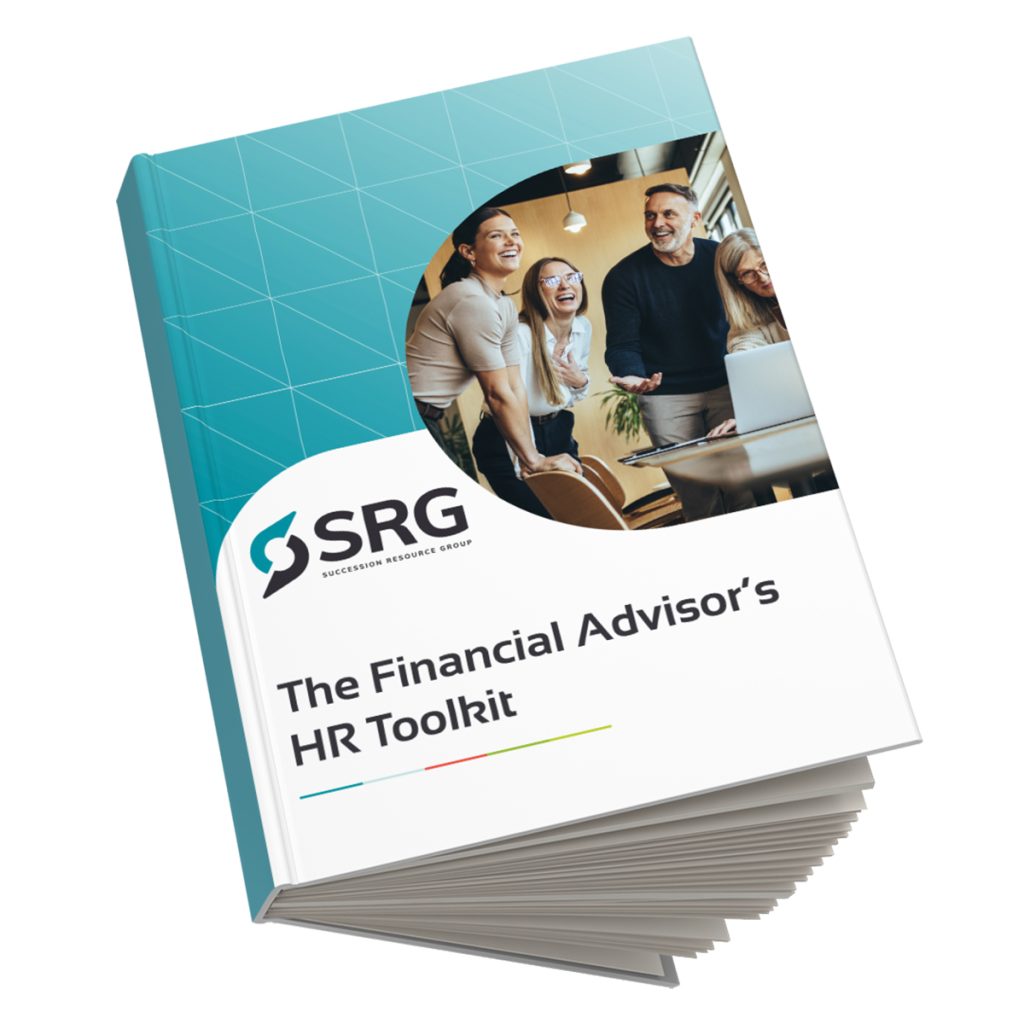
Download Your eBook! Please enable JavaScript in your browser to complete this form.Please enable JavaScript in your browser to complete this form. Name * FirstLast Phone Work Email *How Did You Hear About SRG? *— Select Choice —ConferenceDirect MailExisting/Past ClientGoogle AdWordsOtherReferralSocial MediaSeminar/WorkshopWebinarWebsite Download Streamline Your Practice with These Essential Tools Effective personnel management, including formalized employee agreements, equity sharing, and compensation plans, is equally crucial to the success of your financial practice as well as that of your team. Our toolkit is designed with all the essentials you need to manage your HR processes effectively, saving you time and increasing your efficiencies. Here’s what you’ll find inside: Expert recommendations on employment agreements Best practices for compensation Key elements for clear job role descriptions Guidance for creating a career path for your team Our toolkit is designed to help you improve your employee satisfaction, increase retention, and better align employee compensation plans with business initiatives. Complete the form to receive your free HR Toolkit today! Learn more about SRG’s Employment Resources and Equity Sharing services. Schedule your free consultation below!