
Empowering Advisors, Enhancing Transitions
Download Your eBook! Please enable JavaScript in your browser to complete this form.Please enable JavaScript in your browser to complete this form. Name * FirstLast Phone Work Email *How Did You Hear About SRG? *— Select Choice —ConferenceDirect MailExisting/Past ClientGoogle AdWordsOtherReferralSocial MediaSeminar/WorkshopWebinarWebsite Download Empowering Advisors, Enhancing Transitions Discover how SRG helps institutions support advisor growth and retention through expert guidance, seamless transitions, and strategies that reduce lift on your internal teams.
Selling to Your Kids? Why Family Deals Demand Extra Scrutiny

Selling your RIA practice to a son, daughter, or other family member might feel like a natural, low-stress transition, because there’s trust and familiarity. Many advisors assume they don’t need the same level of formality required of an outside RIA sale transaction. As a result they may skip a formal valuation, because they aren’t aiming for full value, or considering gifting equity. But this relaxed approach can open the door to tax exposure, compliance pitfalls, and long-term misunderstandings. In fact, intra-family sales demand more structure and care—not less—from both a practical and technical perspective. Here are five details and considerations to keep in mind that make these deals uniquely complex and why they deserve extra attention: 1. Third-Party Opinion of Value Is Non-Negotiable Family transactions are subject to close IRS scrutiny, especially when there are gifts involved or the sale price appears below fair market value. A credible, independent valuation is critical for: Establishing a supportable value of the business. Reporting a defensible value for gift tax purposes Supporting installment sale terms Managing the optics with non-involved heirs or business partners Using a third-party valuation firm ensures the agreed-upon price holds up under audit and provides a solid foundation for tax planning strategies. There are still tools at one’s disposal to influence or control the value, but doing so with an objective starting place—and with the correct strategy—will help ensure the RIA for sale is not recharacterized post-transition. Even if valuation isn’t the founder’s focus, it is still advisable to receive a formal valuation to avoid common post-sale pitfalls. Occasionally, advisors operating under an independent broker-dealer (IBD), inquire about simply ‘putting’ the business in the name of their son or daughter for no additional compensation to avoid formally “selling” or gifting. While it is possible to do at the IBD level, transferring an advisory business that has produced hundreds of thousands or millions of dollars of taxable income over the past decades, especially in an industry with a very active and well-known M&A market, is simply asking to be audited. 2. Alternative Financing Solutions For family business sales, there are unique financing options that can and should be considered. Self-Cancelling Installment Notes (SCINs) can be a powerful estate planning tool when selling to a family member. These notes are similar to a traditional promissory note, with the buyer/family member making payments of principal and interest out of cash flow, over some agreed-upon period. But, SCINs have a unique feature – the note can automatically terminate upon the seller’s death, potentially removing any unpaid balance from the seller’s taxable estate, without creating a tax liability for the buyer (the remaining debt outstanding at the seller’s passing isn’t forgiven, it simply terminates and ‘goes away’). SCINs can be a useful tool for family succession, but their structure must be airtight: SCINs need to include a “mortality risk premium” to offset the note’s cancelable feature – for example, a slight premium on the interest rate The valuation of the premium must be actuarially sound and based on health-adjusted life expectancy The term of the SCIN should be within the actuarial life expectancy of the seller – for example, a note shouldn’t be 20-years for a seller that is 85 years old The SCIN should be properly documented in value. The IRS will challenge and recharacterize notes that lack documentation or are undervalued For sellers with impaired health or shorter life expectancy, this can be an efficient way to reduce estate tax exposure, but it must be coordinated with a valuation professional and tax counsel. 3. Gifting Equity to a Family Member – Employee Gifting the business, partial or full, to a child who is also a key employee raises serious issues under both the gift tax rules and compensation regulations. To qualify as a gift by the IRS, the gift should be detached and disinterested generosity – a tough argument to make when the family member is on payroll. If an owner gave equity to anyone else on payroll, it would clearly be treated as a grant, thus making the argument that a grant to an employee related to the owner should in fact qualify as a “gift” is problematic/risky. Key considerations for gifting: Is the equity truly a gift, deferred compensation, or a grant of non-cash compensation? Is the employee/family member receiving equity for “less than adequate consideration?” Can the gift be split with your spouse? Can a minority interest be applied? Many family businesses are surprised by the gifting/granting considerations and thus get blindsided. Even well-intentioned, informal transfers can trigger unintended tax consequences if not properly documented. 4. Formal Governance Protects Relationships and the Business A key mistake in family transitions is letting relational trust substitute formal governance. When sharing ownership, with ANYONE (especially family), you need: A detailed Partnership Agreement, Operating Agreement, or Shareholder Agreement A buy-sell agreement with clear terms Defined roles and responsibilities for both generations A succession plan that survives death, disability, or divorce Mechanisms for resolving disputes (especially if other siblings are involved) Even if the culture is close-knit, legacy issues, entitlement perceptions, and money create a combustible mix. The hope is that you will never need to consult any of these agreements, whether selling to a family member or anyone else, but it is advisable to have well-thought-out governance documents you don’t need, than the inverse. Clear documentation avoids family blowups later. 5. Don’t Assume One Buyer = One Option In some cases, it may be advantageous to split ownership. For example, gifting minority interests over time while selling controlling interest later or using a grantor retained annuity trust (GRAT) or family limited partnership (FLP) structure to transition wealth gradually while maintaining control. Each of these has technical hurdles but can open up estate planning advantages that a straight sale misses. Bottom Line: Treat a Family Sale Like the High-Stakes Business Deal It Is Selling an RIA to a family member is not a shortcut—it’s a high-wire act, with an audience
Advisor Succession Plan: Inside a Real-Life Succession Plan
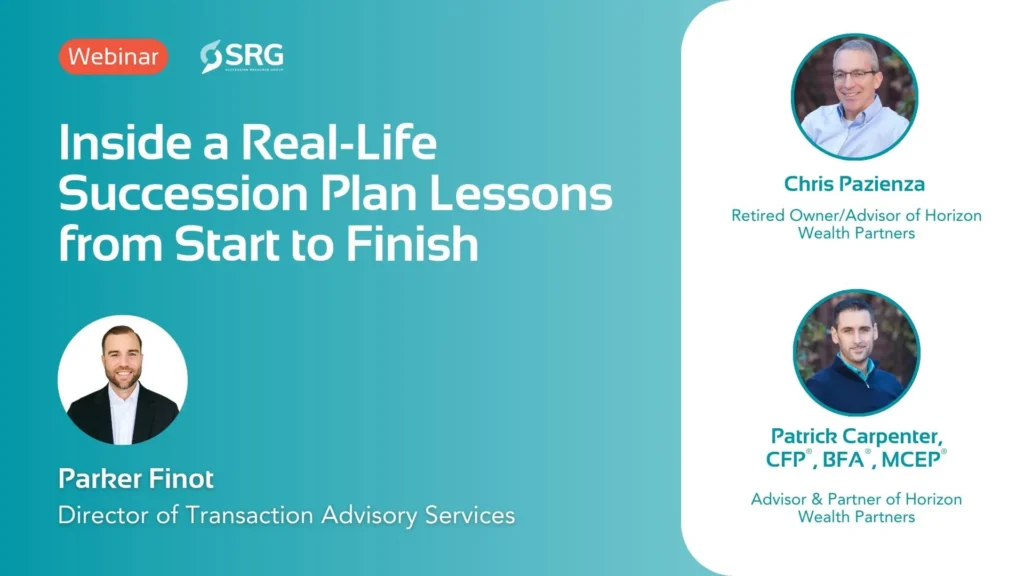
Why an Advisor Succession Plan Matter Real-Life Advisor Succession Plan: Lessons From Start to Finish is a complete, real-world case study showing how one multi-advisor firm moved through every step of a true advisor succession plan. You’ll see how the team handled valuation, financing, ownership changes, and client transitions from beginning to end—making this a practical example of a succession plan from start to finish. This session is built for financial advisors and firm owners who want proven, experience-based guidance. You will learn how to reward key team members, protect business value, structure a smooth transition, and prepare for a confident exit. You’ll also hear lessons from a real-life advisor succession plan that you can apply whether you’re planning an internal sale, grooming successors, or preparing your firm for the future. Speakers Host Parker Finot Director of Transaction Advisory Services Paper-plane Linkedin-in Guest Chris Pazienza Retired Owner/Advisor of Horizon Wealth Partners Guest Patrick Carpenter, CFP®, BFA®, MCEP® Advisor & Partner of Horizon Wealth Partners
Protecting Your Practice Against the Unexpected – David Grau Jr.
Access the Slides From the Session Download View our 2025 M&A Infographic Download Schedule a Call With Our Team Download Founder / CEO Paper-plane Linkedin-in Twitter Areas of Expertise: Advisor SuccessionSmall Business SuccessionFamily Business TransitionM&A Tax Strategies, NegotiationFinancing, Financial AnalysisRIA and IBD Rep Valuation, Continuity/ContingencyAdvisor M&A, Business PlanningRIA Buy-Side & Sell-Side Representation David Grau Jr., MBA David Grau Jr. is the founder and CEO of Succession Resource Group, a succession and M&A consulting company for advisors. Prior to launching SRG, David was the leading M&A consultant for a well-known succession planning firm to advisors where he led and developed numerous programs for RIAs. Prior to this role, David served in the United States Navy. David is a published author and accomplished speaker and has been interviewed and cited in dozens of publications over the last decade. He is currently one of the leading speakers in the financial services industry on M&A and next-gen building strategies, with over 200 presentations to his credit. In the past five years, he has spoken at a variety of the industry’s leading firms, including LPL Financial Services, Wells Fargo, Ameriprise Financial, ING, Independent Financial Group, Geneos, Swan Global, Advisor Group, Fidelity, Jackson National, Prudential, Raymond James, and regularly volunteers his time speaking for the Financial Services Institute (FSI) and FPA chapters around the country. David holds a Bachelor’s Degree from Portland State University and has a Master’s Degree from Willamette University’s Atkinson Graduate School of Management. David, his wife Kristen and their three children are long-time residents of Portland, Oregon, but take every opportunity to travel. Fun Facts: David enjoys spending time with his family, reading, running, is an avid wine enthusiast and developing a taste for cigars, loves traveling, reading, he also enjoys snow and water sports and loves basketball (playing or watching). Prior to having three children and starting a business David had a beautiful head of hair. Now he doesn’t.
What’s the Deal with PE and Aggregators! (Ep. 23)
Watch the Replay Related Resources 2025 Advisor M&A Report Check Out our Press Release→ Succession Readiness Checklist Check Out the Checklist→ Selling Your Practice with Expert Advocacy Watch the Replay → Grab A Valuation We offer a variety of solutions and turnaround times to fit your needs. Join myCompass Our membership club grants you inside tips and opportunities to grow. Review our Seller Services We’re here to ensure you secure the best buyer, price and terms.
Breaking the Cycle | Compensation Strategies That Protect Value & Drive Growth
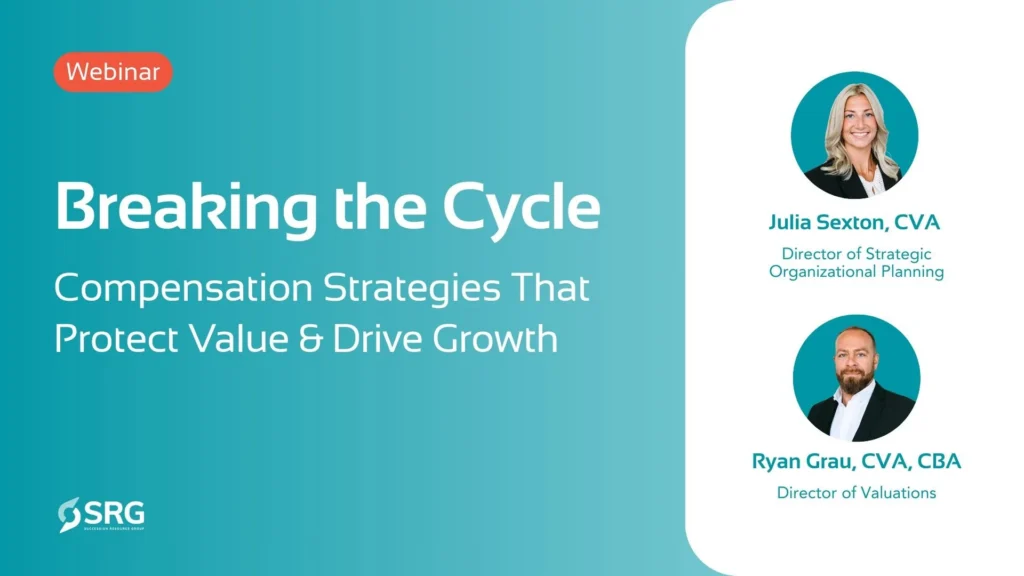
Valuation expert Ryan Grau, CVA, CBA, and compensation strategist Julia Sexton, CVA, reveal the most common comp mistakes—and how to fix them. Learn how to build pay models that drive growth, retain talent, and preserve business value. Watch the Replay Host Julia Sexton, CVA Director of Strategic Organizational Planning Paper-plane Linkedin-in Host Ryan Grau, CVA, CBA Director of Valuations Paper-plane Linkedin-in
5 Must Have Items for Your Equity Grant Plan

Granting equity is one of the most impactful — and complex — decisions a business owner can make. SRG’s “Top 5 Must-Have Items in Your Equity Grant Plan” infographic outlines the essential elements every advisor should include to protect, structure, and maximize their firm’s value. From corporate authorization and valuation to vesting terms and share class, this guide simplifies a process that can otherwise be overwhelming. Whether you’re granting equity for the first time or refining your existing plan, this resource ensures you’re covering every critical detail. Download the infographic today to learn how to build a strong, compliant equity plan that supports growth, rewards key talent, and safeguards your firm’s future. Please enable JavaScript in your browser to complete this form.Please enable JavaScript in your browser to complete this form. Name * FirstLast Phone Work Email *How Did You Hear About SRG? *— Select Choice —ConferenceDirect MailExisting/Past ClientGoogle AdWordsOtherReferralSocial MediaSeminar/WorkshopWebinarWebsite Download
Executing A Successful Internal Succession Plan In The Private Equity Era Of Advisor M&A

Watch the Replay Related Resources 2025 Advisor M&A Report Check Out our Press Release→ Succession Readiness Checklist Check Out the Checklist→ Selling Your Practice with Expert Advocacy Watch the Replay → Grab A Valuation We offer a variety of solutions and turnaround times to fit your needs. Join myCompass Our membership club grants you inside tips and opportunities to grow. Review our Seller Services We’re here to ensure you secure the best buyer, price and terms.
Webinar Questions
Have questions about the upcoming webinar? We encourage you to share your thoughts, ideas, or any questions you have ahead of time! Whether you’re curious about the topic, looking for more in-depth insights, or just seeking clarity on something specific, we want to hear from you. During the live event, we’ll do our best to address as many questions as possible. Our goal is to make the session as interactive and informative as possible. However, if we can’t get to your question during the webinar, don’t worry—we’ll make sure to follow up with you personally via email afterward. Your input helps us make our webinars even more valuable, so don’t hesitate to reach out. We appreciate your engagement and look forward to discussing your questions and thoughts!
Sample Valuation Reports
Our Sample Valuation Reports We provide sample valuation reports to give prospective clients a clear view of the quality, structure, and insights they can expect from our work. These examples demonstrate our thoughtful, thorough approach to each engagement and highlight how we tailor our analysis to the unique context of each business. They’re designed to build trust and help clients understand the value we bring to the decision-making process. Sample Starter Valuation Download Sample Premium Valuation Download Sample Elite Valuation Download