Why SRG Delivers Real ROI

Please enable JavaScript in your browser to complete this form.Please enable JavaScript in your browser to complete this form. Name * FirstLast Phone Work Email *How Did You Hear About SRG? *— Select Choice —ConferenceDirect MailExisting/Past ClientGoogle AdWordsOtherReferralSocial MediaSeminar/WorkshopWebinarWebsite Download What’s the real ROI of hiring SRG? Our latest infographic breaks down why firms choose SRG, not just for answers, but for outcomes. From saving time and streamlining execution to gaining strategic clarity and confidence, SRG’s process is designed to reduce friction and deliver high-impact, sustainable results. Discover: Why SRG replaces the need for multiple consultants How we cut down delays and drive momentum What makes our deliverables actionable and built to last The ROI you gain from hiring a neutral, industry-savvy partner Whether you’re navigating a valuation, acquisition, succession or other transition, this visual guide shows how SRG helps you act decisively and move forward smarter. Download the infographic to see how we deliver real ROI at every step of your journey.
When Your Key Stakeholders Want to Help You Sell: 4 Things to Watch For

Please enable JavaScript in your browser to complete this form.Please enable JavaScript in your browser to complete this form. Name * FirstLast Phone Work Email *How Did You Hear About SRG? *— Select Choice —ConferenceDirect MailExisting/Past ClientGoogle AdWordsOtherReferralSocial MediaSeminar/WorkshopWebinarWebsite Download When your successor, internal buyer or home office wants to “help you sell,” it can be a win or a warning sign. Our latest infographic breaks down four critical considerations every advisor should weigh: Valuation – Will it be fair and accurate or biased toward the buyer? Structure – Are the deal terms designed to protect your best interests? Process – Who’s leading the timeline, and are they moving too fast or too slow? Representation – Do you have someone advocating solely for you? Whether you’re exploring internal succession or weighing a third-party offer, this infographic highlights the hidden risks and the steps you can take to protect your legacy. Download the infographic now to learn how SRG helps you navigate the sale on your terms.
Legal/Tax/M&A: Where Your Professionals Fit Into Your M&A and Succession Plan
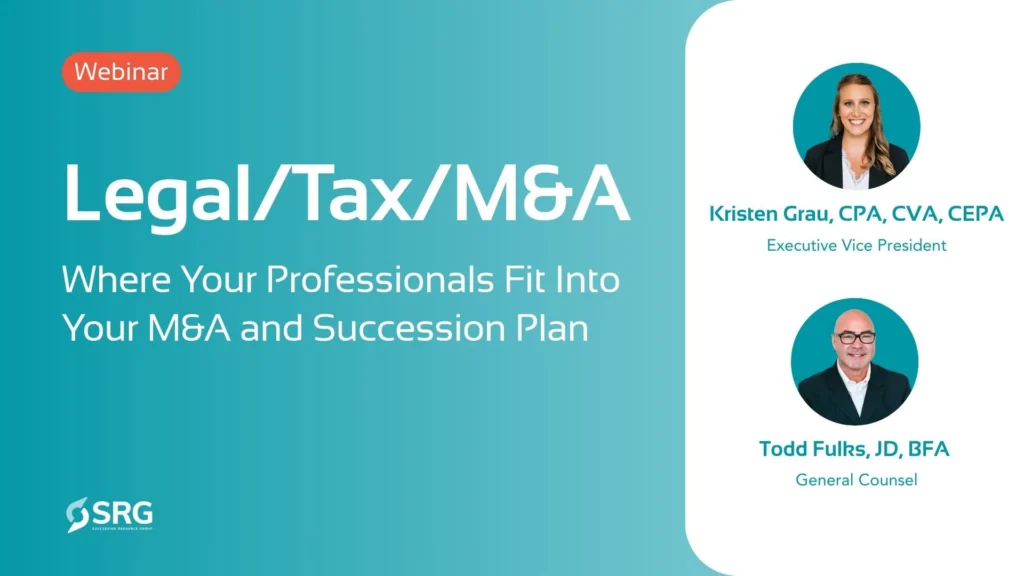
Discover how to align the right professionals with the right phase of your M&A or succession plan — without wasting time or money. This session delivers hard-earned insights from hundreds of real-world advisory firm transitions. Watch the Replay Host Kristen Grau, CPA, CVA, CEPA Executive Vice President Paper-plane Linkedin-in Host Todd Fulks, JD, BFA General Counsel Paper-plane Linkedin-in
Contingency Planning FAQ

What is a contingency plan? A contingency plan is an agreement between two or more advisors designed to protect your business in case of your death, disability (temporary or permanent), loss of license, and possibly even retirement (although most plans do not deal with succession planning). There are a variety of plan types to solve for these issues:
Year End
Strategy Starts Early Strong outcomes start earlier than most advisors expect. Many SRG clients engage in multiple projects because our work is strategy-centered and sequential—each phase builds on the last. We don’t just produce documents; we guide informed decisions that carry through to execution. Engaging early gives you more than time—it gives you options. It creates room to align priorities, pressure-test decisions, and connect individual projects to broader business goals, leading to clearer direction and stronger outcomes over the year ahead. What Affects Your Timeline To keep your project moving, early engagement and active participation are essential. Key factors that influence your timeline include: Calls & Meetings: Most projects require multiple scheduled calls, including a final review to ensure you have the information you need to make decisions and move forward. Decision-Making: Delays in selecting strategies can slow progress. Third-Party Reviews: Broker-dealers, custodians, lenders, attorneys, tax advisors, and compliance teams may require several weeks for document review and approval. Regulatory Review: Agencies like FINRA, the SEC, and state regulators may experience year-end backlog, seasonal delays or closures which can slow momentum. Internal Coordination: Gaining alignment with business partners, staff, family members or other key stakeholders can add time. Your Role: Timely submission of questionnaires, financials, and other documentation is critical. Other factors such as business restructuring, holiday schedules, technology transitions, or extended negotiations can also affect the pace of progress. Starting early and staying engaged helps ensure your project progresses smoothly and avoids common year-end bottlenecks. Need help prioritizing? Let’s chat. Plan to Finish by Year-End. Engage & Submit Questionnaires By… Service/Service Tier Avg # of Calls Without Expedite With Priority Access Merger Support – Elite 16 5/23/2026 9/5/2026 Succession Planning – Elite 20 5/23/2026 9/5/2026 Entity Support- Elite 8 6/22/2026 9/5/2026 Deal Support – Elite 10 7/22/2026 10/5/2026 Merger Support- Premium 10 7/22/2026 10/5/2026 Succession Planning – Premium 10 7/22/2026 10/5/2026 Compensation Design – Elite 6 8/21/2026 10/5/2026 Entity Support – Premium 6 8/21/2026 10/5/2026 Equity Sharing – Elite 6 8/21/2026 10/20/2026 Deal Support – Premium 7 8/21/2026 10/20/2026 Entity Support – Starter 0 9/20/2026 9/20/2026 Contingency Planning – Elite 4 9/20/2026 11/4/2026 Employment Agreements – Elite 4 9/20/2026 10/20/2026 Valuation – Elite 3 10/5/2026 11/4/2026 Employment Agreements – Premium 3 10/5/2026 11/4/2026 Compensation Design – Premium 4 10/5/2026 11/4/2026 Deal Support – Starter 0 10/20/2026 10/20/2026 Valuation – Premium 2 10/20/2026 11/19/2026 Contingency Planning – Premium 2 10/20/2026 11/19/2026 Valuation – Starter 0 11/12/2026 12/2/2026 Compensation Design – Starter 0 11/12/2026 11/12/2026 Contingency Planning – Starter 0 11/12/2026 11/12/2026 Employment Agreements – Starter 1 11/12/2026 11/12/2026 Won’t Make the Year-End Deadline? Don’t sweat it! Even if a project cannot be fully completed by year-end, initiating the project early allows SRG to establish key baselines, prepare necessary documentation, and “lock in” relevant data or effective dates to help you achieve the intended results once the project is completed post year-end. While speed may feel important, our goal is to ensure your outcome is strategic, thorough, and aligned with your goals—not just completed by an arbitrary date. Benefits of ExpeditingYour Project Our expedited option is designed for clients who want to move quickly and efficiently without sacrificing quality. By expediting your project, you gain access to distinct advantages: Flexibility in Scheduling: Greater control over appointment times that fit your calendar. Proactive, Advanced Scheduling: We pre-schedule 2–3 calls in advance to keep momentum and ensure on-time completion. Same-Day / 24-Hour Response: Enjoy prioritized responses so your questions and needs don’t wait. VIP-Only Content & Resources: Get exclusive access to templates, guides, and strategic tools curated for fast-track clients. Concierge Experience: White-glove service with increased attention to detail and efficiency. Enhanced Onboarding Experience: A smoother, faster start designed to set your project up for success from day one. Timeline Transparency:What You Should Know We understand the urgency many clients feel around year-end timelines. If you engage and submit your completed questionnaire by the specified deadline, we will make every effort to complete your project by year-end. However, final delivery is subject to factors outside our control, including third-party availability (e.g., lenders, attorneys, regulators), required approvals, and timely execution or decision-making on your part. To increase the likelihood of meeting your timeline, we strongly encourage early engagement, quick responsiveness, and consistent participation throughout the process. Please note that timely submission alone is not enough—questionnaires must be complete and accurate. If responses are missing or vague, we will not have the necessary information to move forward, and your project may be delayed beyond year-end as a result. Ultimately, the question is this: Do you want your project done fast, or done right? While speed may feel important, our goal is to ensure your outcome is strategic, thorough, and aligned with your goals—not just completed by an arbitrary date. Book a Discovery Call to Learn More Schedule an appointment to learn how SRG can help you! Days Hours Minutes Seconds
A Legacy Preserved Under Pressure

When Time Is Short, the Right Partner Makes All the Difference Succession planning after advisor death is one of the most urgent and complex challenges a firm can face. When a long-time Hawaii-based financial advisor unexpectedly passed away, their family was left with a major challenge: how to transition a complex, high value practice in under 60 days while mourning the loss of their loved one. Without a succession plan in place, the estate faced potential client attrition, lost value, an employee in limbo, a lease payment, and industry regulated complications. That’s when the family reached out to the deceased advisors’ Practice Management Consultant who referred to them to Succession Resource Group for help. The Challenge Following the sudden death of the advisor, the estate was left without a succession plan or an interim servicing advisor in place. The practice itself had a strong revenue base, generating $684,227 in revenue (79.0% recurring) and serving 248 households. However, it faced several immediate and significant challenges. Among these was an active lease obligation with 33 months remaining, adding financial pressure during a time of uncertainty. Coordination with the broker-dealer and regulatory compliance were urgently needed, further complicating the estate’s efforts to stabilize the business. The most pressing concern was the urgent value risk—without swift action and a clear strategy for succession planning after advisor death, the estate stood to lose everything. Compounding the situation was the vulnerability of a key, loyal employee, whose future with the practice was uncertain and at risk. These factors combined to create a highly complex and time-sensitive situation for the estate in identifying and implementing a succession solution. The Strategy In the wake of a sudden death, SRG launched its Seller Advocacy Program to guide the estate through the transition. Despite having limited data and no prior valuation available, SRG quickly created a prospectus that allowed the estate to take immediate action. Through targeted outreach, the team sourced 32 qualified buyers—specifically focused on local options—to ensure continuity and client familiarity. 10 finalists were interviewed and negotiated offers were considered, giving the estate meaningful choices rather than a rushed exit. Importantly, SRG positioned the practice for maximum value—not just a fast transaction—helping preserve the seller’s legacy while protecting long-standing client relationships. By applying their expertise in succession planning after advisor death, SRG brought structure, strategy, and compassion to the business transaction at a time when the family, employee, and clients needed it most. The Results 12% Over asking price 100% Cash down upon closing 3.1% Over industry recurring revenue multiples 33-Month lease obligation assumed by buyer 100% Fee to SRG paid by buyer 100% Staff retained by buyer Don’t Wait for the “What If” Be Prepared. Be Protected. What happens if life throws a curveball? Illness, injury, or worse—none of it waits for the right time. And when the unexpected hits, your clients, staff, and family may be left with more questions than answers. That’s why succession planning after advisor death is essential—not just for business continuity, but to protect everything you’ve worked so hard to build. Secure Your Legacy with SRG’s Contingency Retainer SRG’s Contingency Retainer is a proactive planning service empowers you to make critical decisions while you’re alive and well. You authorize a strategy to protect your business, define your wishes, and ensure your practice is positioned to transfer smoothly—no matter what happens tomorrow. Are You Interested in Entity Support? Let’s Talk. For our Premium and Elite clients, SRG handles this entire process: setting up the publications, securing affidavits, and preparing the Certificate of Publication form, so all you have to do is submit it to the NY Department of State. Book a consultation with our team today and let’s get started.
New York State Entity Publication Guide

Overview Congratulations on forming your LLC with the New York Secretary of State! To help you meet the state’s requirements, we’ve outlined the steps below to guide you through the mandatory publication process. Legal Requirement Under New York Limited Liability Company Law §206, within 120 days of formation or authorization, an LLC must publish a notice once each week for six consecutive weeks in two newspapers—one daily and one weekly—designated by the county clerk of the county in which the LLC’s office is located. A list of available publishers can be obtained from the county clerk’s website. Publication Timeline Within 120 days after filing the Articles of Organization or Application for Authority with the New York Department of State, the entity must publish a notice in two newspapers. These newspapers are designated by the county clerk of the county where the entity’s office is located, as stated in the Articles or Application. Newspaper Specifications One daily and one weekly newspaper must be used Publications must run for six successive weeks. The content must be either a copy of the Articles of Organization or Application for Authority or a notice containing its substance. Proof of Publication Obtain affidavits of publication from both newspapers. Complete a Certificate of Publication, which can be found on the following website: Link to Certificate of Publication Form. Mail these affidavits along with the Certificate of Publication and a check of $50 for the filing fee to: New York Department of State Division of Corporations One Commerce Plaza 99 Washington Avenue, Suite 600 Albany, NY 12231 For further details, visit the New York Department of State Division of Corporations website. Are you interested in entity support? Let’s Talk. SRG handles this entire process: setting up the publications, securing affidavits, and preparing the Certificate of Publication form, so all you have to do is submit it to the NY Department of State. Book a consultation with our team today and let’s get started.
Selling My RIA as a Financial Advisor, Prioritizing Client Fit Over Highest Offer

John’s Journey John Gunn was the Managing Principal of John L. Gunn & Associates, LLC, a Portland-based Registered Investment Advisory firm, prior to selling to Mainsail Financial Group. In his practice, John advised high-net-worth individuals, foundations, and pension plans, bringing decades of business experience and a reputation for excellence. He has been recognized as a Five Star Wealth Manager in Portland Monthly Magazine and served as a long-time member of the American Institute of CPAs National Financial Planning Insights Panel. “When it came time to sell my firm, I engaged SRG’s Seller Advocacy services to guide the process. For me, this decision wasn’t just about securing the best offer — it was about protecting my clients, ensuring continuity, and preserving the legacy I had built.” Selling My RIA: How I Found Peace Of Mind In the Process For many business owners, the thought of selling the company they’ve poured their lives into is overwhelming. I get it – for me, when thinking of selling my RIA, there was more to consider than just the financials. It was a deeply emotional process, one that required balancing personal priorities, finding the right partner, and ensuring that my clients and legacy were left in good hands. As the former owner of an RIA who recently went through this very journey, I thought it might be useful to share some powerful lessons about the experience, and how I made peace with my decision to sell. My story is unique to me, but not far removed from that of many financial advisor business owners who will all eventually ponder this same leap in the coming decade. The Moment I Realized What Truly Matters For years, I had juggled the demands of my business with my personal life, always trying to give everything I could to both. While I was still healthy and could likely continue, my wife’s health began to decline. There came a point when I had to ask myself a hard question: What am I willing to sacrifice? For me, the answer was clear. I couldn’t sacrifice my relationship with my wife. As much as I cared about my clients, my family had to come first. I realized, “I can’t do right by my wife and do right by my clients. One of them has to give, and it’s not going to be my wife. And so then the anxiety I had was simply about the fact that I didn’t know if I’d be able to find people that I would feel good about handing my clients off to.” That realization was a turning point. It wasn’t easy to admit that I couldn’t do it all anymore, but I knew I had to take a step back to honor the people who mattered most. If you’re in a similar place—feeling torn between your personal and professional obligations—let me assure you: it’s okay to choose your family. It’s okay to step back and say, “I’ve given all I can, and now it’s time for a new chapter.” This was the first step in my exit planning journey, and while it brought anxiety, it also brought clarity. Building Confidence in the Process Once I made the decision to sell my RIA, the next challenge was finding the right buyer—someone I could trust to take care of the clients I’d built relationships with over the years. That uncertainty weighed on me. How could I be sure I’d find the right people? At first, I wasn’t sure I would. But as I worked with my advisors and started the process, something shifted. I began to see that there were good buyers out there, people who shared my values and who I’d feel proud to recommend to my clients. “Once we went through the process far enough for me to realize that I am going to find somebody… SRG did a good job of generating interested parties…And then together we narrowed that list down. And, you know, coming to the realization that, yes, there are good people here that I will be absolutely delighted to write strong recommendations to my clients saying, these are good people and they’ll take care of you.” That was a game-changer for me. I went from feeling anxious about selling to feeling confident that I was doing the right thing, not just for myself, but for my clients. If you’re considering selling, my advice is simple: Trust the process. Start early, work with people you trust, and take the time to really evaluate your options. The right partner is out there, you just have to be willing to find them. Why Fit Matters More Than the Highest Offer When it came time to choose the buyer, I had one priority: I needed to know, without a doubt, that my clients would be in good hands. “My only real priority was I needed to have somebody that I could feel confident handing my friends and clients off to, knowing they’d be well taken care of. The vetting process was about understanding their investment process, but most importantly, who they were as people. Can I trust them to truly put my clients’ interests first? Are they personable enough to make my clients comfortable? That became the lead criteria for me. Ultimately, I chose the buyer who fit these values, even though their offer wasn’t the highest, because it was the best fit. And everything I’ve seen in the past year proves I was right.” In the end, I didn’t choose the highest offer. I chose the buyer who aligned with my values, someone I trusted to care for my clients and carry on the legacy I’d built. A year later, I can say with confidence that I made the right call. For anyone going through this process, let me share this: Fit matters. Numbers are important, of course, but they aren’t everything. When you’re handing over something as personal as your business, you want to know it’s going to the right people. Trust your
New York State Society of Certified Public Accountants: Structuring the Deal: Taxation When Selling Your Financial Service Business

December 15, 2020 By: David Grau Jr., MBA, and Nicole Frey, CFPPublished Date: Oct 1, 2020 For professionals planning to purchase or sell a financial services book of business, the most common negotiating points are the purchase price, deal structure, timeline, and financing considerations. These are critical points to discuss and finalize before signing on the dotted line. It’s also important to be aware of the effect of the tax treatment on the deal and know the different tax structures commonly employed. If not structured purposefully, the tax treatment of a deal may unintentionally favor either the seller or the buyer and can have a significant impact on the total value received/paid. Depending on what’s been negotiated, the majority of the sale proceeds may be classified as ordinary income or long-term capital gains. Negotiating this early in the process will ensure that the purchase price can be adjusted up or down to balance the benefit. As a result, the tax allocation of the sale proceeds is one of the key elements of a deal structure and should be considered carefully by both parties. Potential Deal Structures To decide which tax structure works best for the deal, the parties will enjoy some level of flexibility as long as they remain within the boundaries of current tax laws and the objectives of the transaction. The first decision that must be made is what exactly is to be sold (assets and/or equity) before discussing how the purchase price should be allocated to a particular asset or equity or both. The following are the two most common considerations: Asset sale In an asset sale, the buyer selects certain individual business assets to be purchased from the seller, with each asset having a specific dollar amount of the purchase price paid for it and allocated as such in the purchase agreement. This includes the following primary categories (in addition to any tangibles that may be acquired): Personal goodwill: client relationships, rights to revenue, the reputation of the business (i.e., the book of business) Restrictive covenants: nonsolicitation, noncompete, and/or no-serve agreement with the seller. Post-closing transition assistance: services provided by the seller, such as assistance with client meetings, phone calls, emails, letters, etc. Equity (stock) sale Rather than buying individual assets, the buyer and seller may elect to make the seller’s business entity (e.g., corporation or LLC) the subject of the transaction and enter into a sale of the seller’s ownership interest in the entity. The transfer of the ownership in the entity allows the seller to transition all assets and the liabilities of the business to the buyer, including all— contracts, permits, licenses, and registrations. Since both an asset sale or stock sale may ultimately result in long-term capital gains tax treatment for the seller, the choice is influenced greatly by the buyer’s preferences and whether there’s perceived value in buying the business entity. Asset Sale: Categories and Tax Treatment The most common deal structure when buying or selling a financial services practice is a sale of assets, versus an equity-based sale. This does vary based on the size of the transaction; deals involving larger firms will more often employ an equity-based strategy to ensure the acquired business remains a going concern. When purchasing the assets from a seller, it’s important to ensure that both buyer and seller agree on how the purchase price will be allocated for tax purposes, and such meeting of the minds should be included in the purchase and sale contracts. Personal goodwill The majority of the purchase price is typically allocated to personal goodwill—an IRC section 197 intangible asset consisting of the seller’s client relationships, reputation, expertise, and abilities. Year-to-date 2020, the average transaction for financial service professionals allocated 93% of the purchase price to personal goodwill, up from 91% in 2019. For the seller, the sale of personal goodwill should generate long-term capital gains tax treatment and be amortizable over 15 years by the buyer. Post-closing transition support Depending on the extent of the seller’s services to the buyer post-closing, compensation for these services can be either included in the purchase price (typically for limited services such as introducing the buyer to the transferred clients) or be paid in addition to the purchase price (for the seller’s expanded involvement post-closing beyond just transitioning clients). As shown in Figure 1, the average transaction allocated 3% of the purchase price to the seller’s post-closing support, though this allocation tended to be greater on smaller deals. For the seller, they want to ensure only a de minimis portion of the purchase price is paid for their transition assistance, as this portion is labor and taxed as ordinary income, subject to Social Security and Medicare taxes. The buyer, however, generally seeks to allocate more of the purchase price to the transition support, as this portion provides them a tax write-off in the allocated amount, pro-rated for the year in which the services were provided. Restrictive covenants To protect the buyer’s investment, the seller will commonly be required to enter into a restrictive covenants agreement (similar to personal goodwill, this too is an IRC section 197 intangible asset), whereby they promise not to compete with the buyer, solicit the buyer’s employees or vendors, or serve any of the clients the buyer purchased from the seller. In exchange for this promise, the seller will receive a portion of the purchase price as consideration, resulting in ordinary income for the seller and a 15-year amortization by the buyer. Because this asset doesn’t produce a tax-favorable outcome for buyer or seller (relative to the alternatives previously described), neither party seeks to allocate any more than would be required to ensure the buyer has an enforceable contract. Year-to-date 2020, the average transaction allocated 3% of the purchase price to restrictive covenants. Not allocating a portion of the purchase price to restrictive covenants may render the provisions unenforceable and otherwise confuse the intended tax result. Tangible assets Tangibles assets, such as furniture and equipment, are not commonly part of the deal since there’s often little to no value to
Balancing Act | Exploring Value and Terms in Deals (Ep. 24)