
How Firms Use Equity Stakes to Retain Top Advisor Talent, Drive M&A
By: Tobias SalingerPublishing Date: January 27, 2026 Internal transactions in which financial advisors buy equity in their firms represent a growing share of wealth management M&A deals, a new study found. Those deals boost advisors’ compensation via stakes in expanding firms, making them more likely to stay long-term. And they’re becoming more popular, according to a webinar last week held by consulting firm Succession Resource Group on its annual M&A study and hosted by founder and CEO David Grau and Parker Finot, its director of transaction advisory services. The study analyzed data from 171 transactions in 2025, including firms with about $14 billion in total client assets that Succession Resource advised, as well as other deals that used financing from Oak Street Funding and PPC Loan, which both collaborated in the study. Across M&A deals, a small group of highly competitive buyers continues to drive record valuations, leading to new highs in transaction volume. The number of potential acquirers per seller plummeted last year to 61 from 85 in 2023 and from 66 in 2024. Grau noted four main M&A trends from 2025: private equity investors’ impact on deal sizes, overall higher valuations, a smaller pool of possible buyers and a rising number of internal deals. “That’s not noteworthy in the sense that there’s more succession planning taking place,” he said. “But it’s noteworthy because most of these that we’re seeing are not supporting a partner retiring, and younger gen-two, gen-three folks buying them out. That happens too, but that’s separate. These are just straight-up purchases, buying into a firm that these advisors are working at and it’s happening a material amount of the time where we want to take note of it and share that with you today.” To read the full article, please visit: https://www.financial-planning.com/news/how-m-a-is-rewarding-top-financial-advisor-talent Disclaimer This article was first published by Tobias Salinger The original article can be found here. All rights to the original content are held by FinancialPlanning.com.
2026 Advisor M&A Review

Webinar Recordings Watch the Webinar Replay 2026 Advisor M&A Market Insights: What Actually Happened in Advisor M&A Powered by SRG’s 10th annual review of completed M&A transactions, our Flagship webinar distills what actually happened in the market into clear, decision-ready benchmarks for RIAs and financial advisory firms. Built on the industry’s most comprehensive dataset of verified, closed transactions, this session delivers highly accurate valuation benchmarks and deal insights that go far beyond self-reported surveys. You will learn what is driving multiples, where buyer demand is strongest, and how terms are shifting as the market evolves. We will also break down the valuation metrics advisors care about most, including revenue multiples versus EBITDA multiples, and explain when each applies based on business model, size, profitability, and growth profile. Valuation is only part of the story. This webinar also dives into the deal structures that determine what sellers actually take home, including cash at close, seller notes, and other components that can significantly impact real outcomes. You will leave with clarity on what buyers are prioritizing, what quality firms are commanding in today’s market, and how to position your business for a stronger result. Led by David Grau, Jr. MBA (CEO) and Parker Finot (Director of Transaction Advisor Services), this is a data-backed, practical session designed to help you make smarter decisions with more confidence. Whether you are preparing to build value, buy, sell, or accelerate growth, this will be one of the most actionable hours you can invest in your 2026 planning. Get the Presentation Deck Download Download the Infographic Please enable JavaScript in your browser to complete this form.Please enable JavaScript in your browser to complete this form. Name * FirstLast Phone Work Email *How Did You Hear About SRG? *— Select Choice —ConferenceDirect MailExisting/Past ClientGoogle AdWordsOtherReferralSocial MediaSeminar/WorkshopWebinarWebsite Download Speakers Host David Grau Jr. MBA CEO/President Paper-plane Linkedin-in Host Parker Finot Director of Transaction Advisory Services Paper-plane Linkedin-in Sponsored by Data Contributors Transcript 100:00:06.580 –> 00:00:25.530David Grau: All right. Good afternoon, everybody. Welcome to Succession Resource Group’s 10th Annual 2026… well, it’s not the 10th annual 2026 review, but it’s our 10th annual review of the M&A data. This is our 2026 edition. Really excited to have you join us here today. We… 200:00:26.020 –> 00:00:45.119David Grau: we like being able to pause in January, aggregate all the deal data, all the succession data, everything that we have seen happening in the prior year, and try to feed that back to you, us, as an industry, just to be able to keep our collective fingers on the pulse of what’s happening out there for buying and selling practices. 300:00:45.310 –> 00:00:58.569David Grau: This is probably not your first rodeo, I know there’s a bunch of you that join us every year for this, as well as listen to us occasionally at the custodial, broker-dealer conferences, FPA meetings around the country throughout the year. 400:00:58.740 –> 00:01:09.049David Grau: We want to try to help you stay abreast of this, because at the end of the day, big firm, small firm, RIA, duly registered, whatever the label is that you are wearing today. 500:01:09.490 –> 00:01:25.569David Grau: Your business, your advisory practice, is probably your most valuable asset, and we want to make sure, whether you’ve done a valuation or not, you can at least have a number next to it on your personal balance sheet, because it has such substantial value, and frankly, today, it’s harder to understand than ever before. 600:01:25.940 –> 00:01:41.339David Grau: Right? You read the trade publications, the press releases out there about deals, it’s enough to make your head spin. So, we’re gonna try to share that data with you here today, but also carve out time to answer your questions, which hopefully you either A showed up with some, or B, 700:01:41.410 –> 00:01:45.949David Grau: We’re going to prompt some, just organically, as we progress through the slides here today. So. 800:01:46.730 –> 00:01:50.170David Grau: Couple boring administrative things to knock out first. 900:01:50.610 –> 00:01:55.019David Grau: The housekeeping items… Watch the chat. 1000:01:55.020 –> 00:02:15.710David Grau: There’s a chat feature in here. Granted, it’s a one-way chat feature, but there you go, see? There’s information that will be dropping in there for you, so it should be helpful. Use the Q&A feature. There’s a Q&A panel here, I promise you, we will actively watch it. If you have technical issues, that won’t be Parker and I, we’ve got Guy here, our amazing moderator, that will help with that stuff, but if you have questions. 1100:02:15.780 –> 00:02:17.830David Grau: As we progress through the slides. 1200:02:18.410 –> 00:02:30.529David Grau: We will make sure we either answer them organically as we progress, because Parker and I will be watching the Q&A panel, or we’ll answer it towards the end, because we are planning to reserve 15-20 minutes for that specifically. So… 1300:02:30.530 –> 00:02:40.079David Grau: Beyond that, there is a poll question we’re gonna pop up. This just helps us have a better idea, better understanding of you as our audience, where you’re at. 1400:02:40.080 –> 00:02:48.589David Grau: what’s relevant and interesting to you, so you’ll see that pop up here momentarily. We’ll take it down, and won’t get in the way. You know, Zoom, presumably, it’s off to the side. 1500:02:48.890 –> 00:03:01.649David Grau: So, you’ll see the poll question pop up, case in point. So there’s a poll question, if you would participate, that would be lovely. If you don’t, we’ll just leave it up forever. So, a couple other easy ones. We always get questions on slide availability. 1600:03:01.680 –> 00:03:11.309David Grau: These slides are available. Our team will be reaching out to you after we get done with the session here today, either tomorrow or certainly early next week, if you want a copy of the slides. 1700:03:11.440 –> 00:03:17.069David Grau: Just let Craig, Sabrina, Nikki, and our team know, and they will happily share them with you. And… 1800:03:17.380 –>
Everything You Need To Understand Liquidation Rights

Liquidation rights, also known as liquidation preferences, are a key element in contract negotiations for mergers and acquisitions. They determine who gets paid and when should a company choose to sell or liquidate all its assets. With a merger, liquidation rights can be leveraged in the deal once the buyer figures out the breakdown of existing parties who need to get paid. For acquisitions, it’s all about properly allocating preferred stock and liquidation preferences to investors. Liquidation Rights and Organizational Hierarchy When a corporation is formed, it’s up to the board of directors to set up a stock structure that should include executive, preferred, and common stock. Each category awards the recipient with a certain number of votes per share and a place in the liquidation queue. If venture capital is used for start-up money, the venture capital firm will typically insist that they be the first to get paid in the event of liquidation or sale of the company, ahead of debt holders or other preferred stockholders. Common stockholders get paid last. Liquidation rights also come into play in the event of a bankruptcy. In this case, as in the case of a general liquidation or sale, a company liquidator needs to unwind the complexities of secured and unsecured debt, investor liquidation preferences, and preferred stockholder allocations. It’s important to understand that the organizational hierarchy of liquidation rights can be very different from the executive or even board hierarchy of the company itself. General employees are typically issued common stock and can walk away with nothing in certain scenarios. Liquidation Preference is a Key Element in M&A Deals Researching liquidation rights should be part of the due diligence process for any merger or acquisition. When there’s a change in ownership, certain obligations need to be attended to. Among those, there could be unresolved debt or repayments to investors. This is one of those areas that bringing in an experienced MA consultant will pay dividends for you. In most cases, it’s the seller’s responsibility to meet repayment of debt obligations before closing the deal, but the buyer may inherit some of those liabilities if they are not careful. Companies only need to sell 51% of their equity shares to transfer control to another business or private entity. The remaining shareholders keep their shares, some of which may be preferred stock that holds a liquidation preference. Your legal team needs to evaluate that. Liquidation Rights for Preferred Stockholders Issuing preferred stock to select investors or partners in the firm is not a guarantee of payment in the event of a sale or liquidation. It does, however, put them closer to the front of the line. Keep that in mind when structuring an acquisition contract. To ensure liquidation rights are clearly defined, it is recommended that you utilize different classes of preferred stock. Callable shares, which can be bought out by the company prior to the next acquisition or merger, are a sensible option if investors will go for it. Convertible preferred shares can be an attractive option also, and a good negotiating tool. They can be traded for common stock using a predetermined multiplier. Issuing these as part of an acquisition strategy can be a tradeoff for guaranteeing liquidation rights. Classes of preferred stock to avoid when drafting an MA contract are participatory preferred shares and cumulative preferred shares. They each offer dividend guarantees, which can be a slippery slope. There are better ways to ensure major investors make a profit. Liquidation Rights for Common Stockholders Holders of common stock only benefit from liquidation rights when the acquisition price exceeds the sum of the guarantees made to preferred stockholders and any debt payments that need to be made before the deal can be closed. Like preferred stock, common stock can be allocated into different classes, and liquidation rights can be assigned based on those classes. This is also how voting rights are awarded. When acquiring a new company, creating these classes is your responsibility. When assigning common stock to employees, make sure there’s a reasonable vetting schedule in place to protect the company. If things don’t go well in the first few years and you have to sell, this will eliminate any liquidation rights for common stockholders. Liquidation Preference for Founders with Capital Investment A founder investing his or her own money into a company is not the same as a venture capital firm making an investment. Founders don’t have a special liquidation preference. They’re treated the same as any other preferred stockholder. To alleviate concern over this, companies can create an “executive” class of preferred stock that has better voting rights and is higher up the chain for liquidation preference. This will usually guarantee some compensation after venture capital firms are paid. Liquidation Rules for Creditors and Debt Holders In cases of insolvency, there are rules for paying off creditors when a liquidation occurs. These don’t have to be included in an MA contract, but this list should be used when negotiating a purchase or sale. The following debts should be paid off in this order. Secured Creditors with a Fixed Charge Preferential Creditors Secured Creditors with a Floating Charge Unsecured Creditors Fixed charges are assets used to secure a loan that have a fixed value, such as property or equipment. An example of a floating charge is stock, which fluctuates (floats) in value, but fixes on the liquidation date. Unsecured loans have no collateral attached and can be saved for last.
The Exchange: Entity Structure and Why It’s The Backbone of Your Advisory Firm (Ep. 28)
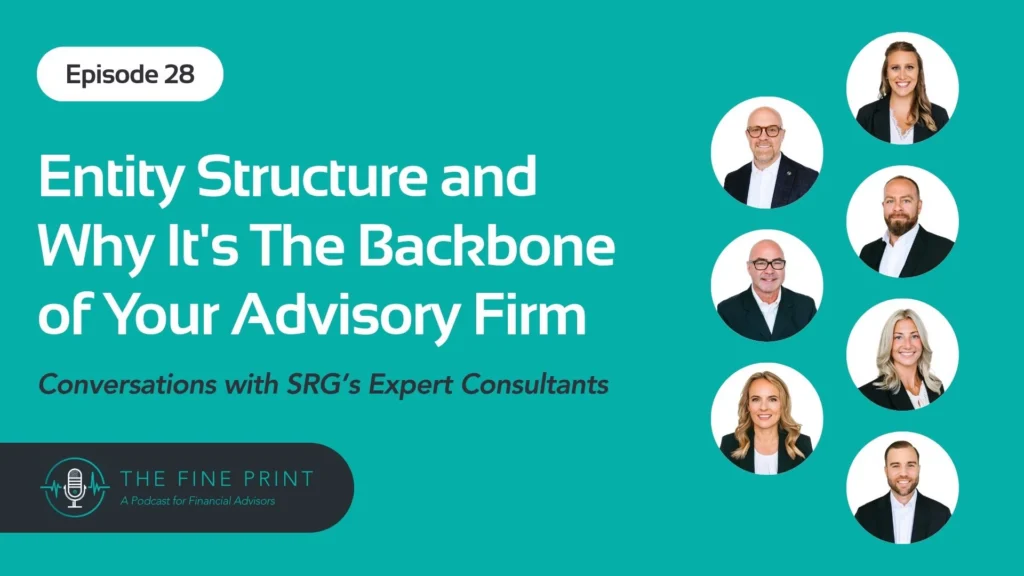
Entities and Entity Maintenance Entity structure is not just a legal formality. It plays a major role in how an advisory firm grows, shares ownership, and transitions leadership. In this episode of The SRG Exchange, SRG’s consulting team and general counsel unpack why entities have moved from a “set it and forget it” task to a core piece of business strategy. You will hear how entity decisions influence everything from equity sharing and internal succession to mergers, lending, disputes, and value building. Why entities are now strategic, not administrative The team discusses how entities used to be treated as a quick setup for liability and taxes, but have become foundational for firms with growth plans, W2 employees, equity sharing, and long-term succession goals. Why entities are now strategic, not administrative The team discusses how entities used to be treated as a quick setup for liability and taxes, but have become foundational for firms with growth plans, W2 employees, equity sharing, and long-term succession goals. Entity structure supports retention and equity pathways A properly structured entity can create divisible ownership units or shares, enabling retention strategies and giving next-gen leaders a pathway to buy, earn, or convert into real equity. S-corp versus LLC taxed as partnership The group compares the tradeoffs of rigidity and flexibility across entity types. An S-corp can be effective in specific scenarios, but many firms pursuing mergers or complex ownership structures benefit from the flexibility of an LLC taxed as a partnership. Entity structure impacts M&A, mergers, and equity swaps Entities do not only matter for succession and equity sharing. They also shape peer-to-peer acquisitions, mergers, partner buyouts, and equity swaps. Poor structure or conflicting agreements can reduce tax strategy options and create deal friction. Why entity maintenance matters Entity documents need to reflect reality. The team shares how outdated operating agreements and inconsistent ownership schedules can create serious issues during valuations, due diligence, disputes, or even basic financing. What maintenance actually includes Maintenance is more than annual state filings. It includes documenting changes, capturing ownership updates, maintaining minutes, and ensuring titles and governance terms stay consistent over time. The real risk: it is not an issue until it is The group explains why entity problems often stay hidden until a triggering event happens, such as an owner dispute, a loan request, a merger, or litigation. When that happens, outdated documents become evidence. In the context of succession planning Rather than doing entity work in isolation, the team recommends aligning structure with the firm’s goals first. That includes what the founder wants to do long-term, whether the path is internal succession, external sale, mergers, or ensemble building. Who is Featured in This Episode Nicole Frey, CFP® David Grau Jr., MBA Julia Sexton (Sullivan), CVA Ryan Grau, CVA, CBA Kristen Grau, CPA, CVA, CEPA Parker Finot Key Takeaway Entity design and maintenance are foundational. When done strategically, they make it easier to share equity, retain talent, execute transactions, and protect long-term value. When ignored, they create friction at the exact moments when a firm needs clarity the most.
Should Financial Advisors List Their Practice? The Truth Behind RIA Practice Listings

The Truth About Listing a Financial Advisory or RIA Practice — And Why It’s a Strategic Advantage, Not a Weakness. For many financial advisors and RIA owners, the idea of “listing” their practice triggers an immediate sense of resistance. It can feel public, vulnerable, and even risky. Some envision a Craigslist-style listing that signals desperation. Others fear clients or staff discovering the news prematurely. And nearly every advisor has heard some version of the belief that good practices don’t need listings — the right buyer will just appear. These assumptions have created one of the most pervasive misconceptions in the financial advisory industry. Yet, as SRG’s extensive experience shows, listing your practice is not a last resort — it’s a leadership decision. A strategic accelerator. A valuation maximizer. A risk-reducing mechanism. In today’s competitive advisory marketplace, listing a practice confidentially and professionally is one of the most effective ways to uncover qualified buyers, increase value, and protect clients. Let’s break down the real truth behind the myth. Why the Myth Exists in the Financial Advisor & RIA Space 1. Misunderstanding What “Listing” Actually Means Many advisors imagine a public posting revealing: their name their AUM their client list their revenue their intent to exit In reality, professional listings (like those SRG facilitates) are private, controlled, gated, and fully confidential. Are You Ready to Exit? Download SRG’s Seller Readiness eBook Selling your business can seem like a daunting task. Our Seller Readiness E-Book identifies crucial elements for you to think about as you begin the process of finding your successor. 2. Fear of Optics Financial advisors and RIA owners often pride themselves on stability, trust, and continuity. They fear that listing creates the perception of instability. 3. Desire for Simplicity Selling to a colleague or local advisor feels easier — even if it lowers valuation or increases risk. 4. Believing “Good Practices Sell Themselves” This mentality reinforces the idea that a listing is only for advisors struggling to find a buyer. Each of these fears is rooted in emotional instinct — not reality. The Reality: Listing Is One of the Strongest Strategic Moves an Advisor Can Make 1. A listing is confidential, controlled, and entirely seller-driven. A proper advisory practice listing is not public. SRG’s listing process is intentionally designed for discreet, confidential outreach. Nothing is posted publicly. Nothing is shared without a signed NDA. Your name, your client list, your financials, and your intentions are all protected until you decide otherwise. A listing is not a “for sale” sign — it’s a structured, professionally managed expression of interest designed to attract qualified buyers, not curiosity seekers. 2. Listing expands your buyer pool — and competition directly increases value. One of the biggest risks in a sale is limiting yourself to too few candidates. When sellers only talk to their friend, their junior advisor, or a single referral, they drastically reduce competitive tension — which often translates to: lower upfront value less favorable terms weaker client transition support longer seller obligations A listing introduces strategic choice. It brings in candidates you would never meet otherwise — candidates you can compare, interview, and evaluate. It gives you leverage and a clearer understanding of what the market is willing to pay. 3. Listing doesn’t lock you into anything – it gives you optionality Many sellers think that once they list, they’ve “started the clock” or agreed to sell. Not true. Listing simply opens the door. You can: proceed delay pause or walk away entirely You control the pace. You control the communication. You choose when — or if — you accept any offer. A listing is optionality, not commitment. 4. Listing allows SRG to screen out 90% of unqualified, unprepared, and unaligned buyers. Without a structured process, sellers are forced to field calls from anyone with a passing interest — tire-kickers, undercapitalized advisors, mismatched cultures, and buyers who lack financing. With SRG managing the listing, you never deal with: buyers who don’t meet financial requirements advisors who only want the “top 20% of your book” competitors fishing for information firms with no capacity for transition management This prevents wasted time, misalignment, and unnecessary exposure. 5. Listing allows you to shape the narrative, not react to it. When you proactively list with a structured process, you become the pilot — not the passenger. You determine: How buyers perceive your practice How clients are introduced How staff is prepared How your brand and legacy are represented What strengths are highlighted What risks are managed Without a listing, buyers create their own narrative — usually based on incomplete or inaccurate assumptions. Listing is how you take control of your story. 6. A listing is a sign of good business ownership – not desperation Strategic buyers respond best to strategic sellers. Listings demonstrate that you are intentional, organized, committed to continuity, financially informed, and proactive. This increases confidence – which increases deal quality. 7. A Well-Crafted Listing Attracts Sophisticated Buyers A high-quality listing is not a generic advertisement. SRG creates a professionally structured profile backed by: Certified valuation Financial review Client demographic analysis Transition planning strategy Risk-adjusted value modeling Deal structure guidance This positions your practice as a premium opportunity, not an anonymous listing. In fact, many of the highest-value sales SRG has executed in the past decade started with a listing — because listings generate healthy competition that private conversations cannot. Conclusion: Listing Is Not a Sign of Weakness — It’s a Sign of Intentional Leadership Advisors don’t list because they’re weak. They list because they are: Strategic Responsible business owners who plan rather than react protective of their clients committed to a good transition honoring their family’s financial future protecting the legacy of their firm – including the employees who helped build it maximizing value reducing risk taking control of their exit A listing is not an exit — it’s the beginning of a well-managed, thoughtful, confidential exploration of your options. Used correctly, it positions sellers for the strongest valuation, best buyer, and smoothest
2nd form Test
Testing Form Handler
The Exchange: The Truth About Advisor Contingency Planning (Ep. 27)

Advisor Contingency Planning In the first-ever episode of The SRG Exchange, SRG’s consulting team comes together for a candid discussion on one of the most overlooked and essential components of running a financial advisory firm: contingency planning. Drawing from real client experiences and day-to-day advisory work, the team breaks down what advisors often misunderstand, what regulators actually expect, and what a truly functional continuity plan must include. This conversation sheds light on the operational, legal, and relational challenges that surface when a plan fails, and offers practical steps to help advisors protect clients, revenue, and family long before an emergency occurs. Why Contingency Planning Still Falls Short The episode opens with a direct reality check. While nearly every advisor knows they should have a contingency plan, very few have one that would truly work under pressure. The team discusses common gaps they see across the industry, including: plans that exist only on paper and do not reflect firm reality unclear successor instructions incorrectly structured agreements that fail when tested BD or custodian forms mistaken for full plans They explain why these gaps become critical risks, not just for compliance, but for clients, staff, and family members who are left scrambling. Understanding What a Real Plan Looks Like From valuation considerations to internal decision-making authority, the team outlines the building blocks of a functional, actionable plan. Key insights include: why a contingency plan must tie directly to a firm’s legal entity structure the importance of identifying who actually has the authority to take over why buy-sell agreements are not always enough how entity maintenance impacts continuity readiness the role of service agreements, compensation, and communication plans The takeaway is clear. Effective contingency planning is not one-size-fits-all. It must be tailored to the firm’s ownership structure, internal roles, and growth stage. Lessons From the Field The discussion includes real scenarios pulled from SRG’s consulting work, including both successes and cautionary tales. Advisors will hear: what happens when documentation does not match operational reality how unexpected disability or death can affect valuation and transition options why even well-intentioned plans break down during crisis how firms that plan proactively preserve value and avoid chaos These examples ground the conversation in real-world impact and show exactly how preparation, or lack of it, plays out. Practical Guidance for Advisors The team shares tangible steps advisors can take to strengthen or build their plan, including: conducting a full review of existing agreements validating successor roles and responsibilities documenting operational continuity steps maintaining updated books, records, and entity documents ensuring clients know the firm has a plan in place They also discuss how often plans should be revisited, and why regular maintenance matters just as much as initial creation. Conclusion: Protecting What Matters Most The episode closes with a reminder that contingency planning is not just a compliance requirement. It is a fiduciary responsibility. By proactively addressing these issues, advisors protect their clients, their staff, the value of their firm, and the people they care about. The key takeaway: a contingency plan is not complete until it works in real life, under real pressure. Advisors who invest the time to get this right are better positioned to navigate the unexpected and maintain stability for their business and everyone who depends on it. Who is Featured in This Episode Nicole Frey, CFP® David Grau Jr., MBA Julia Sexton (Sullivan), CVA Ryan Grau, CVA, CBA Kristen Grau, CPA, CVA, CEPA Parker Finot
RIA Leaders: Top 10 firms by number of financial advisors for 2025
By: Tobias SalingerPublishing Date: November 25, 2025 Whether or not publicly traded wealth management firms disclose their headcounts of financial advisors in their quarterly earnings, the number represents a closely watched industry metric. So the below rankings of fee-only registered investment advisory firms with the most advisors in Financial Planning’s annual RIA Leaders study reveal which companies are hiring and training at the largest volume. Executives that have led giant wealth management firms such as Ameriprise, Wells Fargo Advisors, Morgan Stanley and Merrill to remove their quarterly headcount figures frequently argue that the number of advisors is no longer as important as the amount of client assets, organic growth, productivity or, of course, revenue and profit. On the other hand, advisor headcount affects each of those other figures. And the firm with more advisors than any other, LPL Financial, proudly shared the size of its ranks of 32,128 advisors at the end of the third quarter. Fee-only RIAs such as Savant Wealth Management, Moneta Group Investment Advisors and EP Wealth Advisors don’t approach that level of scale. However, they’re operating in a field with a stagnant overall headcount of advisors, a massive succession challenge amid looming retirements and a possible hiring shortfall in the face of growing consumer demand for advice. Technology may solve part of those problems, said David Grau, the CEO of consulting firm Succession Resource Group. He compared the potential of technology like artificial intelligence to the difference between moving a big pile of wood with or without a wheelbarrow. While there’s “obviously a need” to hire more advisors, that dearth of incoming talent isn’t “as bad or as out of proportion as we have made it out to be in the past,” due to the AI and other tech, Grau said. To read the full article, please visit: https://www.financial-planning.com/list/fee-only-rias-with-the-most-financial-advisors-in-2025 Disclaimer This article was first published by Tobias Salinger The original article can be found here. All rights to the original content are held by FinancialPlanning.com.
The RIA founder’s dilemma: Choose your successor or sell
By: Tobias SalingerPublishing Date: November 24, 2025 This is the 28th installment in a Financial Planning series by Chief Correspondent Tobias Salinger on how to build a successful RIA. See the previous stories here, or find them by following Salinger on LinkedIn. Registered investment advisory firm founders who build profitable businesses with a stable base of clients must one day decide how they would like to pick a successor. With around a third of the industry’s financial advisors expecting to retire in the next decade and a looming potential shortfall of professionals compared to the demand for advice, RIA successors will either emerge internally or through an acquisition. One path at that fork in the road likely poses a more lucrative exit from the field, but with less autonomy about the transition of clients to a new advisor after selling the firm. The other trail enshrines an advisor’s legacy with those clients under the same company with hand-picked successors. But developing those successors has proven challenging for many firms that are simultaneously fielding higher bids from RIA aggregators. Internal successions equate to a “natural discount of at least 30%” compared to selling to private equity-backed firms and other RIA and advisory team consolidators, said Steven Tenney, a former advisor who is the founder of consulting and RIA coaching firm Grandview & Co. and the author of a new book published earlier this month called, “RIA Succession Alpha.” They also require “empowering the next generation of successors,” so that “the firm starts to run on its own, with less input from the founder,” he noted. After an RIA has created its plan, its one or more owners and their team must work together through the transition. “Without clarity, you’re aimless, and so you’ve got to start there,” Tenney said. “Many people treat succession planning as an event, as opposed to a necessary part of business. There is near-perfect overlap between succession planning and good business planning. It’s one and the same.” To read the full article, please visit: https://www.financial-planning.com/news/how-to-hire-and-advance-an-ria-successor Disclaimer This article was first published by Tobias Salinger The original article can be found here. All rights to the original content are held by FinancialPlanning.com.