
The Future of Financial Advisory Firms

Here are the four pillars that stood out to our team as essential to supporting and accelerating high-performance wealth management firm growth. These pillars represent the trends, strategies, and opportunities that will influence independent financial advisors’ success in not only meeting but surpassing their annual growth goals.
Three Major RIA Growth Mistakes to Avoid
For most advisors and RIAs who own their firms, growth is the ultimate goal, whether through organic strategies, M&A activity, or some combination thereof – and for good reason. Without growth, firms run the risk of losing clients they can’t replace, missing the chance to capitalize on massive opportunities like the great wealth transfer, and falling too far behind competitors to catch up. But with a few adjustments to right-size common mistakes, advisors can capture growth opportunities and set their firms up for future success, whether that means selling the business or passing it down to the next generation within the firm.
Contingency Planning – A key to acquisition success?!

To start with, let’s define the term “Contingency Planning.” Contingency Planning is specifically referred to you creating a plan (a contract) that defines what to do with your business in case of your death or disability (temporary or permanent). Given the regulatory environment you exist within as a financial advisor, and the limitations that FINRA’s continuing commission policy places on you (IM-2420-2), it is prudent to come right out and say it – YOU NEED A PLAN. And not just for the obvious reason of taking care of your clients and extracting the value your family deserves. A contingency plan can be the key to a successful acquisition. Here are two major reasons: 1. Most advisor sales/acquisitions have all or a part of the purchase price that is seller financed on an earn-out, promissory note, or combination of the two. This means the seller is going to loan you money over some period of years. They WILL require that you have a plan in case something happens two years into the deal, and insurance is only part of the solution. They want to know that you are a responsible business owner and have a plan for your own business, so they can rest assured that if something happens, your clients (and theirs) will be left in good hands (and that the balance of the note/earn-out will be paid). 2. Contingency planning is a fantastic way to build your acquisition pipeline. If you asked 100 advisors who are over the age of 60 about selling their practice to you, statistically you might get lucky and find one that is interested in talking. However, if you asked the same 100 advisors about their contingency situation, you’d find that most know they should have a plan in place, but don’t. If you asked them about working together to create some type of death/disability plan, you will get a lot more positive responses. So how does that turn into an acquisition? When I help advisors create these types of plans, my first recommendation is to communicate the plan to the key stakeholders (i.e. the clients, OSJ, BD, spouses, etc.). Once the clients have been told about you and your role the contingency partner, you will be the first person the advisor thinks of when its time to start slowing down. I have helped many of my clients create two or three of these plans each year, and I can tell you this strategy pays dividends. It will take time, but it is a valuable part of the acquisition strategy. It also provides a great service for the advisors you create a plan with, because the alternative (dying without a plan) makes for a very unfortunate story.
The True Power of Succession Planning — A Retirement Readiness Guide

Building a successful independent financial advisory firm that can support the firm’s key stakeholders is a significant accomplishment. But building a successful firm is the first milestone, not the end of the journey. Once the firm is established and stabilized, the next milestone should be to create a sustainable enterprise. This goes beyond figuring out the service and pricing model, attracting and retaining loyal clients, solid branding, and a trustworthy reputation.
Set Your Firm Up for Success — Using Entity Structure to Unleash Growth

Starting your business as a financial advisor is an exciting prospect. You’re setting the foundation for a successful future and commitment to growth. Whether you are creating a platform to last the duration of your career or working to formalize/upgrade your established enterprise, effective entity planning and setup will serve as the base on which you can build and hopefully as a springboard for future generations. But there are important considerations to navigate when setting up an entity that are almost always overlooked and go beyond using your state’s website or an online filing service to establish an entity. Financial advisors have unique considerations and constraints when it comes to forming business entities, which are even more important to get right as you grow and scale your business. Here are the areas that you need to examine when choosing an entity type. Getting the Basics of Entity Right Why Financial Advisors Set Up a Legal Business Entity Business goals play a major role in choosing the ideal structure for an entity. Short-term needs and long-term goals are important to consider, but there are also highly specific reasons unique to financial advisors for choosing an entity. Entity Structure as a Personal Liability Shield Protecting yourself and your personal assets from business risks is paramount. Your E&O insurance is great but won’t address your other liabilities as a business owner. Personal liability protection becomes a concern when your firm grows, you hire/fire, sign contracts, retain outside experts, and you take on larger amounts of more complex engagements. If you have business partners, you could potentially be held liable for their actions. Creating an entity is a simple and effective way to ensure that liabilities stay with your firm, not you as an individual. Equity Sharing Enables Firm Growth When you grow your financial advisory firm, equity sharing is another factor to consider. More firms attract and retain quality talent by structuring incentive programs that leverage the value and equity in the business. Equity sharing can be an effective way to fulfill promises of advancement to rising stars as part of your firm’s career path. It can also be used to add new business partners and merge with other advisors as your firm grows and evolves. Having an entity and the related governance agreements in place gives you something that is easily divisible and helps ensure you can get the equity back should you need to. When operating as a sole proprietor, equity sharing is effectively impossible since a sole proprietor consists of only one professional, and adding a second then creates a defacto partnership with no liability protection or tax savings, which isn’t the intended outcome for most advisors adding a partner or junior partner. Tax Advantages of Proper Setup Setting up an entity will not guarantee you’ll save money on taxes, but when done right, most advisors do have tax savings – which, as you grow, becomes more and more material. But beyond the typical tax savings (again, when done right), you will find major tax savings as you leverage the entity to buy practices, sell equity internally, or merge outside practices in. Extended reading: First DOL, Now IRS Gunning for Advisors Advisory Firm Entity Structures and Taxation Understanding the Difference Between Legal Form and Tax Status When setting up an entity, there are two different aspects to keep in mind that can be confusing: the basic legal form and the tax status. The legal structure is registered with your state, such as a limited liability company (LLC) or corporation. This legal form determines which laws in that state apply to the entity. This may mean that there are statutes regarding how that entity can be managed and operated, and business formalities that must be followed. The tax status pertains to how tax authorities like the IRS view your entity. For instance, you’ll notice on the tax forms that there is no box to check for an LLC, because an LLC is only a legal form, not a tax status. In the example of an LLC, you must then choose how the LLC will be taxed. A single-member LLC, for example, is usually taxed as a sole proprietorship (a disregarded entity) where the income and deductions are reported on your personal tax return. Multiple-member LLCs are usually taxed as partnerships, unless you elect to have your LLC taxed as an S-corporation (but it’s still an LLC in the legal sense). If you form a corporation, the IRS needs to make a distinction whether it’s a C or S corporation, because it makes a dramatic difference tax-wise. There are also nuances to consider, such as who will/can own an interest in your LLC or S-Corp, and understanding the pros and cons of each entity type as it pertains to the legal and tax implications. Pass-Through Taxation for Financial Advisors To further elaborate on tax status, most entities have what’s called pass-through taxation. This means that the income isn’t taxed at the entity level, but your share of the income and deductions passes through to the personal level. This makes the income subject to Social Security and Medicare taxes. If you own an S-corporation, the taxation is also pass-through, but with some differences. S-corporation shareholders need to pay themselves a “reasonable” salary that satisfies the IRS. This salary is reported on Form W-2 with payroll and income taxes withheld. However, the profit distributions to the owners are not subject to Social Security and Medicare taxes. C-corporations are not pass-through. The income is taxed at both the entity and shareholder levels. Officers of C-corporations need to be paid salaries reported on Form W-2 with payroll and income taxes withheld. Dividend payments are taxed at the dividend rate and are not subject to Social Security and Medicare taxes. Choose the Right Entity Structure Advisors Should Consider More than LLC vs S-corp Selecting the right entity type often seems easy, it’s likely a limited liability company or S-corporation. You do a quick Google search, or hopefully have a conversation with your local CPA or attorney, and they’ll share their recommendation. However, before making such an important decision, it is critical to make the selection in the context of your
Employee Retention Guide for Advisors – 2024 ed.

Strategies to Fortify Employee Retention and Minimize Advisor Turnover In the fast-paced and competitive realm of financial services, the role of employee retention strategies has never been more critical for registered investment advisors. Independent advisors understand that retaining a skilled and dedicated team is as essential as acquiring new clients and expanding services. This article explores the multifaceted world of employee retention, providing insights into what the most effective advisory firms are doing today. The Paramount Importance of Employee Retention Retaining talent is a key element to scaling a business, sustaining growth, and maintaining a steadfast commitment to clients. The financial services sector faces not only industry-wide competition but also a scarcity of talent. Given the substantial investments in training financial advisors, employee retention emerges as a pivotal factor for the sustained success of financial services firms. Establishing the Pillars of Success A robust employee retention strategy begins with a foundation rooted in three foundational steps: well-crafted employment agreements; intentionally designed compensation plans; and a career path to partnership. This foundation should seamlessly align with the overarching business goals of your advisory firm, fostering team retention through clearly defined roles, comprehensive job descriptions, structured pay bands, and thoughtful equity/profit-sharing strategies (reserved for the most elite and impactful team members). Defining Roles Clearly delineating positions within the firm, from your operations and administrative team members to your C-suite and everything in between, lays the groundwork for an effective employee retention strategy. Outlining the various roles on your team, even if many of the roles are covered partially by the same person until the business grows and can justify narrowing people’s scope, is critical to make sure both you and your team understand the team’s needs in advance. Recruiting is something firms should never stop doing, and having a clear understanding of the next hire and roles needed can ensure strategic hires are accretive and done proactively. Crafting Job Descriptions Each position within your firm should come with detailed job descriptions that outline roles, responsibilities, expectations, and required skills. It is also important to ensure that the job descriptions are continually refined. As the firm grows, job requirements will gradually narrow, allowing team members to specialize and gain efficiencies. The narrower job requirements generally also make it progressively easier to find talent to fill such roles, as opposed to hiring a generalist that has skills across multiple disciplines. Formulating an Equity/Profit-Sharing Strategy There’s an old saying, “No one washes a rental car.” The point of the saying is that behaviors change when there is a sense of ownership. This is directly applicable to the professionals on a team. When they feel “invested,” they tend to approach the business differently. To foster a sense of ownership and create greater alignment with your employees, it is worth considering ways to give them a sense of ownership. ➡️ Free Download: Financial Advisor’s HR Toolkit Compensation Plan Design – The B.B.P. Formula Historically, advisory firms have paid their administrative/operations staff hourly or a salary. Team members responsible for client service or business development were paid a percentage of the gross revenue. While this legacy compensation model remains prominent in the industry, its usage is declining and being replaced by a more scalable compensation model that provides greater security to younger advisors joining the team, fosters greater enterprise value, and promotes teaming. The first step in getting away from a legacy compensation model and creating something that will help foster teaming, is more narrowly defining job roles and tailoring the compensation to incent the needed behaviors/outcomes for such roles. Most firms have struggled to find/recruit advisors to join their team that can find clients and service them. This is largely because providing excellent client service and doing business development require unique skill sets. Those that possess both skills are generally good at both, but not great at either. But with time and latitude, they will generally gravitate towards and excel in one area. Those who are mediocre at both service/operations and prospecting will have a place in early-stage growing teams, but the firm often outgrows these generalists as the firm achieves scale. And on the occasion the firm finds someone who is great at both – these team members that often make poor employees long-term, as most eventually leave to start their own practices. To begin to narrow the skills and requirements for roles, an effective high-level way to group professional staff for the purposes of compensation plan design is identifying the “Farmers” and the “Hunters” on the team. Most growing firms will have their professionals in a hybrid capacity, but again, most of these professionals are only truly great at one of these two areas. The goal is to narrow the work for each professional to the thing they are best at in an effort to maximize their potential and drive efficiency/effectiveness. Farmers Farmers are the service professionals on the team, taking care of clients, managing the investments, handling operations, etc. Their primary function is to ensure the firm retains clients. Farmers will have a base salary comprising roughly 80-90% of their total compensation. Farmers who service clients are often paid a salary that adjusts annually based on the number of clients and/or assets under management. As the amount of clients/AUM increases, through the assignment of more clients to service, referrals from existing clients, additions to accounts, or appreciation of the assets, the salary will be adjusted according to a predetermined schedule that is calibrated for the location and qualifications of the individual. They will often be eligible for bonuses based on new assets from existing clients or new referrals from existing clients. The final component is the “profit” element – which is designed to get them focused on the overall health and performance of the company. There are a variety of ways to structure this, but most farmers are eligible for a profit-sharing plan that pays a bonus at the end of the year based on firm
4 Reasons to Formalize Your Business Entity as a Corporation or LLC

The decision to form an entity structure for your financial practice is a critical step for experienced independent financial advisors. Many advisors address this topic after a specific need for it has arisen, but addressing it proactively allows you to establish the right structure with less stress and take advantage of numerous other benefits along the way. This article highlights the signs indicating when it’s time to establish an entity and the risks associated with not doing so. Business Growth and Liability Protection As an advisor, you likely have errors & omissions insurance to protect your business. But, that only covers you as an advisor, not as a business owner. As your practice grows, you will hire/fire more frequently, your business will become increasingly complex, and thus it becomes imperative to establish an entity structure (e.g., a limited liability company (LLC) or a corporation). This is even more true if you are operating or setting up your own independent Registered Investment Advisor. By doing so, you separate your personal assets from business liabilities, providing a layer of protection against potential legal claims and financial risks. If you fail to establish or maintain an entity structure, your personal assets are vulnerable, putting your hard-earned wealth at stake. Professional Credibility and Permanence Forming an entity lends professionalism and permanence to your financial practice. It demonstrates to clients, colleagues, and potential partners that you are committed to a long-term business venture and take your profession seriously. Without a formal entity structure, your practice may be perceived as a lifestyle practice or temporary endeavor, raising doubts about its stability and sustainability. Business Entity Tip from SRG Tax Efficiency and Flexibility Establishing an entity structure allows you to optimize your tax situation and take advantage of potential deductions, credits, and other tax benefits. Different entity structures offer varying tax advantages, so it’s essential to consult with a professional to determine the most suitable structure for your practice. Operating without an entity structure can result in missed tax-saving opportunities, potentially leading to higher tax liabilities and reduced profitability. It is important to consider your short and long-term growth plans as part of this consideration, as some structures may make your ability to merge/purchase/tuck-in other practices more or less difficult. Extended reading: First DOL, Now IRS Gunning for Advisors Succession Planning and Business Continuity Planning for the future is crucial for any financial advisor, including establishing a workable succession plan and ensuring business continuity. An entity structure enables you to more easily transfer ownership, sell the practice, or pass it on to a successor, maintaining continuity for clients and preserving the value you’ve built. Operating without an entity structure can complicate or hinder the succession process, potentially leading to disruptions and client attrition. For experienced independent financial advisors, the decision to form an entity structure for their practice should not be overlooked or dealt with as a quick “check the box” issue. Establishing the appropriate entity structure will ensure your business is futureproofed and avoid having to rework your entity later. It also provides crucial benefits such as liability protection, enhanced credibility, tax efficiency, and a solid foundation for succession planning. Failing to form an entity structure exposes personal assets to risk, limits professional credibility, and may result in missed tax benefits and future succession challenges. Whether you are a Registered Investment Advisor, a dually registered advisor under a broker dealer, or a hybrid, SRG’s team of entity experts has worked with financial advisors nationwide to evaluate the options and provide recommendations designed to support their business while navigating the nuances of the financial services industry. Learn more about SRG’s Business Entity Services for Financial Advisors
Ensure a Seamless Experience with SRG’s myCompass Platform: A Financial Advisor’s Guide
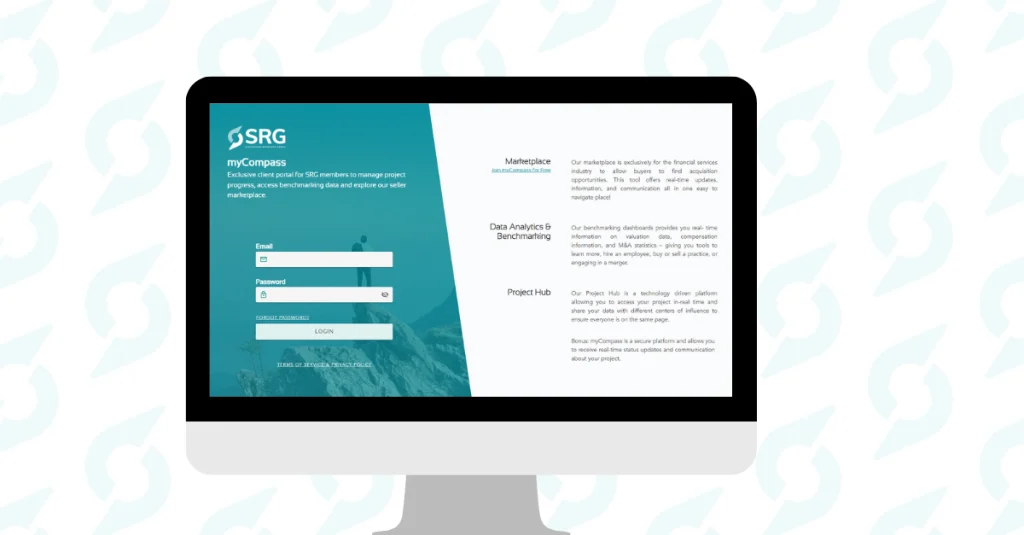
If you follow us on social media or are a subscriber to our monthly newsletter, you’ve heard about the most recent update to our one-of-a-kind client servicing platform, myCompass. Our latest and largest expansion now facilitates all services that SRG provides to clients, ensuring a streamlined and secure experience. Since these updates are still fresh, let’s dive into the benefits of myCompass and how it can take your projects with SRG to the next level.
Teaming Advice When Preparing for a Merger

If you’re showing up to virtual presentations or conferences, you’ve likely noticed a recurring topic that’s been buzzing around the industry: teaming up and preparing for a potential merger. Hopefully, you’ve sat in on a few of these discussions, and if you’re reading this you’ve probably considered a teaming scenario to some extent. Many advisors we’ve worked with find the concept intimidating, however, with the right approach and some careful planning, you can navigate this process like a pro. So, let’s dive right in!
Selling Your Advisory Practice: What Your Clients Need from You

You’ve decided to put your exit strategy in motion. Maybe you’ve identified a buyer, or you’re considering multiple successors who’ve expressed interest in your practice, or you just decided an hour ago that now is the time to sell. At whatever stage you’re in, your top priority is to protect your clients and deliver a smooth transition that they’ve come to expect after years of working with you.